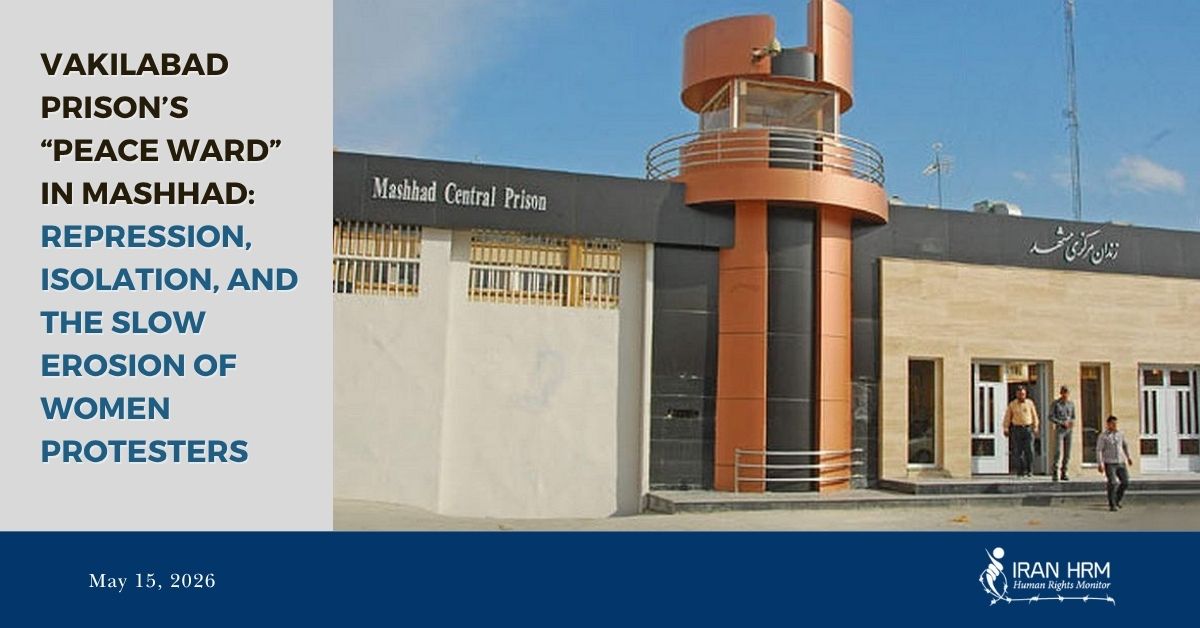
In a cramped, unventilated basement inside Vakilabad Prison in Mashhad, known as the “Peace Ward,” dozens of women detained in connection with the January 2026 protests are being held in degrading, coercive, and inhuman conditions. The ward, deprived of adequate light and air, has in recent months become one of the main holding areas for women protesters and detainees arrested after the protests in Mashhad and surrounding cities.

According to verified information, at least 30 women detained in connection with the 2025–2026 protests and subsequent security developments are currently being held in Vakilabad Prison. Some face grave charges, including “enmity against God” (moharebeh), “insulting the Prophet” (sabb al-nabi), “acting against national security,” “assembly and collusion,” and “propaganda against the state.” In several cases, these charges may expose the detainees to severe sentences, including the risk of execution.
Vakilabad Prison in Mashhad; A Site of Secret Executions and Inhuman Conditions for Women
Vakilabad Prison in Mashhad has long been known as one of the key sites of repression, secret executions, and detention of political and religious prisoners under the ruling regime in Iran. Although its official capacity is reportedly around 2,500 prisoners, previous reports indicate that it has been operated far beyond capacity, with severe overcrowding, prisoners sleeping on the floor, lack of basic facilities, and denial of adequate medical care becoming part of daily life inside the prison.
Among the prison’s various sections, the women’s ward is one of the most disturbing. Reports have described extreme overcrowding, a decaying building, poor sanitation, shortage of hygiene supplies, low-quality food, insects and vermin, and limited access to medical treatment. These conditions seriously endanger the physical and psychological health of women prisoners.
Women held in this ward also face threats, humiliation, restrictions on calls and visits, and punitive transfers. Reports have also pointed to sexual harassment and coercion, constant surveillance through security cameras, and the detention of mothers and children in inadequate conditions. In some cases, children have reportedly been separated from their imprisoned mothers after reaching a certain age.
Women political and ideological prisoners face a different pattern of abuse. They are subjected to security and psychological pressure, prolonged interrogations, threats, denial of access to lawyers, detention in quarantine and security wards, case fabrication, and the use of heavy charges to pressure both prisoners and their families. The transfer of women detained during the 2025–2026 protests to the “Peace Ward” and the women’s quarantine section of Vakilabad Prison must be understood within this same framework.
The “Peace Ward”; A Calm Name for Pressure, Threats, and White Torture
Within Vakilabad Prison’s internal structure, the “Peace Ward” was previously known as a section for prisoners with mental health conditions. In recent months, however, it has become a holding area for a number of women detained during the 2025–2026 protests. Other women protesters are being held in the women’s quarantine section, a situation that sources say has intensified physical and psychological pressure on detainees.
Sources close to prisoners’ families say some women have been kept for weeks, and in some cases months, in quarantine or in the “Peace Ward.” These spaces, marked by degrading conditions, severe contamination, sewage odors, and lack of basic facilities, have become psychologically and physically corrosive environments. Women held in quarantine refer to that section as “shashkhaneh,” a term used to describe a filthy, degrading, toilet-like space.
According to informed sources, the use of these sections for women protesters is not merely physical confinement. It forms part of a broader pattern of sustained pressure, isolation, threats, white torture, and psychological breaking. Restrictions on calls and visits, families being left without clear information, prolonged detention in quarantine, security interrogations, threats of heavy sentences, and billion-toman bail orders have placed additional pressure on both the women detainees and their families.
Women Protesters in Vakilabad; Part of the January 2026 Protest Detainees
The cases of these women show that arrests were not limited to direct participation in protests. Some were targeted for placing flowers or lighting candles at the graves of those killed during the protests. Others were arrested for making a phone call to a television program, posting on social media, assisting wounded protesters, or having family ties to other detainees.
In many of these cases, charges such as “assembly and collusion,” “propaganda against the state,” “acting against national security,” “enmity against God,” “insulting the Prophet,” “insulting sacred values,” and “collaboration with Israel” have been raised. These charges, combined with denial of access to a lawyer of choice, interrogation pressure, billion-toman bail orders, and prolonged detention in the “Peace Ward” or quarantine, place these women at risk of severe sentences.
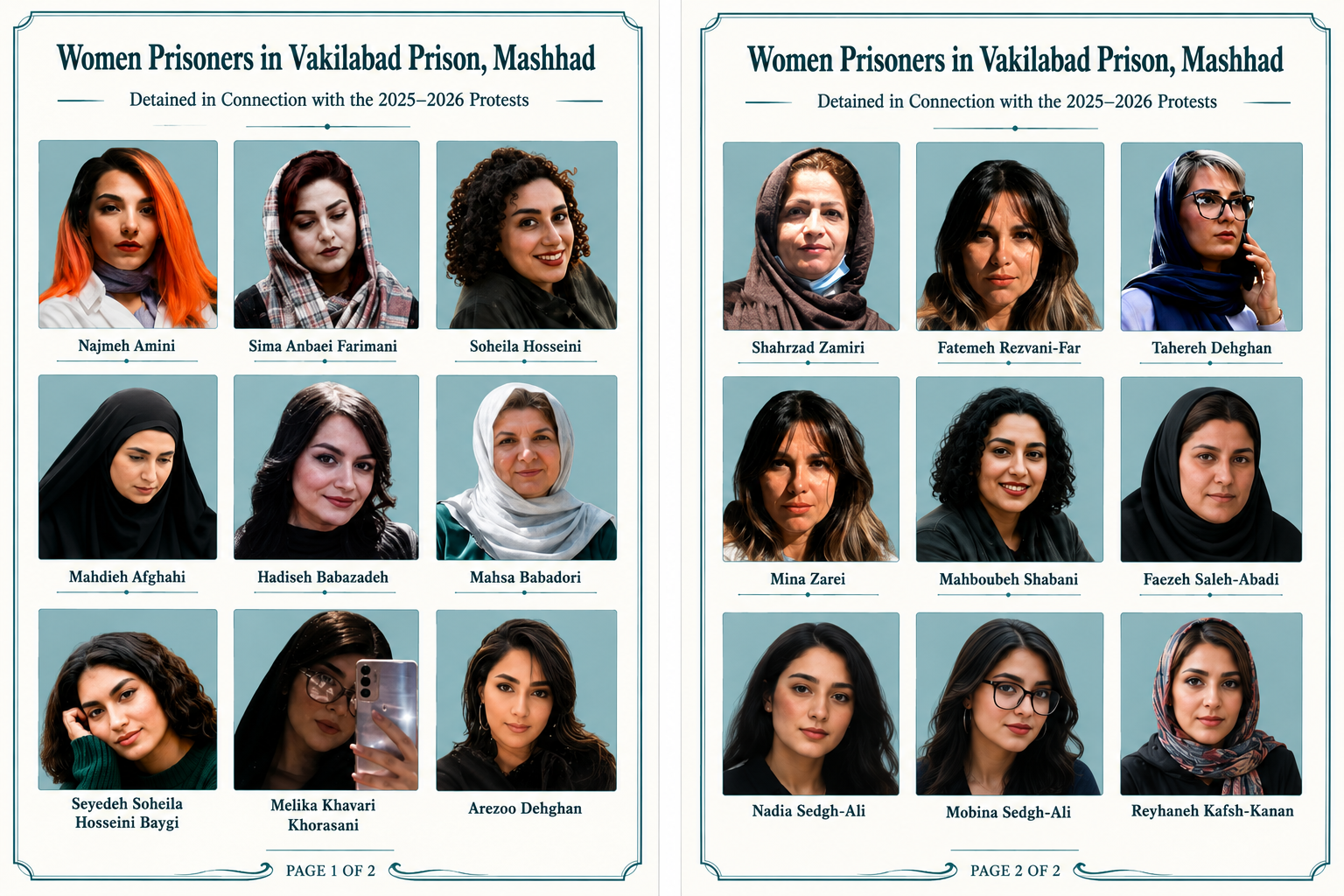 Names and Status of Some Women Detained in Vakilabad Prison, Mashhad
| Name | Summary of Status |
| Najmeh Amini | 22 years old; arrested at Ferdowsi Passage in Mashhad; transferred to a security ward nearly three months ago; facing charges including moharebeh, insulting the Supreme Leader, sabb al-nabi, and confrontation with security forces. |
| Sima Anbaei Farimani | 33, from Fariman; poet, theater actress, and holder of a master’s degree in law; arrested on March 16, 2026; accused of “leading protests,” “encouraging gatherings,” “propaganda against the state,” and “acting against national security.” |
| Soheila Hosseini | One of the women detainees currently held in Vakilabad Prison, Mashhad. |
| Mahdieh Afghahi | Arrested with her husband, Abolghasem Ali-Moradi, solely for making a phone call to a television program. Bail has been set at 8 billion tomans for her and 5 billion tomans for her husband. |
| Hadiseh Babazadeh | Arrested on charges of participating in protests; currently held in Vakilabad Prison’s quarantine ward. |
| Mahsa Bahadori | Held in the women’s ward of Vakilabad Prison since March 20, 2026. Her alleged offense was lighting candles at the graves of those killed during the January protests. She faces charges including assembly and collusion and propaganda against the state. |
| Seyedeh Soheila Hosseini Baygi | Arrested with her husband, Dr. Ahmad Rahimi, for possessing Starlink internet equipment at home and assisting wounded protesters during the January protests in Mashhad. |
| Melika Khavari Khorasani | 21; dental assistant planning to migrate to Germany for further studies; arrested after pouring disinfectant from the window of her workplace onto regime forces; now accused of an “acid attack.” She has been held in pretrial detention for four months. |
| Arezoo Dehghan | 18 years old; arrested solely for participating in the January protests. |
| Shahrzad Zamiri | Social deputy of the cyber police in Khorasan Razavi; held for 43 days in solitary confinement by the IRGC Intelligence Organization before being transferred to the women’s ward about three months ago. Reportedly arrested for answering a relative’s phone call about how to reduce the effects of tear gas during the Mashhad protests. |
| Fatemeh Rezvani-Far | Arrested on January 17, 2026, in connection with the January 8 and 9 protests. She faces the charge of “assembly and collusion.” Despite a heavy bail order, her family has been unable to secure her release. |
| Tahereh Dehghan | Sentenced to one year in prison for participating in protests in Chenaran; transferred to a security ward about four months ago. She is reportedly expected to be conditionally released after serving half of her sentence. |
| Mina Zarei | Arrested after circulating reports about Ali Khamenei’s death and for dancing. Sources say she was severely beaten during arrest and has been held in quarantine since March 1, 2026. |
| Mahboubeh Shabani | Arrested on charges of participating in protests and currently held in Vakilabad Prison. |
| Faezeh Saleh-Abadi | Arrested nearly four months ago in connection with protests and transferred to a security ward more than two and a half months ago. Despite the issuance of a bail order, she remains detained because her family cannot afford the amount set. |
| Nadia Sedgh-Ali | Arrested with her 18-year-old sister, Mobina Sedgh-Ali, solely for placing flowers at the graves of those killed during the January protests in Mashhad. Nadia has been held for three months because her family cannot provide the 6 billion toman bail. |
| Mobina Sedgh-Ali | 18 years old; arrested with her sister Nadia for placing flowers at the graves of those killed during the January protests. The two sisters face charges including assembly and collusion, propaganda against the state, and incitement to unrest. |
| Reyhaneh Kafsh-Kanan | 52 years old; transferred to the ward about 45 days ago and still denied phone calls and visits. Reportedly threatened with torture and execution during her last interrogation session. She is held in quarantine. |
| Hadiseh Morvaridi | 24 years old; arrested in Fariman on January 8, 2026, and transferred to a security ward after interrogation. Because of her social media activity, she faces charges of “insulting sacred values” and sabb al-nabi. |
| Bibi Zahra Mousavi | 21, from Fariman, and the breadwinner of her family; arrested on January 20, 2026. She faces charges including participation in protests, incitement to commit an offense, creating a group, and acting against national security. She spent four months in solitary confinement. After her arrest, the review of her application for Iranian identity documents was also halted. |
| Zeinab Mousavi, known as “Aban” | Detained since February 24, 2026, and currently held in the quarantine section of Vakilabad Prison. Because she faces a moharebeh charge and was arrested with her brother Hassan Mousavi, her case is examined separately below. |
| Maryam Nouri | Wife of Ashkan Torabzadeh, who was killed during the protests. She was arrested only five days after her husband was killed and has remained in prison since. Her father and uncle were arrested at the same time. |
| Adeleh Naeimi | Arrested with her sister Asieh for making a phone call to a live television program on the satellite network Your Time. Adeleh had previously been undergoing cancer treatment. |
| Asieh Naeimi | Arrested with her sister Adeleh. She reportedly developed severe nervous and psychological problems after arrest. |
| Azar Yahoo Torqabeh | Born in 1987; arrested by IRGC Intelligence on March 5, 2026. Because of what authorities described as “expressing happiness over Ali Khamenei’s death,” she faces charges including collaboration with Israel and acting against national security. |
| Masoumeh, known as Azadeh, Yaghoubi | Born in 1979; arrested on January 24, 2026, in connection with the January protests. Sources say she was subjected to severe pressure by the Ministry of Intelligence during interrogation. Bail was set at 5 billion tomans, but her family cannot afford it. She is currently held in quarantine. |
The Case of Zeinab Mousavi and Hassan Mousavi; Moharebeh Charges and the Risk of Severe Sentences
Zeinab Mousavi, known as “Aban,” has been detained since February 24, 2026, and is currently held in the quarantine section of Vakilabad Prison in Mashhad. She was arrested with her brother, Hassan Mousavi, in connection with the January 2026 nationwide protests. Both are facing the charge of “enmity against God” (moharebeh).
 According to information received, security agencies accused the siblings during interrogation of throwing Molotov cocktails during the protests. At the time of writing, no precise information has been released about the circumstances of their arrest, their initial place of detention, the conditions of interrogation, or the evidence presented against them.
An informed source stated that the court hearing in the case of Zeinab Mousavi and Hassan Mousavi was held on April 26, 2026. Moharebeh is among the most serious charges under the penal laws of the ruling regime in Iran and may carry the death penalty.
Despite the gravity of the case, no transparent information has been made available about whether Zeinab and Hassan Mousavi have had access to independent legal counsel, regular communication with their family, the exact judicial process, or the basis of the charges against them. The lack of transparency in a case involving such a grave accusation heightens concerns about violations of fair trial rights and the risk of severe sentences against both detainees.
A Shared Pattern; From Protest-Related Arrests to Billion-Toman Bail Orders
The cases documented in this report point to a shared pattern of judicial and security treatment: arrest in connection with protests, transfer to security wards or quarantine, denial or restriction of access to legal counsel, interrogation pressure, heavy charges, and bail amounts that many families cannot afford.
In several cases, the alleged reason for arrest was not a violent act, but actions such as lighting candles, placing flowers at the graves of those killed, making a phone call to a television program, posting on social media, or helping wounded protesters. These cases show that the post-protest crackdown has targeted not only direct participants in demonstrations, but also families, young women, cultural figures, ordinary citizens, and people connected to victims or injured protesters.
The use of charges such as moharebeh, sabb al-nabi, acting against national security, and collaboration with Israel raises serious concerns about the risk of severe sentences. In cases where proceedings remain opaque and no independent information is available about access to legal counsel, such charges may also be used as tools of pressure to extract forced confessions and intensify fear.
Human Rights Concerns and the Need for International Action
The situation of women detained in the “Peace Ward” and quarantine section of Vakilabad Prison in Mashhad raises grave human rights concerns about the treatment of women protesters and political prisoners by the ruling regime in Iran. Prolonged detention in inhuman conditions, denial of access to freely chosen lawyers, psychological pressure, threats, quarantine detention, and the use of grave charges such as moharebeh and sabb al-nabi indicate an intensified crackdown following the 2025–2026 protests.
These practices may amount to violations of the right to liberty and security of person, the right to a fair trial, the right of access to legal counsel, the prohibition of torture and cruel, inhuman, or degrading treatment, and the prohibition on the use of forced confessions. Holding women detainees in spaces that lack minimum sanitary and human standards, particularly while some face charges carrying the risk of severe sentences, underscores the urgent need for independent monitoring.
International human rights bodies, United Nations Special Procedures, mechanisms concerned with women’s rights, and bodies monitoring the treatment of prisoners should respond urgently to the situation of women detained in Vakilabad Prison in Mashhad. Immediate steps should include monitoring the “Peace Ward” and women’s quarantine section, reviewing the handling of security-related cases, addressing the risk of forced confessions, and calling for detainees’ access to independent lawyers and adequate medical care.
The cases of women detained in Vakilabad are not a list of isolated arrests. They reveal a broader pattern of organized repression against women protesters. The “Peace Ward,” despite its name, has become a symbol of pressure, isolation, threats, and the slow erosion of women protesters inside Vakilabad Prison.