Simultaneously with the heightening of geopolitical challenges and internal legitimacy crises, the Islamic Republic has launched an extensive campaign aimed at escalating repression in Iran across the entire country. This survival strategy relies, on one hand, on the issuance and hasty execution of political death sentences to maintain an atmosphere of dread. On the other hand, it has led to the initiation of a new wave of arbitrary arrests and mass detentions of thousands of citizens under the pretext of wartime conditions. In its third dimension, it targets the capillary layers of society to completely destroy social trust among the people by establishing a system of public espionage.

An analysis of recent events demonstrates how the regime’s judicial and security apparatus utilizes the context of wartime conditions as a catalyst to advance the project of escalating repression in Iran.
The “Social Soldiers Network” Project: Localization of Espionage
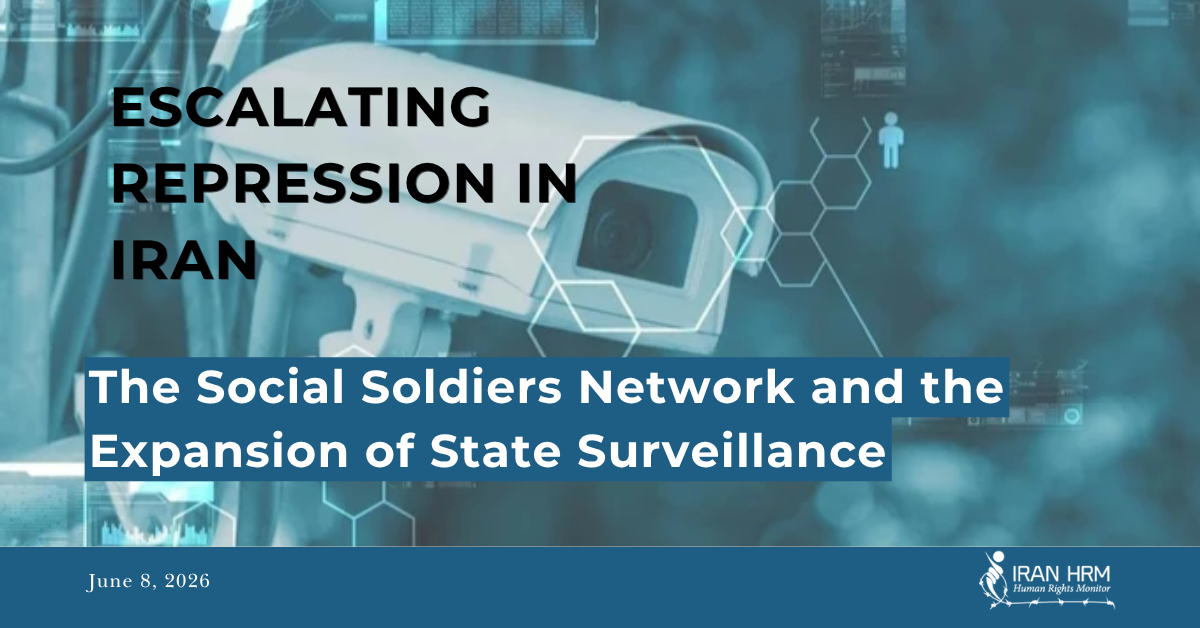
The official unveiling of the project known as the “Social Soldiers Network” by Ali-Asghar Jahangir, the spokesperson for the Judiciary, is a clear manifestation of the novel mechanisms employed for escalating repression in Iran and atomizing society. When the ruling establishment structurally encourages citizens to report on the behavior of others, monitor cyberspace, and transfer information to security agencies, the coefficient of distrust in social relations rises to an extreme degree. Consequently, every individual perceives the other as a potential government spy, forcing society to contract and withdraw further.
According to an official report by the Daneshju News Agency on June 8, the Judiciary spokesperson accused the media of “inverting realities” and criticized the “empire of lies” for attempting to isolate the achievements of the regime, thereby declaring narrative-building and media monitoring as a “public duty.” In this regard, he announced plans for the formation of this network, adding that in continuation of programs such as the “Jan-Fada (Self-Sacrificing) Project” (implemented by the Islamic Organization of Ideology), the Social Soldiers Network is being executed with the objective of mobilizing civilian capacities to establish a new groundwork for escalating repression in Iran.
Dimensions, Nature, and Functions of this Network in Line with Social Control
The concept of the “Social Soldiers Network” (or its parallel titles such as the Soldiers of Hybrid and Cyber Warfare) put forward in the official literature of the Islamic Republic, is a social and media-oriented version of the Basij structure. It operates within the chain of escalating repression in Iran through the following distinct features:
- 1) Official Objective: Countering Hybrid Warfare and Social Threats
In the statements of officials, this network is introduced as part of the “Social Transformation” program, and its duties are outlined as follows:
-
- Monitoring social “harms”
- Public reporting
- Assisting government institutions in “crisis management”
- Countering “cognitive warfare” and “media warfare”
- 2) Similarity to the Basij but with a Distinct Structure
This project is in fact a social/media-focused version of the Basij, which:
-
- Is primarily concentrated on cyberspace
- Utilizes civilian volunteers
- Is designed in a networked and decentralized manner
- 3) The Role of the Judiciary
Based on official statements, the Judiciary intends to use this network for:
-
- Public reporting
- Documenting citizens’ violations
- Cyberspace monitoring
- 4) Linkage and Overlap with Other Projects
This network stands alongside projects such as:
-
- The “Public Whistleblowing” initiative
- The “Social Guidance Patrol” (Ghashte Ershad-e Ejtemai)
- The “Public Cyber Police”
- “Reporting Systems” of security agencies
Accordingly, by activating these novel tools, the ruling establishment brings the social groundwork required for restricting public spaces to fruition; a groundwork upon which the judicial and operational apparatus immediately mounts to triggering a widespread and hasty wave of mass arrests across the country. The official statistics and figures confessed by the Judiciary itself vividly expose the horrific dimensions of this reality.
Mass and Arbitrary Arrests: The Operational Arm of Escalating Repression in Iran
Simultaneously with laying the social groundwork for this network, the judicial branch of the ruling establishment has intensified the process of widespread arrests with the objective of escalating repression in Iran. According to a report by the official Islamic Republic News Agency (IRNA) on June 8, the spokesperson for the Judiciary, addressing a public gathering titled “Defense of the Homeland and Avenging the Martyr Imam,” officially announced the prosecution and detention of thousands of citizens under the labels of “traitors to the homeland” and “mercenaries of the enemy.” This marks a new phase in the violent process of escalating repression in Iran.
According to the explicit confession of the judicial apparatus, a total of 3,121 individuals have been prosecuted, out of whom 2,406 individuals have been arrested and remain in detention. The spokesperson for the Judiciary announced the statistics and percentage breakdown of the charges against these individuals—which serves as the regime’s roadmap for escalating repression in Iran—as follows:
- 20 percent: Charged with operational actions in favor of the Zionist regime.
- 22 percent: Charged with security, economic, military, and financial actions.
- 7 percent: Charged with cooperation and assistance with the Zionist regime.
- 43 percent: Charged with cooperation in political, cultural, media, and promotional activities in favor of the Zionist regime (the primary segment of the arrests, which directly targets freedom of expression and civil activists within the project of escalating repression in Iran).
- 7 percent: Charged with the possession, purchase, or sale of electronic equipment, such as satellite internet terminals (Starlink).
Concurrently with the issuance of over 3000 indictments for these detainees, the judicial apparatus announced that the assets of hundreds of these individuals have been identified and seized inside the country. Following the issuance of court rulings, these assets will be confiscated in favor of the ruling establishment, ensuring that the economic goals of the system are secured alongside escalating repression in Iran.
The Execution Machine: A Tool for Maximum Intimidation and Escalating Repression in Iran
The more naked and violent dimension of this campaign of repression is manifested in the directives of Gholam-Hossein Mohseni-Eje’i, the head of the Judiciary, regarding the acceleration of the issuance and implementation of death sentences. An examination of the statistics indicates that within the 100-day period since the onset of the war (from February 28, 2026, to the present), the process of issuing and confirming political death sentences has significantly accelerated. In order to paralyze the public will and overtly implement the strategy of escalating repression in Iran, the ruling establishment has placed the execution of suspended and older sentences on its agenda alongside the newly detained protesters from January 2026.
Some of the citizens and activists who currently face definitive sentences or the imminent risk of execution as victims of this anti-human campaign—which violates all recognized citizenship rights—include:
Detainees of the January 2026 Protests:
- Arman Marefati: 30 years old, from Saqqez.
- Ismail Ramezanpour: 38 years old, from Fars and residing in Yazd.
- Mohammad Reza Majidi Asl
- Behrouz Zamani Nejad and Kourosh Zamani Nejad
- Majid Nasiri, Shahab Dadkah, and one other individual (identity unverified): Three co-defendants detained during the January 2026 protests in Shiraz, who are facing death sentences or the imminent risk of execution (the identities of only two have been verified).
- Ehsan Hosseinipour
- Maryam Hadavand, confined at Evin Prison’s women ward
- Saeed Zarei Kordshouli from Marvdasht
- Hamidreza Fathi and Abdolreza Fathi from Marvdasht
- Hamidreza Sabet -Ra’y from Marvdasht
- Ali Pishevarzadeh: 28 years old.
- Vahid Ghasemi: Biology teacher at Beheshti High School in Fariman.
- Mohammad Reza Tabari , at imminent risk of execution; denied phone calls and family visits
- Dr. Mohammad Reza Abdollahpour: 28 years old, at imminent risk of execution; denied phone calls and family visits
- Amirmohammad Zare, at imminent risk of execution; denied phone calls and family visits
- Farzad Moradi: Held in the quarantine section of Sheiban Prison in Ahvaz, under imminent risk of execution.
- Benyamin Naghdi: Open tournament champion in Kickboxing and Muay Thai.
- Mohammad Naghizadeh: 22 years old.
Child-Defendants (Individuals under 18 at the Time of Arrest):
- Mohsen Eslamkhah: 20 years old, under 18 at the time of arrest (from the 2022 protesters).
- Matin Mohammadi: (Detainee of the January 2026 protests).
- Erfan Amiri: (Detainee of the January 2026 protests).
Political Prisoners and Ideological-Political Defendants of Previous Years:
- Zabihullah Kouhkan: 34 years old and father of two children, a Baluch prisoner in the Central Prison of Zahedan.
- Mansour Jamali: Imprisoned in Choobinder Prison in Qazvin (death sentence confirmed on the charge of membership in the PMOI).
- Manouchehr Vafaei: 28 years old, political prisoner, arrested in 2024.
- Navid Naghdi: 32 years old, political prisoner, arrested in 2024.
- Manouchehr Fallah: Political prisoner (death sentence confirmed on the charge of membership in PMOI).
- Milad Armoun, Navid Najaran, Mehdi Imani, and Seyed Mohammad Mehdi Hosseini: Defendants in the Ekbatan Town case (detainees of the 2022 protests).
- Rouhullah Karaki: Political prisoner held in Sheiban Prison in Ahvaz (arrested in August 2025).
- Peyman Farahavar: Gilaki poet and political prisoner (detained in August 2024).
- Hassan Mosallavi: Political prisoner held in Sheiban Prison in Ahvaz, death sentence served (detained in 2022).
- Yasin (Mosayeb) Shahbakhsh: Political prisoner, 22 years old (detained in November 2024).
- Hassan Amiri and Hossein Amiri: 20-year-old twin brothers, arrested at a checkpoint on charges of espionage on March 20, 2026.
- Zahra Shahbaz Tabari: Re-confirmation of the death sentence on charges of membership in PMOI.
- Armin Nourmohammadi: Architecture student and political prisoner (last arrested on December 28, 2024).
(It should be noted that these 42 names comprise only a portion of those sentenced to death; furthermore, cases that were carried out within a short interval after the issuance of the verdict have not been included in this list).
Social Closure and the Necessity of Tangible International Intervention
The simultaneous analysis of the three phenomena—namely, “the unveiling of the Social Soldiers Network,” “hasty and mass arrests of thousands under the bogus charge of treason,” and “the indiscriminate issuance and confirmation of death sentences for protesters and political activists”—reveals an all-encompassing, hyper-securitized survival strategy whose ultimate objective is escalating repression in Iran to prevent any form of protest against the violation of human and citizenship rights.
Facing profound crises of domestic legitimacy and geopolitical challenges stemming from the war, the Islamic Republic has redefined its internal campaign as a “full-scale war against society.”
This three-pronged process pursues specific structural objectives in line with escalating repression in Iran:
- 1) Contraction and Breakdown of Public Trust: The “Social Soldiers Network” project, moving far beyond a mere cyber-monitoring tool, is an attempt to localize espionage and transform every citizen into a source of threat to one another. Through this, the regime advances the strategy of atomizing society to stifle any possibility of civic organization or solidarity in its infancy.
- 2) Criminalization of Technology and Awareness: The detention of citizens on charges of possessing tools such as Starlink dishes or engaging in media activity reflects the ruling establishment’s absolute dread of breaking the monopoly of narratives and its utilization of new levers for escalating repression in Iran.
- 3) The Project of Intimidation through Maximum Executions: The extensive list of individuals sentenced to death—ranging from the young protesters of January 2026 and 2022 to dedicated members of society such as teachers, athletes, and physicians, and even children under the age of 18—demonstrates that the regime’s execution machine no longer functions as a conventional punitive tool, but is rather employed as the linchpin of the campaign for escalating repression in Iran to paralyze the public will.
The naked reality presented in this report proves that statements, diplomatic condemnations on paper, and the customary expressions of concern by human rights bodies have lost their efficacy against the accelerated process of escalating repression in Iran. Intoxicated by the wartime atmosphere, the current machinery of repression recognizes no moral, legal, or international boundaries.
Today, halting this accelerated cycle of bloodshed and arbitrary mass arrests requires a tangible, immediate, and coordinated intervention by the international community, the United Nations Human Rights Council, and international courts. Referring the case of the regime’s structural crimes to the Security Council, exerting tangible diplomatic pressures, and conditioning any political-economic relations on the immediate cessation of death sentences for political prisoners represent the minimum practical steps that can halt the unbridled process of escalating repression in Iran and save the lives of dozens of shackled youths—some of whose names are recorded in this document—from the gallows.
Silence or procrastination in the face of this naked campaign is not only a betrayal of the fundamental values of human rights but will also pave the way for the reproduction of harsher totalitarian models across the globe.