While global attention remains heavily focused on the political and diplomatic negotiations between Iran and the United States, a critical issue—the severe human rights situation and the ongoing human rights violations in Iran—has been sidelined due to the inaction of the international community.

Madam Mai Sato, the UN Special Rapporteur on the situation of human rights in the Islamic Republic of Iran, along with a group of independent UN experts, accurately highlighted this crisis. They strictly warned that any final agreement between the US and Iran that overlooks human rights and the fundamental demands of the Iranian people cannot establish a sustainable peace. Accountability, justice, and comprehensive support for victims must be placed at the very center of any negotiations. “A deal that serves geopolitical interests while leaving the Iranian people behind is not a peace agreement worthy of the name,” the experts warned. The experts cautioned that the end of hostilities must not be mistaken for the restoration of rights. “For the Iranian people, that work is yet to begin.”
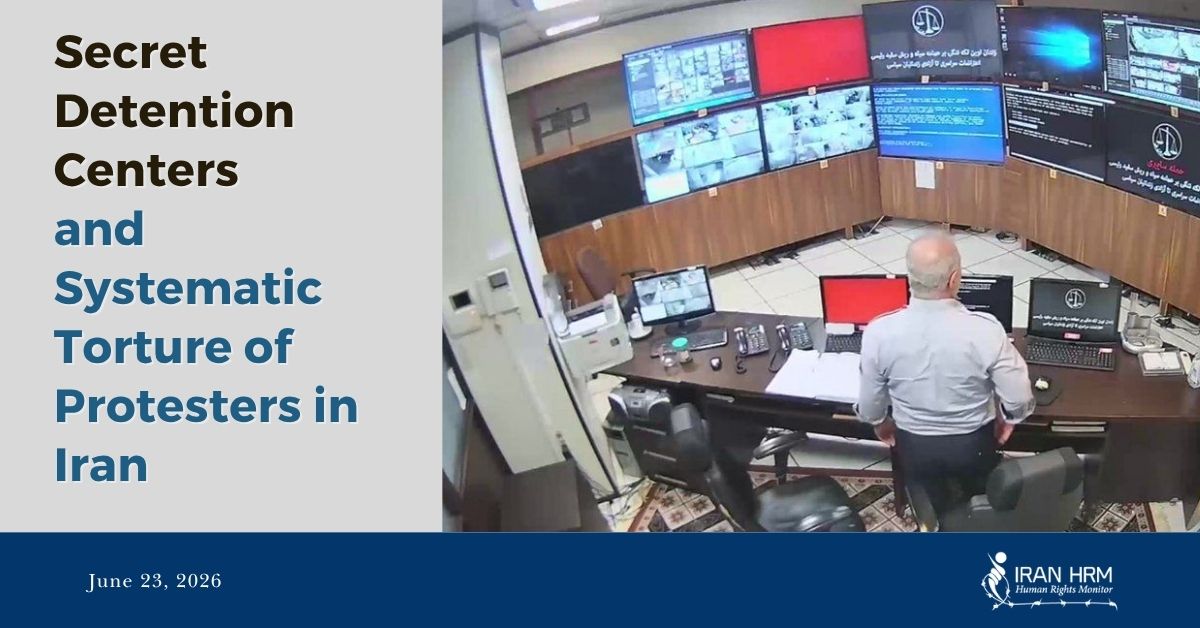
A matter of profound and continuous concern is the status of those detained during the nationwide protests of January 2026 (Dey 1404). Highly reliable reports recently obtained from inside Iran pull back the curtain on the Islamic Republic’s secret and underground detention centers, where detained protesters are still being held. One of the most acute cases involves clandestine detention facilities run by the regime in the city of Fuman, located in the Gilan Province of northern Iran.
Uncovering the Network of Secret and Unofficial Detention Facilities in Fuman
International bodies are well aware that a significant portion of the detention centers utilized by security agencies in Iran do not fall under the official jurisdiction or supervision of the State Prisons Organization. Over the past four decades, many political, civil, and protest detainees have spent parts of their detention inside facilities managed entirely outside public scrutiny and far from media visibility. These black sites are directly operated by repressive apparatuses, including the Islamic Revolutionary Guard Corps (IRGC) Intelligence, the Ministry of Intelligence (MOIS), and the Law Enforcement Command of the Islamic Republic of Iran (FARAJA).
Being detained in such locations is equivalent to enforced disappearance in the vast majority of cases. Detainees suffer from an absolute deprivation of contact with their families, a total denial of access to legal counsel, and crucially, the complete impossibility of international inspection or monitoring (even if the United Nations possesses the will to do so). Based on precise reports received, at least three parallel security centers are actively involved in the unlawful detention, interrogation, and holding of political prisoners in Fuman and its surrounding areas:
- The IRGC Headquarters on the Entrance Road to Fuman from Rasht (Near the 4 Dokhtaran Square): Since the 1980s, this center has been heavily utilized for brutal interrogations and the confinement of political prisoners and civil activists. Prior to the 1979 revolution, this location was a commercial hotel, which was subsequently repurposed into a high-security stronghold.
- The Fuman Ministry of Intelligence (MOIS) Office on Entezam Street: According to received field reports, a portion of those arrested during protests and individuals facing state-security charges are initially brought to this facility. Following preliminary interrogations and the fabrication of case files, they are transferred to Lakan Prison in Rasht to undergo further intensified pressure.
- The FARAJA-Affiliated Detention Center in the Shahr-e Bijar Area: Another hidden facility used for holding detainees is situated in the Shahr-e Bijar region of Fuman. Reports indicate that certain ordinary prisoners and protesters are kept at this location for a period before being distributed and transferred to other state prisons.
Due to the hidden nature of these detention centers and the absolute denial of access for families and lawyers, there is virtually no reliable information regarding the health and well-being of the detained protesters in these sites. Consequently, their lives are in immediate peril, facing extreme risks of horrific physical torture, systemic medical neglect, and even death under torture—outcomes that are tragically common throughout the history of Iranian prisons.
The dire situation of detained protesters of the January 2026 demonstrations in Amol prison
Fresh reports emerging from Amol Prison present a shocking and deeply concerning illustration of human rights violations in Iran, specifically regarding the conditions of those detained during the nationwide protests of January 2026 (Dey 1404). Dozens of detainees from the cities of Amol, Nour, Chamestan, and Lavij have been held for months under highly unsuitable and subhuman conditions, initially in the quarantine ward and subsequently in the special ward of this facility.
Informed sources have reported severe overcrowding, total deprivation of telephone communication rights, extreme restrictions on access to basic welfare amenities, and deliberate negligence regarding the medical care of prisoners.
According to these accounts, approximately 150 individuals from various cities across the Mazandaran Province are confined within the quarantine ward of this prison. These sources have documented that all communication paths linking the quarantine ward to other sections of the prison have been entirely blocked. Access to this ward is under strict security control; reportedly, only the prison warden is permitted to enter, while other staff members are granted highly restricted access.
During a period when more than one hundred individuals were confined to this section, prison guards routinely disrupted the inmates’ sleep and rest during the night hours by continuously striking cell doors with batons and metallic objects. This psychological torture is deliberately systematically applied to induce anxiety, shatter mental stability, and strip the prisoners of their self-control.
At present, while a small number of detainees have been released on bail or heavy bonds, approximately 30 individuals have been transferred to the prison’s “Special Ward”—a facility where conditions are far more militarized and oppressive than the quarantine section. The prisoners held in this ward are entirely deprived of telephone calls with their families, are denied access to the prison commissary, and have even been stripped of their legal right to fresh air (outdoor exercise). This absolute deprivation has left destructive and irreversible impacts on the physical and psychological health of these individuals.
Medical Neglect as a Mechanism for State-Sponsored Murder Inside Prison
One of the most critical concerns raised regarding Amol Prison is the systematic denial of medical attention to prisoners. According to verified reports, one of the detainees suffered a fractured nose due to severe beatings while being held at an IRGC Intelligence detention center. In protest of his detention conditions and the absolute lack of medical care for his physical injuries, this prisoner embarked on a three-day dry hunger strike (refusing both food and water); however, according to informed sources, he received no effective response or intervention from the authorities.
This calculated medical neglect has previously resulted in fatalities. In mid-May 2026 (Ordibehesht 1405), an inmate identified as “Taghi Salimi” suffered a cardiac arrest and lost his life within Amol Prison. Prior to his passing, he was completely denied access to medical services or a physician, and no effective measures were taken to urgently transfer him to medical facilities outside the prison walls.
Continuous Raids, Enforced Disappearances, and Case-Fabrication in Ahvaz
The brutal raid by Ministry of Intelligence (MOIS) forces on the “Qaleh Chanan” region of Ahvaz on March 9, 2026 (18 Esfand 1404) escalated into one of the bloodiest security operations of recent months in Khuzestan Province. During this operation, at least two local residents, identified as Mahmoud Hasnian (Naseri), son of Mohammad, and Heidar Khayatipour, were killed by direct live fire from security agents, while 14 others were arrested.
More than 100 days after this bloody event, the detainees continue to be held in solitary confinement cells within the Intelligence Department’s detention center, and their families remain in absolute ignorance regarding the health and well-being of their loved ones. Concurrently, reports indicate that the cases of these citizens have been coupled with heavy, fabricated, and ambiguous charges, without the public presentation of any independent evidence whatsoever. As of the compilation of this report, even the bodies of the two deceased individuals (Mahmoud Hasnian and Heidar Khayatipour) have not been returned to their families, a matter that has raised anxiety concerning the situation of the remaining detainees and victims to its peak.
The identities of several of these detainees have been verified as follows:
- Tareq Hasnian
- Bahador Zargani
- Mansour Naseri
- Ahmad Bavifard
- Yousef Hosnian
- Amin Naseri
- Jasem Bavi
- Mohammad Ali Bavi
- Hamid Hosnian
Over the past months, the families of these detainees have been repeatedly summoned, threatened, and placed under intense pressure by security agencies to prevent them from disseminating information. The cases of these citizens are being processed in the Second Branch of the Public and Revolutionary Court of Karun County, presided over by Judge Montazeri, where they face a series of dangerous state-security charges. These charges are cited as “shooting at security forces,” “bombing oil pipelines,” “possession of handmade bombs,” “collaboration with the United States and Israel,” and “disrupting public order.” Nonetheless, no independent document, proof, or evidence corroborating these severe allegations has been publicly released to date.
Legal Concordance of the Report’s Facts with International Treaty Violations
The facts of human rights violations in Iran documented above constitute clear, systematic, and gross violations of international law and binding treaties to which the Iranian government is inherently committed:
- Violation of the Right to Life and Health (The Case of Taghi Salimi and the Deceased in Ahvaz): Substantiated by Article 3 of the Universal Declaration of Human Rights and Article 6 of the International Covenant on Civil and Political Rights (ICCPR), the right to life is non-derogable. The deliberate deprivation of medical treatment for Taghi Salimi and the direct shooting of Mahmoud Hasnian and Heidar Khayatipour constitute a direct violation of these provisions and amount to state-sponsored murder.
- Prohibition of Psychological Torture and Deprivation of Rest (The Case of Amol Prison): Continuously striking cell doors with batons at night and depriving inmates of outdoor exercise in the Special Ward represent a flagrant violation of Article 5 of the Universal Declaration of Human Rights and Article 7 of the ICCPR, both of which absolute prohibit torture and cruel, inhuman, or degrading treatment or punishment.
- Prohibition of Enforced Disappearance and Unofficial Detention Centers (The Case of Fuman and Ahvaz): Holding prisoners in secret facilities in Fuman without access to legal counsel and family constitutes a textbook case of “enforced disappearance.” This violates Article 9 of the ICCPR (prohibiting arbitrary detention) as well as Rules 11 and 93 of the United Nations Standard Minimum Rules for the Treatment of Prisoners (The Nelson Mandela Rules) regarding the necessity of separating prisoners and ensuring their safety.
- Violation of the Right to a Fair Trial (Karun County Court): Indicting 14 Ahvazi citizens with capital charges in Judge Montazeri’s court without presenting evidence, alongside denying them the right to legal defense, is a direct breach of Article 14 of the ICCPR.
Epilogue and Conclusion: An Alarm Bell for the Awakening Conscience of the World
One could continuously document such fundamental facts of human rights violations in Iran against ordinary citizens and political prisoners. However, the foundational and vital question remains: when will the international community cast aside its deadly silence and inaction regarding these atrocities?
If the images of more than 30,000 body bags containing victims in January 2026—an event that sparked a wave of global outrage and revulsion—failed to compel free nations and human rights proponents to take practical, urgent, and deterrent action against human rights violations in Iran, can the exposure of these secret black sites and organized torture shake the world’s conscience? Or will eyes once again be closed to these bitter truths due to economic interests and diplomatic maneuvers?
Today, the international community faces a historical test. Overlooking the arbitrary detention of 50,000 protesters and surrendering them into the hands of torturers in unofficial detention centers strips international laws and standards of all meaning. This passive approach grants any dictatorship a completely free hand to suppress, torture, and massacre its citizens. Silence in the face of the Islamic Republic’s machinery of repression is not only a betrayal of humanitarian values but will also lead to the spread of unbridled fundamentalism, allowing it to spill over the borders of these very nations claiming to defend human rights. The era of diplomatic expressions of regret and issuing statements that result in no practical or deterrent action regarding human rights violations in Iran has passed. The time for practical action, holding the Iranian regime accountable, and bringing the perpetrators of these crimes to justice is today.