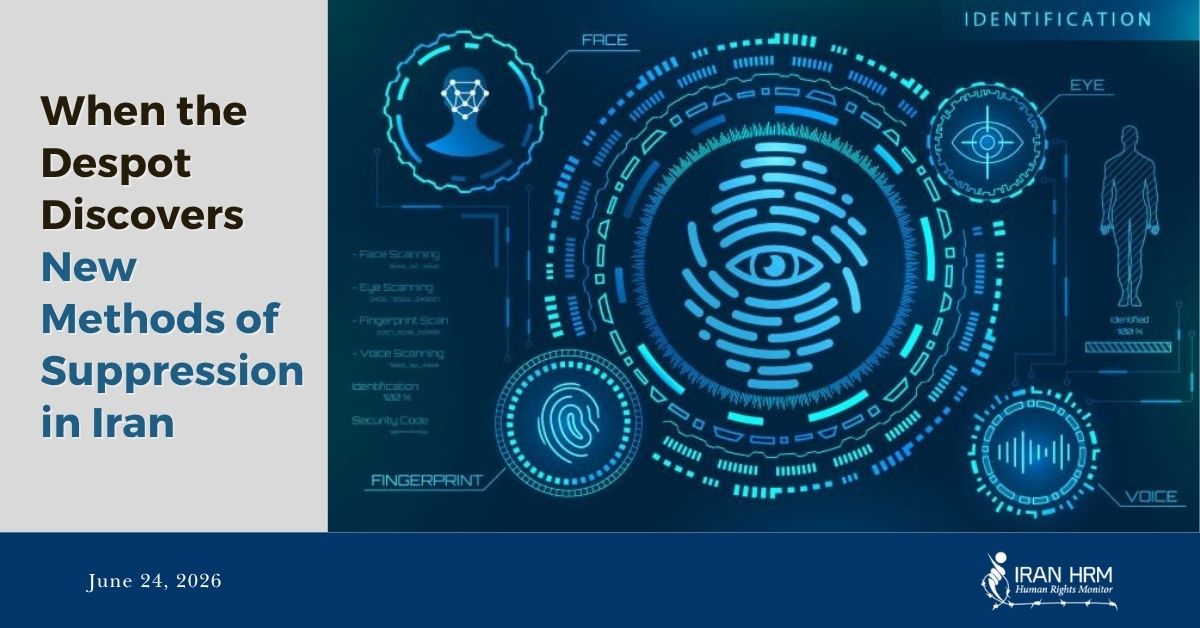
Human creativity is always commendable, up to the point where it is weaponized to engineer new methods of suppression within an authoritarian regime—and in this specific case, within Iran’s religious dictatorship. The containment and eradication of freedoms, especially the freedom of thought through advanced technological, educational, and biometric structures have enabled the regime to exploit accountability vacuums in the international arena, reproducing despotic behavior with impunity. The backdrop to this sinister innovation lies within a global community that has repeatedly failed to hold the Islamic Republic accountable for thousands of human rights violations, leaving it fully aware that its actions face no real consequences.

-
“Look into the Camera If You Want Food” (Biometric Surveillance Serving Oppression)
On June 22, 2026, the Rokna News Agency published a report on the Faculty of Natural Resources at the University of Tehran, headlined: “Look into the camera so we can give you food”?!
The article summary states: Students at the University of Tehran’s Faculty of Natural Resources condemn the cafeteria’s new policy as a coercive measure mandating facial recognition to receive meals. This procedure, enforced through rigid biometric authentication and mandatory physical presence at specific hours, effectively deprives numerous students—particularly those engaged in off-site field research or laboratory experiments—of meals they have already paid for in advance.
Under this system, students can only collect their reserved meals by personally appearing for facial scanning during a tight, designated window. If a student is absent due to laboratory conflicts, educational and field research, sampling, illness, or academic scheduling overlaps, their meal is forfeited without any financial refund.
Structural Analysis: On the surface, this appears to be a mundane administrative issue regarding university dining hours. However, a critical question must be presented to the reader: what is the actual objective behind enforcing facial recognition for access to food? Implementing biometric mechanisms in university cafeterias is part of the regime’s new methods of suppression, designed for physical control, daily tracking, and the preemptive containment of student protest potential.
-
The New Method of Suppression of Free Thought in Iranian Schools
According to a report by Rokna News Agency dated May 13, 2025, the Islamic Republic’s Minister of Education stated:
“One of the core missions of the Ministry of Education is to develop and promote the culture of sacrifice and martyrdom; we must link students with the martyrs.”
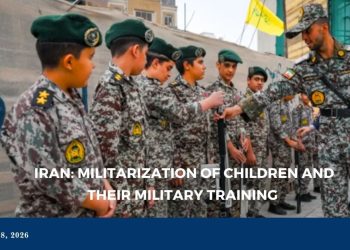
Indoctrinating children—even students as young as eight years old—with this culture is nothing less than the systematic suppression of free thought from early childhood within the Iranian educational system. The minister explicitly acknowledges this strategy by citing an example:
“Referring to the martyrdom of an eight-year-old student, Avin Amir-Kashani, in the Third Imposed War, her diary entries about martyrdom, and her aspiration to become a martyr, the Minister of Education explained: ‘This subject must be integrated into school textbooks to demonstrate that this student possessed an inherent knowledge of martyrdom. It is extraordinary; she kept a diary from the first day of the war until the fifteenth and was martyred that very night. In her diary, she wrote: “I desire to die a martyr just like our Leader.'”
He fully exposes the repressive apparatus of the Ministry of Education by stating:
“Promoting the culture of sacrifice and martyrdom remains a paramount mission of the Ministry of Education. We must mobilize every educational capacity to instill this virtue in the hearts, souls, and minds of our people. The fact that citizens stood resilient in the streets under heavy bombardment was entirely due to this culture and an unwavering belief in these values, which eliminates fear. The soldiers of the Islamic Republic of Iran confronted American hegemony precisely because this virtue is embedded within them. The culture of martyrdom is one of the most critical strategic missions of the Islamic Republic, and we must design comprehensive programming for it. Commemorations and memorials are merely pretexts; our objective is ideological conditioning. The Ministry of Education initiated this during the Third Imposed War by establishing the Taskforce for the Promotion of the Culture of Sacrifice and Martyrdom. Our deputies are fully deployed on the ground. We have directed all available resources toward this initiative, and Farhangian (Cultural) University must integrate this into its core mandate. The students of Farhangian University must serve as the standard-bearers of sacrifice and martyrdom across all educational environments and society at large. We must bind students to the martyrs. We face a heavy mission ahead…”
A stark example of this aggressive promotion of sacrifice and martyrdom in schools is documented in a report by IRNA, the official state news agency, dated June 20, 2026. The headline reads: “The Scientific, Revolutionary, and Jihadist Personality of Martyr Chamran Printed in Student Textbooks.” (https://www.irna.ir/news/86187660/)
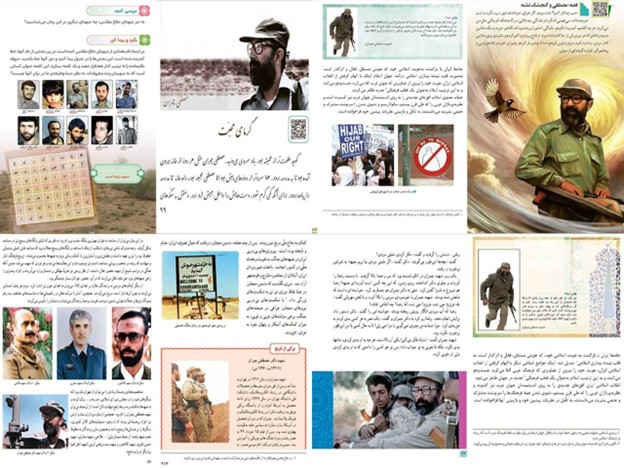
Who is Mostafa Chamran? A politician, military commander, and prominent figure of the Islamic Revolution, Chamran was a key founder of the resistance movement in Lebanon and an influential commander during the initial years of the Iran-Iraq war. [Despite being an elite student who pursued higher education in the United States, following the 1979 revolution, and on Khomeini’s direct advice to preserve revolutionary cadres, he traveled to Egypt for advanced military training (Khabar Online – June 22, 2026)]. He subsequently moved to Lebanon at the invitation of Imam Musa Sadr, becoming a co-founder of the Amal Movement (Persian Wikipedia). Following the revolution, he served as Minister of Defense and Deputy Prime Minister for Revolutionary Affairs. With the outbreak of the Iran-Iraq war, he established the Irregular Warfare Headquarters. [Many label him the ‘architect of resistance’ (ISNA – June 21, 2026)].
The institutional message is clear: academic excellence holds zero intrinsic value unless the individual functions as a jihadist element for the Islamic Republic—a dynamic that exposes the precise dissection of the new methods of suppression targeting young minds through the educational curriculum.
-
Home Schooling Forbidden: The Rationale Behind the Ban
To advance its new methods of suppression, the Islamic Republic has outlawed home schooling nationwide. This policy systematically strips away any alternative pathway that might shield students from state-sponsored ideological coercion and preserve their fundamental freedom of thought.
Mousa al-Reza Kaffash, Deputy Secretary-General of the Supreme Council of Education, explicitly confirmed this restriction, stating that the Ministry of Education issues no permits or licenses for home schooling activities (Rokna – May 21, 2026).
-
State Inaction Toward Narcotics in Schools another New Method of Suppression
Classifying deliberate state inaction regarding drug addiction in schools as a new method of suppression may initially seem unconventional. However, a critical examination of the official statistics published by the Islamic Republic’s own educational authorities exposes the gravity of the crisis:
On May 14, 2026, Rokna News Agency reported:
“Statistics released by educational officials indicate that approximately 136,000 students across the country are currently at risk of drug abuse, with at least 3,600 minors having already experienced narcotic consumption. These metrics document a dangerous decline in the age of first exposure and reflect escalating anxieties over the proliferation of this social harm within school environments… Social experts warn that the infiltration of synthetic and psychotropic drugs into adolescent life poses a direct threat to the health of the next generation. Left unchecked, schools will soon confront a silent yet catastrophic crisis.”
Is the ruling establishment genuinely invested in mitigating this crisis, or is it actively facilitating it? A retrospective look at the January protests—where teenagers were brutally killed by the regime for demanding change—or a glance at recent student demonstrations across major Iranian metropolises following the de-escalation of foreign conflicts, reveals an undeniable reality. Despite the regime’s extensive programming to manufacture compliant, loyalist cadres within schools, the yearning for free thought and personal autonomy remains vibrant among Iran’s youth. What more effective mechanism exists to neutralize this revolutionary potential than enabling systematic substance addiction among these very students? This dynamic unfolds within a context where the dominant trafficking networks supplying narcotics in Iran are widely known to be under the direct oversight of the Islamic Revolutionary Guard Corps (IRGC).
-
The Nishat Plan, Jihadist Groups, and the Risk of Ideological Coercion in Public Education: A New Method of Suppression
Official reporting on the “Martyr Ajamian Plan” and the “Nishat Card Campaign” reveals that these initiatives—while publicly framed as infrastructure rehabilitation, welfare support for marginalized youth, and community philanthropy—are structured to enforce deep ideological conformity within public education. According to an IRNA report dated June 17, 2026, the Minister of Education announced that 1,200 educational facilities have been renovated by jihadist groups. He noted that the Martyr Ajamian Plan, driven by a “popular and jihadist” framework, has commenced across 76,000 schools, with an ultimate target exceeding 100,000 facilities.
In the same report, the Minister characterized the school as “the empowering core of a neighborhood,” emphasizing that the school environment must serve as “the manifestation of the people’s identity and devotion to the homeland.” He dictated that maps, the state flag, and images representing state-sponsored street rallies and nocturnal gatherings must be painted on school walls. This rhetoric extends far beyond physical renovation; it represents a calculated effort to transform public schools into visual conduits for the regime’s official political narrative. Under international human rights benchmarks, a school must remain a secure, neutral, and pluralistic sanctuary that nurtures critical thinking, personal growth, and a child’s freedom of thought—not a venue for institutionalized political indoctrination.
The secondary component of this program, the “Nishat Card Campaign,” is presented by state media as a welfare mechanism to identify and assist underprivileged students in marginalized areas. The Minister of Education stated that 500,000 students were registered in the initial phase to receive these cards, with expansion plans targeting one million, and eventually two million students across the lowest four income deciles. While financial assistance to vulnerable children aligns with the right to equal educational access, intertwining social welfare with jihadist structures and ideological state apparatuses heightens the risk of conditioning aid upon ideological compliance.
The human rights implications become starker when reports from the Pana News Agency regarding the Educational Justice Headquarters are cross-referenced with IRNA’s data. Pana reports indicate that the Educational Justice Headquarters operates explicitly to “implement the Supreme Leader’s directives” and “realize the Fundamental Reform Document of Education,” noting that 15,000 student-led jihadist groups operate under direct teacher supervision. Furthermore, another Pana report outlines the operational involvement of entities such as the Basij Construction Organization, the Mostazafan Foundation, and the Executive Headquarters of Imam’s Directive (Setad) in school-centered initiatives. These sources confirm that the Nishat Plan and its offshoots are not benign welfare or infrastructure projects; they are integrated components of a broader sovereign and ideological state network.
Under international human rights standards—particularly Articles 13, 14, and 29 of the UN Convention on the Rights of the Child (CRC) and Article 13 of the International Covenant on Economic, Social and Cultural Rights (ICESCR)—education must foster the free development of a child’s personality, respect for human rights, and the capacity for independent thought, conscience, and religion. The principle of the “acceptability of education” mandates that educational content remains free from forced political or religious dogmatism. Within this framework, three distinct areas of the Nishat Plan stand in direct violation of international standards: cultural-educational programming anchored in the Fundamental Reform Document, extracurricular activities led by jihadist groups, and the structural infiltration of ideological state organs into public schools. Consequently, any program deployed within a school—regardless of its branding as welfare or support—must be scrutinized regarding its political neutrality, voluntariness, institutional transparency, and the best interests of the child.
- First: The cultural-educational initiatives under the Nishat Plan, by referencing the “educational spheres” of the Fundamental Reform Document, serve as vehicles for specific religious, moral, and socio-political doctrines. These domains demonstrate that the plan is not restricted to recreation, but functions as a platform to transmit the official tenets of the ruling establishment. This structure conflicts with Article 14 of the CRC (freedom of thought, conscience, and religion) and Article 13 of the ICESCR regarding the acceptability of education.
- Second: The mobilization of jihadist groups in school maintenance and extracurricular activities—explicitly coupled with state rhetoric surrounding “jihadist values” and the “Leader’s directives”—blurs the boundary between public service and political conditioning. Official sources detailing the deployment of 15,000 student jihadist groups under teacher management reveal that these programs expose minors to state-sanctioned political socialization. The core issues here are the absence of free choice, the normalization of ideological entities within sanctuaries of learning, and the exploitation of extracurricular activities for political conditioning. This configuration infringes upon the child’s right to freedom of thought, the parents’ right to guide their child’s education, and the absolute requirement of school neutrality.
- Third: The institutional integration of bodies like the Educational Justice Headquarters, the Basij Construction Organization, the Mostazafan Foundation, and Setad in school execution carries distinct human rights implications. Official reports indicate that their partnership in the Martyr Ajamian Plan and Nishat-affiliated programs binds public education to entities whose primary mandate is the propagation of state orthodoxy. This institutional presence undermines educational independence, compromises political neutrality, and facilitates ideological encroachment into the learning environment.
Furthermore, the large-scale registration of impoverished minors to issue Nishat cards demands absolute transparency regarding data collection, storage protocols, institutional access to children’s private data, and independent oversight. When welfare initiatives targeting minors are executed in tandem with security or semi-governmental apparatuses, the risk of exploiting economic vulnerability for political or value-oriented penetration intensifies, threatening the dignity of children and violating the principle of non-discrimination.
In conclusion, the Nishat Plan and its associated initiatives, including the Martyr Ajamian Plan, cannot be evaluated simply as civil or humanitarian programs. Official sources, including IRNA’s report of June 17, 2026, and Pana reports on the Educational Justice Headquarters, demonstrate that these programs operate within an infrastructure bound to the regime’s ideological structures. While the Nishat Plan may encompass structural upgrades and support for marginalized youth, its execution design places it in direct tension with international standards of neutral education. The initiative accelerates the risk of forced political indoctrination, reduces school autonomy, restricts children’s freedom of thought and parents’ right to choose, and remains incompatible with the concept of the school as a neutral space. Therefore, these programs must be subjected to rigorous scrutiny by international human rights bodies regarding the right to neutral education, children’s freedom of thought, parental rights, the principle of non-discrimination, the dignity of underprivileged students, and the autonomy of educational environments.
Sources Referenced:
- IRNA – June 17, 2026: Minister of Education: 1,200 educational facilities renovated by jihadist groups nationwide.
- PANA – March 3, 2024: Justice in the style of the 13th government with a jihad spanning Iran; 17 transformative actions of the Educational Justice Headquarters in the last two years.
- PANA – April 14, 2024: “Educational Justice Program of the Ministry of Education” to be approved and notified soon.
Conclusion and Executive-Legal Mechanisms (Human Rights in Action)
The trajectory pursued by the ruling establishment—wherein welfare infrastructure, educational institutions, biometric surveillance, and even structural social harms (such as the orchestrated proliferation of drug addiction) are systematically weaponized as new methods of suppression—demands a global counterstrategy that transcends symbolic diplomatic resolutions or rhetorical condemnations. The tangible reality in Iran demonstrates that the regime’s strategic apparatus is actively engineering sophisticated mechanisms designed to impose rigid “biometric-security controls and systematic ideological coercion” upon the daily existence of school and university students, thereby systematically eradicating the foundational right to freedom of thought.
To effectively dismantle these modernized patterns of state oppression, the international community needs to pursue concrete, enforceable legal and executive actions:
1-International Criminalization and Documentation of Weaponizing Welfare and Biometrics for Suppression
Human rights organizations and international monitoring bodies need to formally register the mandatory facial-recognition policies in universities, alongside the conditioning of basic food provisions on security check-ins, as severe breaches of the right to privacy under Article 17 of the International Covenant on Civil and Political Rights (ICCPR). International technology firms and developers of biometric AI algorithms need to be legally bound to prevent the direct, indirect, or intermediary sale and transfer of facial recognition technologies to any repressive state apparatus in Iran.
2-Formal Escalation of Home-Schooling Bans to the UN Special Rapporteur on the Right to Education
The systematic obstruction of alternative educational pathways (such as home schooling), designed to maintain an absolute state monopoly over children’s minds and inject state doctrines of militancy and martyrdom, constitutes a direct violation of Article 13(3) of the International Covenant on Economic, Social and Cultural Rights (ICESCR)—which guarantees the liberty of parents to ensure the religious and moral education of their children in conformity with their own convictions. This domestic ban must be treated as a distinct legal violation and formally escalated to the UN Special Rapporteur on the Right to Education to pressure the regime into rescinding its restrictive decrees.
3-Enforcing Accountability on Parallel and Quasi-Governmental Entities in Educational Funding Chains
Entities such as the Executive Headquarters of Imam’s Directive (Setad), the Mostazafan Foundation, and the Educational Justice Headquarters—which act as the primary financial pillars for these new methods of suppression—must be subjected to exhaustive, sector-specific international banking and logistical sanctions under counterterrorism and human rights violation frameworks. They must be legally blocked from utilizing structural development or civil renovation projects as a cover to advance the systematic ideological conditioning of minors.
4-Establishment of an Independent International Commission of Inquiry into Orchestrated Narcotic Proliferation in Schools
It is essential that The World Health Organization (WHO) and the United Nations Office on Drugs and Crime (UNODC), in coordination with independent non-governmental organizations, investigate the influx and broad distribution of synthetic psychotropic substances within Iranian schools. This phenomenon, enabled by the deliberate inaction or complicity of military units like the Islamic Revolutionary Guard Corps (IRGC), must be documented as a deliberate strategy of non-military warfare against the youth. The catastrophic metric of 136,000 endangered students must be presented before international tribunals as a case of state-sponsored public health degradation and biological subjugation.
The right to an education free from forced indoctrination and the right to personal privacy are non-negotiable pillars of human dignity. The conversion of classrooms into ideological barracks and universities into biometric detention hubs requires structural sanctions against executing institutions, international supply-chain prohibitions, and binding processes of international judicial accountability.