HUMAN VOICES BEHIND THE STATISTICS

Selected testimonies reflecting the human impact of inflation, poverty, food insecurity, housing pressures, and declining living standards in Iran.
“From June 10 to July 6, I earned only two million tomans.”
Sanaz, woman-headed household, Eastern Tehran
“My sense of loneliness never ends. Sometimes I feel as if I have been abandoned in a deep well with no rope to climb out.”
Zahra, Street Vendor, Tehran Metro
“For two or three weeks, work completely dried up. I had to borrow money from my brother.”
Shiva, University Graduate and Ride-Hailing Driver
“Sometimes we could not even afford plain bread.”
Tenant woman, Eslamshahr
In November 2025, Fereydoun Rostami, an employee of the Municipality of Marivan, set himself on fire in protest against economic and social pressures. His death became one of the most widely discussed symbols of the hardship experienced by segments of Iran’s workforce.
KEY FINDINGS
Major findings from the report on inflation, poverty, food insecurity, housing pressures, healthcare costs, and economic survival in Iran (2024–2026).
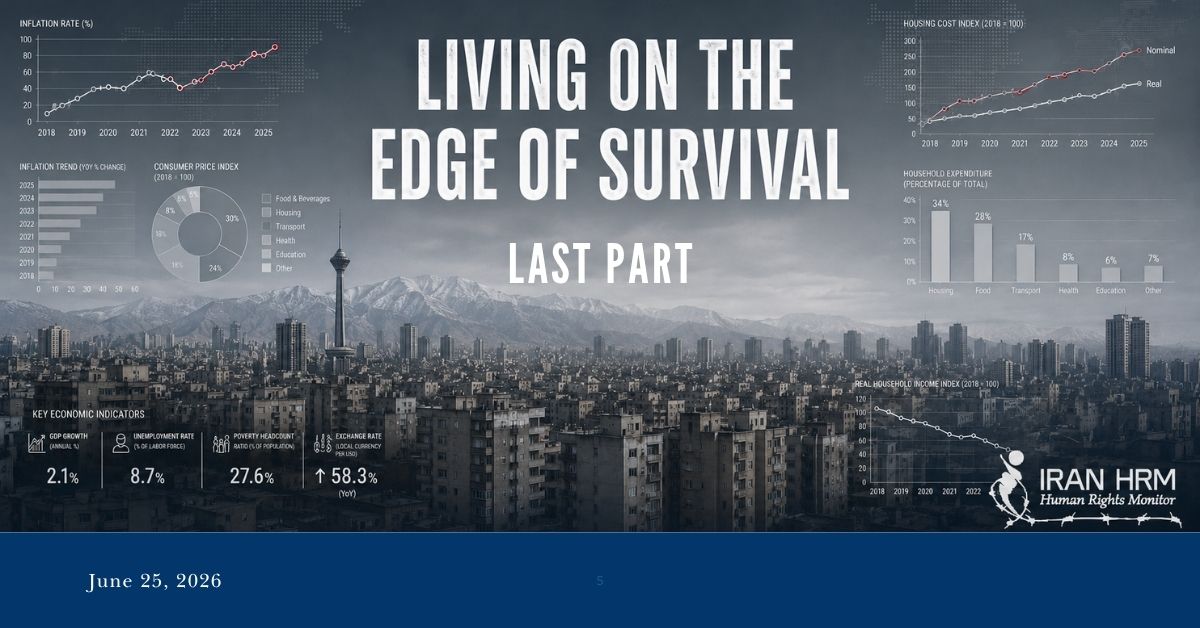
- Annual inflation reached approximately 57.7%, while point-to-point inflation approached 83.9%.
- Food inflation significantly outpaced general inflation, reducing access to adequate nutrition for many households.
- The estimated poverty line for a family of four exceeded 55 million tomans per month, while average wages remained far below this level.
- Housing costs absorbed an increasing share of household expenditure, contributing to housing insecurity and displacement.
- Rising healthcare costs created growing barriers to medical treatment, particularly for low-income households.
- Growing numbers of households relied on borrowing, informal employment, and other survival strategies to meet basic needs.
- Women-headed households, informal workers, pensioners, children, and residents of deprived regions were disproportionately affected.
- Evidence from official statistics, international assessments, and personal testimonies indicates a widening gap between living costs and household income across Iran.
EXECUTIVE SUMMARY
Between 2024 and 2026, Iran experienced a period of sustained inflation, rising living costs, declining purchasing power, and growing economic pressure on households. Official statistics, assessments by international organizations, and documented testimonies indicate that the gap between household income and the cost of living widened significantly during this period.
Annual inflation reached approximately 57.7 percent in May 2026, while point-to-point inflation approached 83.9 percent. Economic estimates placed the poverty line for a family of four above 55 million tomans per month, while average monthly wages remained substantially below that level. International assessments further estimated that approximately 36 percent of the population lives below the international poverty line.
Food insecurity emerged as one of the most visible consequences of the crisis. International organizations reported food inflation approaching 99 percent in early 2026, while the prices of basic staples such as flour and rice increased dramatically. Evidence presented in this report indicates that many households have reduced food consumption, altered dietary patterns, or relied on informal credit arrangements to obtain essential food items.
The report also documents the growing burden of housing and healthcare costs. Housing-related costs account for approximately 43.7 percent of urban household expenditure, while rising rents have increased pressure on low-income and middle-income households alike. At the same time, rising medical costs have limited access to treatment for some families, contributing to delayed care, incomplete treatment, and increased reliance on borrowing.
In response to these pressures, many households have adopted a range of survival strategies, including multiple jobholding, participation in the informal economy, borrowing, reducing consumption, and sending additional family members into the labor market. International estimates indicate that approximately 39 percent of Iran’s employed workforce operates in the informal economy, often without adequate social protection or employment security.
From a human rights perspective, the evidence presented in this report raises concerns regarding access to adequate food, housing, healthcare, work, and an adequate standard of living. Taken together, the findings illustrate how prolonged economic hardship has increasingly affected the daily lives, economic security, and enjoyment of fundamental rights for millions of people across Iran.