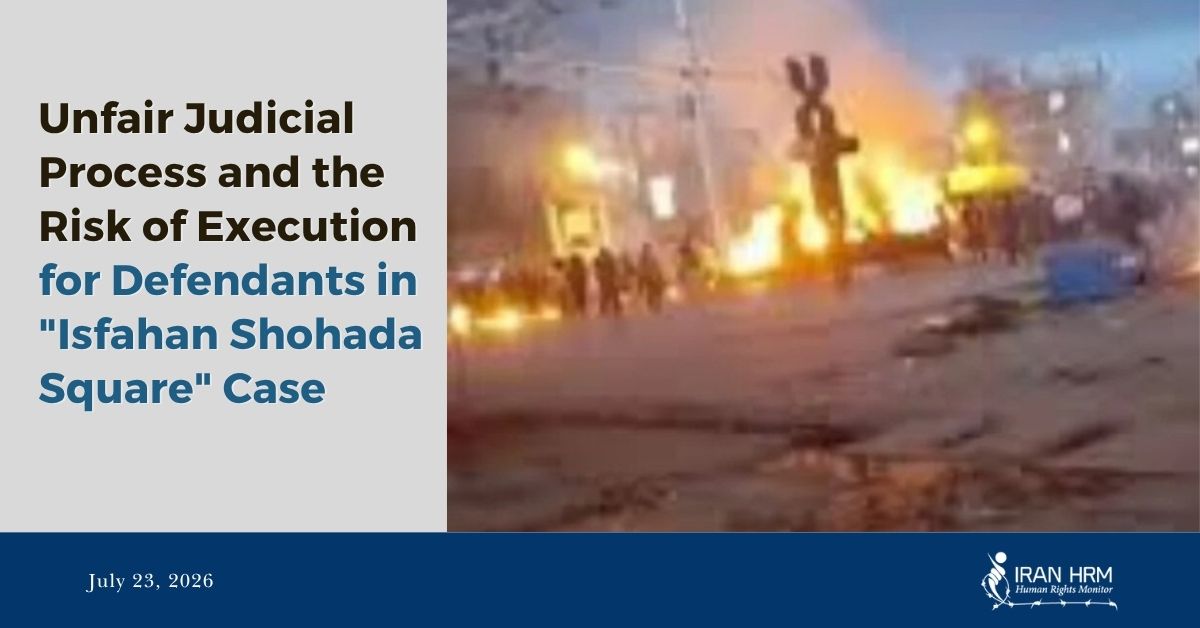
The case known as “Isfahan Shohada Square” has become one of the most critical and prominent judicial cases linked to the nationwide protests of December 2025–January 2026. In this case, 16 detained citizens face judicial prosecution. According to obtained documentation, a significant portion of the charges brought against them carry heavy penalties, including capital offenses such as “Moharebeh” (enmity against God), “destruction of public property amounting to Moharebeh,” “assembly and collusion against national security,” and “propaganda against the system.”

Although this case shares similarities in the number of defendants and charge structures with the well-known “Isfahan Alikhani Square” case, it remains an independent case in terms of subject matter, proceedings, involved individuals, and cited events. A detailed review of the process demonstrates blatant violations of fair trial standards, court sessions held within high-security prison facilities, denial of defense attorneys’ right to access case files, and the infliction of severe torture on defendants to extract forced confessions.
Court Held Inside Prison: An Unprecedented and Opaque Procedure
In an unprecedented move contrary to the principle of open and public trials, the court session to hear charges against all 16 defendants was held on Monday, July 13, 2026 (22 Tir 1405), inside Dastgerd Prison in Isfahan.
Judge Morteza Barati and Judge Mohammadreza Tavakoli presided over the session, with an individual named Kheirollahi attending as the prosecutor’s representative. Although the case was officially registered in Branch 5 of the Isfahan Revolutionary Court, the actual proceedings and session management were conducted by judges from Branch 1 of the Revolutionary Court. Reports also indicate that all stages of this trial session were video recorded.
Identity of Detainees and Occupational Ties to Shohada Square Shoe Market
Legal evaluations indicate that out of the 16 defendants in this case, the identities of 12 individuals have been verified, while the identities of 4 others remain unknown. Most of the detainees are not prominent political activists, but rather business owners, shopkeepers, or employees of shoe stores in the vicinity of Isfahan’s Shohada Square whose workplaces were impacted during the protests.
Names of the 12 Identified Defendants:
- Ahmadreza Saeedi (Shoe store employee)
- Milad Boeiri (Owner of a shoe store in Shohada Square)
- Mehrdad Boeiri (Brother of Milad Boeiri)
- Ali Boeiri (Brother of Milad Boeiri)
- Taraneh Rahimi (20 years old, store employee and twin sister of Romina)
- Romina Rahimi (20 years old, twin sister of Taraneh)
- Navid Elyasi
- Abolfazl Dadgostar
- Mehdi Mansouri
- Hamed Mehralian
- Mehdi Asadi
- Setayesh Saedi
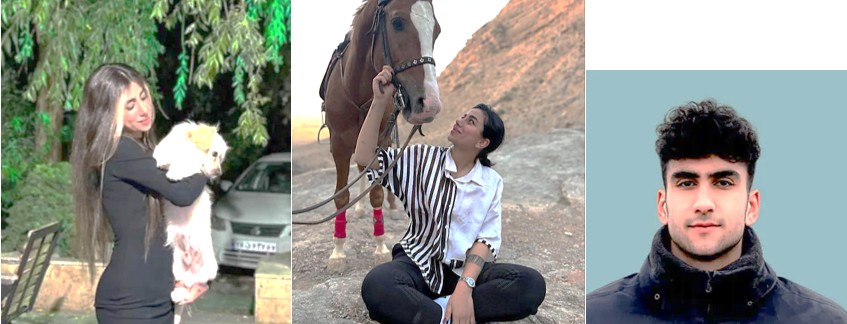
These citizens are currently held in Dastgerd and Dowlatabad prisons in Isfahan. Taraneh and Romina Rahimi, 20-year-old twin sisters, spent their 20th birthday in May 2026 in judicial limbo behind bars.
Classification of Charges: Risk of Death Sentences Under “Moharebeh”
The primary charge leveled against most defendants in the case is “Moharebeh” (enmity against God) through the carrying of cold weapons” and “destruction of public property amounting to Moharebeh”—charges that, under the Islamic Penal Code of the Iranian regime, can lead to severe penalties, including execution.
However, the legal status and charges are not identical for all defendants:
- Direct Perpetration of Moharebeh: The primary charge against most male defendants in the case.
- Complicity in Moharebeh and Destruction of Property: Two of the defendants face these specific charge titles.
- Assembly and Collusion: The primary charge brought against Setayesh Saedi, whose defense attorneys have requested full acquittal due to the complete lack of supporting evidence.
Disclosure of Severe Torture and Use of Taser Against Ahmadreza Saeedi
One of the most shocking events recorded during the July 13 court session was the explicit statement made by Ahmadreza Saeedi in the presence of the judges. He publicly declared that he was subjected to severe physical and psychological torture during his interrogation and time in security detention facilities.
According to Saeedi, the investigator personally used an electroshock weapon (taser) on his neck and genitals, inflicting severe injury to extract forced confessions. Under international human rights standards and anti-torture conventions, any confession obtained under duress and torture is devoid of legal value. Raising such shocking disclosure obligates any court to halt proceedings and launch an independent, impartial investigation—an action entirely ignored by the court.
Violation of the Right to Defense and Severe Restrictions on Defense Counsel
One of the most fundamental pillars of a fair trial is the defendant’s free and effective access to chosen legal counsel and sufficient time to review the case file. According to reliable reports, the defense attorneys representing the defendants in the Isfahan Shohada Square case were denied access to most of the case contents, documents, and records prior to the trial session.
This deliberate restriction prevented attorneys from preparing legal defense based on a full review of the evidence. Following this, defense counsel filed formal objections, demanding a stay of proceedings, complete handover of the case file, and postponement of the verdict to allow adequate preparation of a fair defense.
Lack of Documentation Regarding the Deaths of Two Individuals During Protests
During the December 2025–January 2026 (Dey 1404) protests near Isfahan’s Shohada Square, two individuals—a member of the Islamic Revolutionary Guard Corps (IRGC) and an unhoused (homeless) citizen—lost their lives. Despite initial claims by the judiciary and security apparatus regarding the defendants’ role in these deaths, the failure to produce any evidence whatsoever resulted in no direct charges of murder or complicity in murder being included in the issued indictment.
Obtained documentation and information indicate the following:
- Lack of Evidentiary Proof: No document, video, or evidence proving the presence or involvement of the defendants in the deaths of these two individuals was presented during the court session.
- Geographical Distance: The location where the IRGC member died was geographically distant from the defendants’ place of business and presence (shoe stores), establishing no connection between them.
- Exculpatory Video: Regarding the deceased unhoused citizen, a video extracted from the defendants’ mobile phones exists within the case evidence showing Taraneh Rahimi attempting to mediate during an altercation, urging those involved to refrain from beating the individual.
Therefore, from a legal perspective, attributing criminal responsibility for the deaths of these two individuals to the defendants in this case is completely baseless and lacks legal validity.
Conclusion and Operational Demands from International Bodies and the United Nations
The Isfahan Shohada Square case is a clear example of the instrumentalization of the judiciary to suppress civil protests and instill fear in society. Holding in-camera trials within prison facilities, denying defense attorneys access to case documentation, ignoring brutal torture (including the use of tasers) to extract confessions, and bringing severe charges such as “Moharebeh” without supporting evidence demonstrate a flagrant violation of Article 14, Paragraph 3 of the International Covenant on Civil and Political Rights (ICCPR) and the Universal Declaration of Human Rights regarding the right to a fair trial.
In light of the grave and immediate threat of capital sentences (execution) facing these 16 citizens, it is essential that UN human rights bodies and the international community immediately enact the following concrete and operational measures:
- Urgent Action by the UN Independent International Fact-Finding Mission (FFM): Document the details of this case, record the names of the presiding judges (Morteza Barati and Mohammadreza Tavakoli) as well as interrogators accused of torture, and officially incorporate their names into upcoming reports to the UN Human Rights Council for future international criminal accountability.
- Direct Demand by the UN High Commissioner for Human Rights (OHCHR): Issue an official and urgent call to stay the issuance of verdicts, grant the Special Rapporteur on the situation of human rights in Iran full access to the case file, and allow an in-person visit with the defendants in Dastgerd and Dowlatabad prisons in Isfahan.
- Activation of UN Special Procedures Mechanisms: Formal communications and urgent appeals by the Working Group on Arbitrary Detention (WGAD) and the Special Rapporteur on Torture regarding Ahmadreza Saeedi’s statements concerning taser torture, compelling the Iranian government to conduct an independent forensic medical investigation.
- Consular Actions and Summoning of Ambassadors by UN Member States: Summon Islamic Republic ambassadors across various capitals to deliver diplomatic warnings and exert direct political pressure to halt the issuance and implementation of death sentences in protest-related cases.
- Legal Action by Lawyers and International Organizations: Submit documented reports of this case to international courts and national judicial authorities to apply the principle of Universal Jurisdiction against perpetrators of fair trial violations and those ordering torture in this case.