
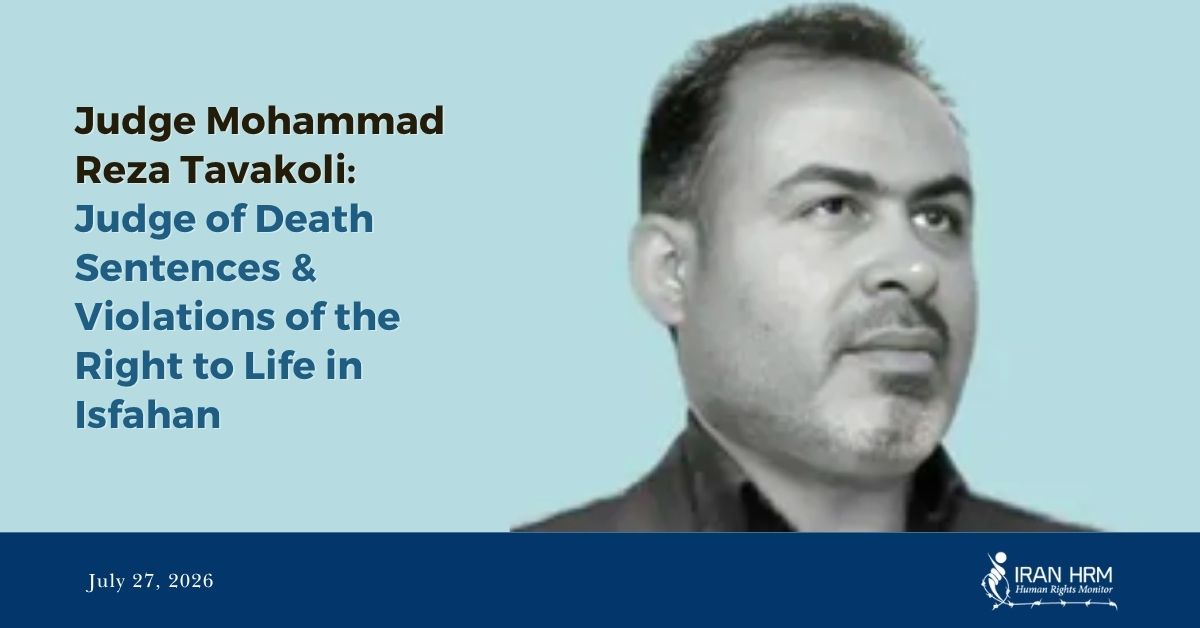
In two cases stemming from the January 2026 nationwide protests in Isfahan — namely the “Alikhani Square Case” and the “Shohada Square Case” — where 12 protesters received death sentences in the former (with two individuals, Erfan Esfandiari and Gol-Mohammad Mohammadi, executed on July 19, 2026 [28 Tir 1405]) and 16 protesters face the grave risk of receiving death sentences in the latter, one judge’s name stands out in the violation of the most fundamental human right — the right to life: Judge Mohammad Reza Tavakoli.


Judicial Profile and Background of Judge Mohammad Reza Tavakoli, Judge of Death Sentences in Isfahan in Protesters’ Cases
| Title | Details & Background |
| Full Name | Mohammad Reza Tavakoli |
| Current Position | Head of Branch 1 of the Revolutionary Court of Isfahan |
| Previous Positions | Head of Branch 5 of the Khomeinishahr Public Court, Public and Revolutionary Prosecutor of Najafabad, Judicial Deputy to the General Head of Public and Revolutionary Courts of Isfahan |
| Date of Appointment to the Revolutionary Court | November 29, 2023 (8 Azar 1402) — by decree of Gholamhossein Mohseni-Eje’i |
| Most Significant Cases | Cases of House of Isfahan, Toomaj Salehi, Alikhani Square, Shohada Square, Mostafa Salehi, 15 Baha’i Women, 22 Political Activists |
| Most Significant Sentences Issued | Death sentences, long-term imprisonment, and supplementary punishments in political and security cases |
| Ongoing case (2026) | Isfahan Shohada Square case- Case currently in proceedings; 16 protesters face the grave risk of receiving death sentences.
|
| Human Rights Violations | Numerous reports detailing concerns over fair trial standards, access to legal counsel, expedited proceedings, and the use of the death penalty in cases related to protests |
When Judge Tavakoli served as the Head of Branch 5 of the Public Civil Court of Khomeinishahr in Isfahan, he was honored as an “Exemplary Judge of the Islamic Republic” by Ali Ranjbar (Deputy of the Disciplinary Prosecutorial Office for Judicial Evaluation), Rasoul Zargarpour (Governor of Isfahan), Ahmad Khosravi-Vafa (Chief Justice of Isfahan Province), and Mohammad Reza Habibi (Public and Revolutionary Prosecutor of Isfahan Province).
(IMNA News Agency – June 28, 2014 / Commendation of 30 Exemplary Judges of Isfahan Province تجليل از 30 قاضي نمونه استان اصفهان)
In November 2023 (Azar 1402), Mohammad Reza Tavakoli was appointed Head of the Revolutionary Court of Isfahan by a decree from the Head of the Judiciary.
According to reports received regarding the trial proceedings, Tavakoli — a person of low education — manages political and security cases by making arbitrary and harsh decisions to gain favor with higher authorities and secure promotions; to the extent that in the case of Toomaj Salehi, he increased the charges against him from 3 to 10 counts.
In recent years, by issuing death sentences and heavy prison terms in political, security, and ideological cases, he has become one of the most ruthless judges in the Iranian judicial system. His name is tied to prominent cases such as the “House of Isfahan”, the initial death sentence for Toomaj Salehi, the “Alikhani Square” case, and the issuance of heavy sentences for political activists and Baha’i citizens. The appointment of Judge Tavakoli as Head of Branch 1 of the Revolutionary Court of Isfahan coincided with a surge in the adjudication of security cases and nationwide protests.
Record of Death Sentences and Heavy Prison Terms Issued
| Year | Case | Result & Sentences Issued |
| 2017–2020 (1396–1399) | Mostafa Salehi Case | Active involvement in the case during his tenure as Public Prosecutor of Najafabad; Mostafa Salehi was executed in August 2020 (Mordad 1399). |
| 2023 (1402) | House of Isfahan Case | Issuance of death sentences for Majid Kazemi, Saleh Mirhashemi, and Saeed Yaqoubi (drawing severe international criticism). |
| 2024 (1403) | Toomaj Salehi Case | Issuance of an initial death sentence, which was later overturned by the Supreme Court. |
| 2024 (1403) | Case of 15 Baha’i Women | Issuance of a combined total of 75 years of imprisonment plus supplementary punishments for 15 Baha’i citizens. |
| 2024 (1403) | Case of 22 Isfahan Political Activists | Issuance of over 161 years of imprisonment plus supplementary punishments for 22 political defendants. |
| 2026 (1405) | Isfahan Alikhani Square Case | Issuance of death sentences for 12 detainees from the January 2026 (Dey 1404) protests and prison terms for dozens of other defendants. |
Details of 4 Key Cases Resulting in Death Sentences
- “House of Isfahan” Case (2022 Protests)
In this case related to the 2022 protests, three protesters named Majid Kazemi, Saleh Mirhashemi, and Saeed Yaqoubi were tried and sentenced to death on charges of Moharebeh (enmity against God) in connection with the killing of Basij forces during these protests. Families and defense lawyers reported that the defendants were subjected to severe pressure during detention and were denied adequate time and opportunity to defend themselves; furthermore, the trial process violated the standards of a fair trial. Majid Kazemi, Saleh Mirhashemi, and Saeed Yaqoubi denied any involvement in the killing of Basij forces and maintained their innocence until the final moments before their executions. Despite these protests, their death sentences were carried out.

- Initial Death Sentence of Toomaj Salehi (April 2024)
On April 24, 2024 (5 Ordibehesht 1403), Branch 1 of the Revolutionary Court of Isfahan, presided over by Judge Mohammad Reza Tavakoli, sentenced aTomaj Salehi, a dissident rapper, to death on the charge of “Corruption on Earth” (Efsad-fil-Arz). This ruling was issued despite the fact that the Supreme Court had previously overturned the earlier verdict against him, 6 years and three months in jail, and remanded the case back to the primary court to address procedural defects.
- “Isfahan Alikhani Square” Case (January 2026)
One of the most critical cases presided over by Judge Tavakoli is the so-called “Isfahan Alikhani Square” case — a case that led to the arrest of dozens of protesters from the January 2026 (Dey 1404) protests and resulted in death sentences for 12 of them. Branch 1 of the Revolutionary Court of Isfahan, under Judge Tavakoli, issued indictments for 59 detainees in this case. Ultimately, 12 of the defendants were sentenced to death on charges including “murder” and “Moharebeh“, while 23 others were sentenced to five to ten years in prison despite being acquitted of certain charges. The proceedings for this case took place in only three court sessions, each lasting approximately one hour. A notable aspect of the Alikhani Square case is the presence of several young defendants among those sentenced to death. According to published reports, among the twelve individuals who received death sentences are individuals born between 1998 and 2007 (1377 to 1386 AP). An Afghan citizen is also among those sentenced.
- Mostafa Salehi Case (January 2018 Protests)
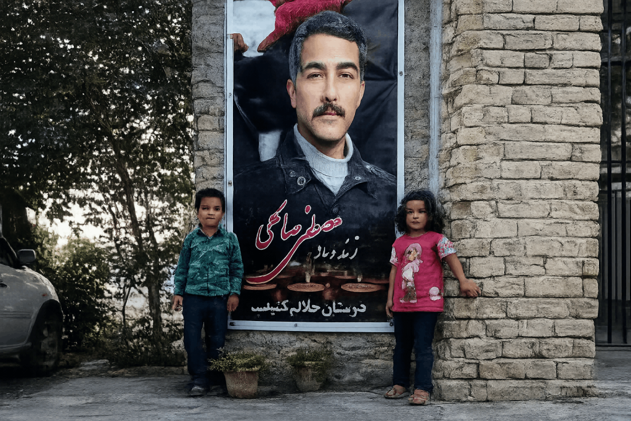
Mohammad Reza Tavakoli’s record in cases involving protesters dates back to years prior to his tenure as Head of the Revolutionary Court of Isfahan. One of the most prominent cases involves Mostafa Salehi, a detainee from the January 2018 (Dey 1396) protests. Mostafa Salehi was arrested on charges of killing a security force member during the Isfahan protests and, after several years of judicial proceedings, was executed in August 2020 (Mordad 1399). At that time, Mohammad Reza Tavakoli served as the Public and Revolutionary Prosecutor of Najafabad and played an active role in pursuing this case.
Violations of Laws and Treaties
Violations of Iranian Domestic Law in Cases Presided over by Judge Tavakoli:
- Denying defendants effective access to defense counsel of their choice during proceedings;
- Holding court sessions within extremely limited timeframes without providing adequate opportunity for defense;
- Relying on confessions where there were ambiguities and formal objections regarding how they were obtained;
- Failing to publish documents and evidentiary proof in capital punishment cases;
- Conducting group trials for multiple defendants without an independent review of each defendant’s individual circumstances;
- Issuing death sentences under conditions where formal legal objections had been raised regarding the failure to observe due process.
Violations of International Human Rights Law in Cases Presided over by Judge Tavakoli:
- Article 3 of the Universal Declaration of Human Rights (UDHR): Everyone has the right to life, liberty, and security of person.
- Articles 9 and 10 of the UDHR: Emphasizes the prohibition of arbitrary arrest and detention and guarantees the right to a fair and public hearing.
- Article 11 of the UDHR: Recognizes the presumption of innocence and the right to an effective defense.
- Articles 6, 9, and 14 of the International Covenant on Civil and Political Rights (ICCPR): Addresses the right to life, liberty, fair trial, access to legal counsel, and procedural guarantees for defendants.
- Convention on the Rights of the Child (in cases involving defendants under 18 years of age): Emphasizes special protections for children in penal proceedings and strict limitations on applying severe punishments to them.
- UN Basic Principles on the Independence of the Judiciary and the Role of Lawyers: Emphasizes the independence of the judicial system, the right to access counsel, and full compliance with fair trial guarantees.
Summary and Operational Demands from International Bodies and the United Nations
The judicial record of Judge Mohammad Reza Tavakoli demonstrates that he acts not as an independent judge, but as a direct executor of policies of repression, intimidation, and the issuance of death sentences accompanied by systematic violations of fair trial standards and the right to an effective defense against protesting citizens in Isfahan province. Issuing mass death sentences in brief, minutes-long court sessions, ignoring the torture of defendants, and issuing death sentences for young protesters place him among the primary violators of the right to life within the Iranian judicial apparatus.
Given the immediate and severe risk of execution facing defendants in the “Alikhani Square” and “Shohada Square of Isfahan” cases, it is imperative that international bodies and the United Nations immediately execute the following tangible and operational measures against Judge Mohammad Reza Tavakoli and the entire relevant judicial structure:
- Listing under International Human Rights Sanctions Regimes: Urgent action by the European Union, member states, the United Kingdom, Canada, and the United States to designate Judge Mohammad Reza Tavakoli on targeted human rights sanctions lists (due to gross violations of human rights and the violation of the right to life).
- Immediate Action by the UN Independent International Fact-Finding Mission on Iran (FFM): Documenting the rulings issued by Judge Tavakoli, documenting his name as a senior violator of the right to life, and including his case file in official reports to the Human Rights Council for international criminal prosecution.
- Application of Universal Jurisdiction: Gathering and submitting legal dossiers of Tavakoli’s death sentences to courts and judicial authorities of independent nations to issue international arrest warrants and pursue criminal prosecution against him for crimes against humanity.
- Formal Demand and Warning by the UN High Commissioner for Human Rights (OHCHR): Issuing an urgent statement demanding an immediate halt to executions in cases originating from Branch 1 of the Revolutionary Court of Isfahan, and obligating the Iranian government to grant special access to the UN Special Rapporteur on Iran to visit the defendants in these cases.
- Decisive Consular Diplomacy by UN Member States: Summoning ambassadors and diplomatic representatives of the Islamic Republic in various countries, making any diplomatic engagement strictly contingent upon an immediate halt to death sentences issued in the branch managed by Judge Tavakoli.