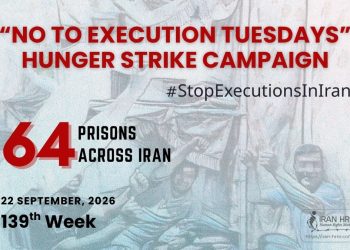
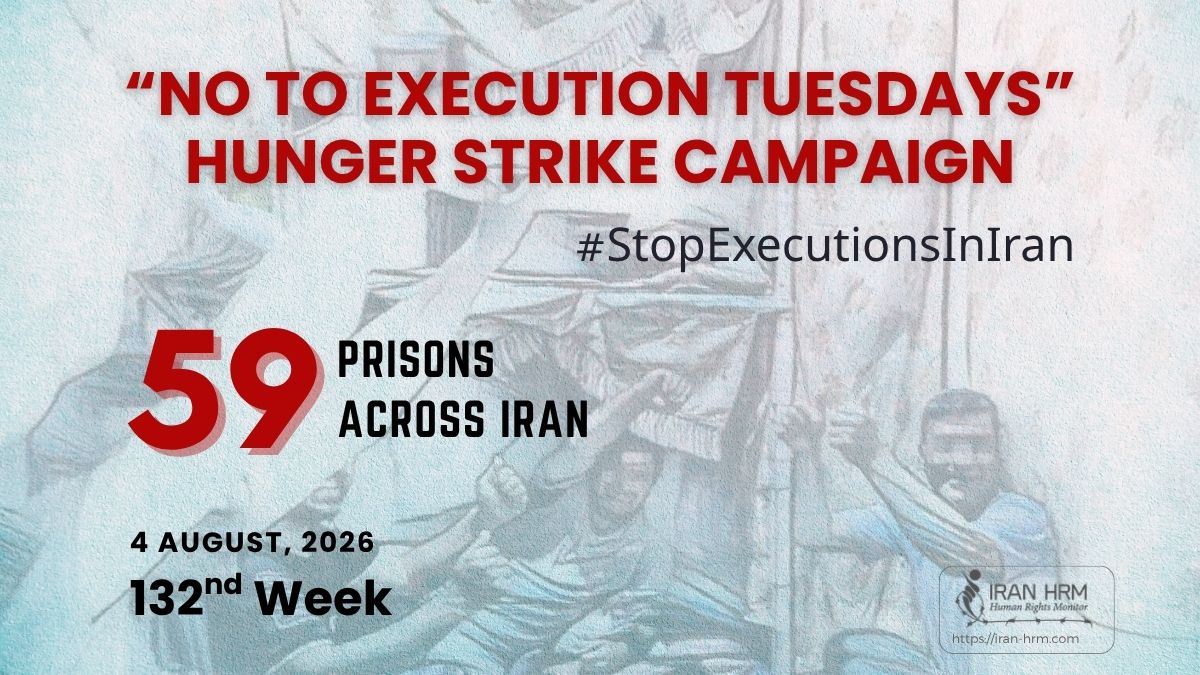
Resistant prisoners in 59 prisons across Iran continued the 132nd week of the “No to Execution Tuesdays” campaign with a widespread hunger strike in protest against the rising and relentless wave of executions by the regime. Publishing a statement, members of this campaign warned that by intensifying executions and creating an atmosphere of fear and dread, the regime is attempting to prevent the formation of any popular protests and uprisings. While emphasizing the continuation of their resistance, these striking prisoners called for all-out solidarity and unconditional practical action by all human rights organizations and political currents to stop the execution machine in Iran.

Please find the full text of the statement by the “No to Execution Tuesdays” campaign below:
Continuation of the “No to Execution Tuesdays” campaign in week 132 in 59 prisons across the country
Call for collective solidarity against execution
As we have witnessed in recent weeks, the crisis-creating and crisis-ridden regime ruling over the lives of the people has expanded executions. So much so that since the beginning of Mordad (July 23, 2026) until now, it has executed 35 people, one of whom was a child offender and another was a woman. 28 of these individuals have been executed in the period between July 28, 2026, and now, 3 of whom were among those sent to the gallows from the protesters of the January uprising.
The Velayat-e Faqih (clerical rule) regime, which has conditioned the continuation of its rule on the suppression and exploitation of the people, especially the deprived and working classes, has heavily assaulted the lives and livelihoods of the people under the pretext of war; it has occupied the streets at night with a notorious minority, reducing them to vulgarity, deployed armored units and checkpoints in main passages, and makes no effort to stop the war.
This is because it does not fear war, and foreign threats are considered a blessing to it, much like the eight-year war with Iraq. Despite their many differences, the entire fear of the various ruling factions is the taking root of an internal uprising. They know well that through “missile cities” they can buy as much time as possible against the United States and Israel to guarantee their survival.
No foreign country or power, despite the warmongering of the Iranian regime, is a bearer of peace, democracy, equality, and human rights for Iran and the region. As opponents of execution, we naturally oppose war and foreign intervention as well, and we have declared this many times.
Welfare, equality, freedom, joy, and the negation of any form of exploitation and tyranny are only possible through the people and collective power. For this very reason, Mojtaba Khamenei, the unseen dictatorial leader, acts upon his father’s will, invokes the God of the 1980s, and brings execution cranes to the streets to take the lives of Amir Hossein Safari and Abolfazl Sepahi in public, and executes the 19-year-old youth, Arvin Kheirkhahan, who was full of the passion of life, in Shahroud, in order to continue the slaughter and massacre of the January uprising in this manner, to prevent any form of protest for revolutionary and fundamental transformation.And his representatives in Friday prayers and the state radio and television (Seda va Sima) speak of the fruits of execution and praise the executioners.
Now, every awakened conscience thinks that if these protesting youths were criminals and murderers and are being hanged in public, why were their trials not held openly, and why are they secretly tortured and tried?!
Yet, in contrast, inside the prisons, we are witnessing a commendable resistance; resistant and fighting prisoners protest against the process of suppression inside and outside prisons in various ways, they are sent to solitary confinement, they are exiled, but they only become seemingly silent when they go to the gallows and become immortalized.
This resistance is not limited to political prisoners; in the past two weeks, 1,500 prisoners in Unit 2 of Ghezel Hesar Prison, with an iron will, went on a hunger strike for more than two weeks and did not end their strike until prison officials and the prosecutor’s office agreed to commit to stopping the execution of sentences.
On the other hand, in 59 prisons, the “No to Execution Tuesdays” campaign continues with solidarity, and as members of the campaign, our will to continue the campaign has grown stronger with the intensification of executions. Given the current situation and the fact that daily they execute one of the protesters, including the detainees of the January uprising, raising the issue of execution for public opinion is essential; because execution means “deprivation of life” and state violence, and in Iran, every execution has a political goal and is meant to create fear and terror, and now the threat of this anti-human act has engulfed the entire Iranian society.
We deem it necessary to thank and appreciate all political organizations and parties, human rights, trade union, and civil institutions, including retirees and domestic and international figures, for their opposition to execution in general and their support for the “No to Execution Tuesdays” campaign. However, with all humility and in light of the above, we expect parties, organizations, political, human rights, trade union, and civil currents that oppose execution to act without “ifs and buts” in defense of the “right to life” and “no to execution.”
Given that for 132 weeks prisoners have unitedly advanced the “No to Execution Tuesdays” campaign, performing their minimum duty as prisoners, and its members have been transferred to solitary confinement, beaten, and executed, it is expected that opponents of execution take effective steps to stop executions and utilize every opportunity for a practical reaction to executions.
The fact that the prosecutor of the executioner regime has threatened opponents of execution with punishment even for expressing their views shows the progress of the “No to Execution” movement and its importance. Therefore, it is necessary that opposition to execution becomes more widespread and includes all those sentenced to death, whether political with any tendency or non-political with any charge.
As we have repeatedly declared, our power lies in our solidarity, and through resistance and getting organized, we will break the barrier of tyranny and execution.
Members of the “No to Execution Tuesdays” campaign are on hunger strike on Tuesday, August 04, 2026, in the 132nd week, in the following 59 prisons:
Evin Prison (women’s and men’s wards), Qezel Hesar Prison (Units 2, 3, and 4), Karaj Central Prison, Fardis Prison of Karaj, Greater Tehran Prison, Qarchak Prison, Khorin Prison of Varamin, Choobindar Prison of Qazvin, Ahar Prison, Arak Prison, Langeroud Prison of Qom, Khorramabad Prison, Borujerd Prison, Yasuj Prison, Asadabad Prison of Isfahan, Dastgerd Prison of Isfahan, Sheiban Prison of Ahvaz, Sepidar Prison of Ahvaz (women’s and men’s wards), Nezam Prison of Shiraz, Adel Abad Prison of Shiraz (women’s and men’s wards), Firouzabad Prison of Fars, Dehdasht Prison, Zahedan Prison (women’s and men’s wards), Borazjan Prison, Ramhormoz Prison, Behbahan Prison, Bam Prison, Yazd Prison (women’s and men’s wards), Kahnuj Prison, Tabas Prison, Birjand Central Prison, Mashhad Prison, Gorgan Prison, Sabzevar Prison, Gonbad-e Kavus Prison, Qaemshahr Prison, Rasht Prison (men’s and women’s wards), Rudsar Prison, Havigh Prison of Talesh, Azbaram Prison of Lahijan, Dizel Abad Prison of Kermanshah, Ardabil Prison, Tabriz Prison, Urmia Prison, Salmas Prison, Khoy Prison, Naqadeh Prison, Miandoab Prison, Mahabad Prison, Bukan Prison, Saqqez Prison, Baneh Prison, Marivan Prison, Sanandaj Prison, Kamyaran Prison, Ilam Prison, Kerman Prison, Borujen Prison, and Neyshabur Prison.
The 132nd Week
August 04, 2026
#No_To_Execution_Tuesdays_Campaign