Labour Exploitation, Human Trafficking and Sexual Exploitation
Marking 23 August, International Day for the Remembrance of the Slave Trade and its Abolition
On the night of 22–23 August 1791, enslaved people rose up in Saint-Domingue, present-day Haiti, in an event that became a turning point in the historic struggle against the slave trade. UNESCO designated 23 August as the International Day for the Remembrance of the Slave Trade and its Abolition to honour the victims and examine the mechanisms that deprived human beings of control over their bodies, labour and destinies.

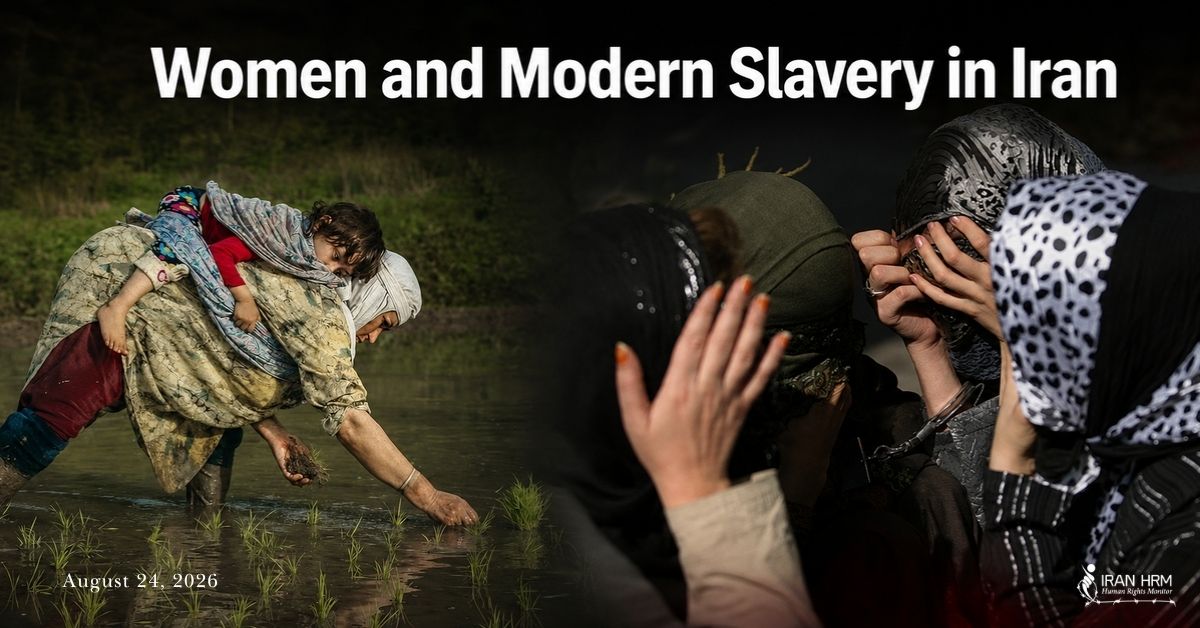
This commemoration is not confined to the past. In Iran today, discriminatory laws, exclusions from labour protections, ineffective oversight, the criminalisation of victims and impunity for perpetrators continue to facilitate severe labour exploitation, human trafficking and the sexual exploitation of women and girls. This report uses the term modern slavery where exploitation is accompanied by coercion, threats, deception, the confiscation of documents or earnings, restrictions on movement, or a genuine inability to leave the situation.
A profound employment gap
Data from the Statistical Center of Iran show that women’s economic participation rate stood at only 13.7 per cent in spring 2026, compared with 67.8 per cent for men. Women’s unemployment rose from 13.7 per cent in spring 2025 to 16.7 per cent in spring 2026, while the number of employed women fell by 187,000 over the same period. This disparity reflects a labour market in which state policies and laws have failed to guarantee women equal access to formal, protected employment. (Statistical Center of Iran; ISNA, 3 and 11 August 2026)
Lower wages and exclusion from social insurance
In May 2025, Ahmad Meydari, Minister of Cooperatives, Labour and Social Welfare, stated that the average declared monthly wage of insured men was 16.4 million tomans, compared with 14.2 million tomans for women, a monthly gap of 2.2 million tomans. He also said that, of the 580,000 people newly enrolled in social insurance between February 2024 and February 2025, approximately 363,000 were women, meaning that they had previously lacked coverage. These figures cover only formal employment; the authorities have still not published the number of uninsured women working in home-based occupations, agriculture and small workshops. (ISNA, 3 May 2025)
In July 2024, a labour activist reported that some women workers received only four million tomans a month and that the Labour Law was not enforced in their workplaces. Women working from home also depend on intermediaries to sell carpets, handicrafts and food products. According to labour activist Somayeh Golpour, many of their earnings remain ‘miles apart’ from the official minimum wage. (ILNA, 3 July 2024 and 22 October 2021)
Legal exclusions and workplaces beyond effective oversight
Article 38 of Iran’s Labour Law requires equal pay for equal work. However, Article 188 excludes family-run workplaces from the law, while Article 191 permits the government to exempt workplaces with fewer than 10 employees from certain provisions. In July 2024, the Deputy Minister for Labour Relations stated that 87 per cent of the country’s approximately 1.3 million workplaces employed fewer than 10 people and that most occupational accidents occurred in these units. He also acknowledged the use of blank-signed contracts and contracts signed under threat of dismissal or against promissory notes. This situation is a direct consequence of legal exclusions and the failure of state institutions to inspect workplaces and enforce the law effectively. (Iranian Labour Law, Articles 38, 188 and 191; ILO NATLEX; ILNA, 2 July 2024)
Figures from Iran’s Legal Medicine Organization show that 1,986 people died in workplace accidents in the year ending March 2025, including 15 women. During the first 11 months of the following Iranian year, 22 women and 1,857 men were recorded as having died in occupational accidents. The authorities did not publish the women’s names, ages, workplaces, insurance status or the findings of investigations into their deaths. (Legal Medicine Organization; ILNA, 19 August 2025; IRNA, 1 May 2026)
Women killed or injured in unsafe workplaces
On 1 June 2024, a vehicle carrying women tomato pickers overturned on the Dehdasht–Gachsaran road. Two women aged between 35 and 40 were killed, while two others, aged 33 and 40, were injured. The employer’s identity, the workers’ insurance status and responsibility for their transport were not disclosed. At the Arcopal Ravand factory in Kashan, approximately 20 women workers suffered respiratory poisoning following a gas leak on 12 December 2023. Seventy-five workers at the same factory had been poisoned the previous day, yet the initial report did not establish the final cause. (ILNA, 1 June 2024 and 12 December 2023)
The fire at the Arghavan Commercial Complex in Andisheh, Shahriar County, on 5 May 2026 was a further example of the consequences of ineffective safety oversight. Zahra Farahmand, Bahar Mahdipour, Golnoush Baharlou and Shokoufeh Hassanvand were killed. Bahar Mahdipour, 26, worked as a receptionist at the Tamax women’s sports club. The head of the Shahriar Fire Department confirmed that the building’s composite cladding contributed to the rapid spread of the fire. (Mehr News Agency, 5 May 2026; Asr Iran, 6 May 2026)
These facts document wage discrimination, exclusion from insurance, coercive contracts and lethal workplace hazards. The absence of publicly available cases involving withheld wages, debt bondage or restrictions on women leaving employment does not establish that such coercion is absent. It reflects the lack of disaggregated data, transparent inspections and published investigative findings. State responsibility extends beyond a failure to protect: legal exclusions, non-enforcement and the withholding of information about workplace deaths have entrenched conditions conducive to the severe exploitation of women.
Trafficking of Women and Girls: A More Explicit Form of Modern Slavery
In the trafficking of women and girls, deception, transfer, control, restrictions on exit and sexual exploitation frequently operate together. Trafficking networks exploit poverty, unemployment, flight from abusive homes and the search for work abroad. In the absence of effective state protection and accountability, these vulnerabilities become sources of profit for traffickers.
Recruitment and cross-border trafficking networks
The 2025 Trafficking in Persons Report issued by the United States Department of State again placed Iran in Tier 3, the lowest category, finding that the authorities did not meet the minimum standards for eliminating trafficking and were not making significant efforts to do so. According to the same report, Iranian authorities arrested 96 people for alleged sex trafficking in April 2024, based on media reports, but did not disclose the number or identities of the victims or the outcome of judicial proceedings. (United States Department of State, 2025 Trafficking in Persons Report)
On 24 April 2024, Saeed Montazerolmahdi, spokesperson for Iran’s Law Enforcement Command, said that the ‘Escort Service’ network transferred girls abroad to provide sexual services. Twenty-four people were arrested in the first phase and 57 in the second, a total of 81, but the police did not release the number of victims, the routes used or the judicial outcomes. On the same day, the police announced the ‘King’ network, which trafficked women to Türkiye and Georgia through air routes or the Bazargan border crossing. Members were arrested in Tehran, Alborz Province, at an airport terminal and at the Bazargan crossing. (ISNA, 24 April 2024)
Deceptive recruitment through job offers and competitions
In the ‘Chaturbate’ case, girls and young women, mainly aged 15 to 26, were recruited with promises of work in computing, English-language services and website design. According to the police account, they were then organised to produce live-streamed sexual content. In the ‘Level Up Dance’ case, organisers used advertisements for a dance competition in neighbouring countries to identify girls; the police said the network’s objectives included producing sexual content, trafficking in persons and establishing prostitution networks. In both cases, the authorities withheld the number of victims, the extent of coercion and the outcome of judicial proceedings. (ISNA, 24 April 2024)
Social media recruitment, passport confiscation and threats
The 2024 Trafficking in Persons Report found that traffickers increasingly used social media, particularly Telegram, to recruit victims in Iran. Women seeking work abroad and girls and young women who had fled home were identified as especially vulnerable. Iranian women and girls have been subjected to sexual exploitation in Afghanistan, Armenia, Georgia, Iraq, Pakistan, Türkiye and the United Arab Emirates. In some cases, traffickers confiscated victims’ passports and threatened them with violence or punishment if they returned to Iran. Passport confiscation, threats and the practical prevention of exit place these cases among the clearest forms of trafficking and modern slavery. (United States Department of State, 2024 Trafficking in Persons Report)
The ‘Alex’ case: a transnational trafficking network
Iran’s judiciary announced that Shahrouz Sokhanvari, known as ‘Alex’, was executed on 20 May 2023 on charges of ‘trafficking in persons for the purpose of prostitution’. According to the official account, his network used a front company and student visas to transfer women and girls from Iran to Malaysia and then to other countries. An Iranian employee in the visa reception section of the Malaysian Embassy in Tehran allegedly helped expedite visa applications. Twelve core members of the network were arrested. One recruiter, identified only as ‘Masih’, had referred at least 30 girls to the network in exchange for payment. Despite the execution of the principal defendant, the names, ages, cities of origin and fate of these girls were never disclosed. (Judiciary Media Centre, 20 May 2023)
Unnamed victims and unquantified protection
In its official 2023 reply to the United Nations Human Rights Committee, the Iranian government acknowledged that it had been unable to obtain and provide data on trafficking cases and their outcomes from the responsible bodies. At the same time, it claimed that more than 350 social emergency centres were operating and that a Commission on Countering Trafficking in Persons had been established. Yet it supplied no figures on women and girls identified as victims, access to safe accommodation, medical and psychological services or legal assistance. The 2025 Trafficking in Persons Report further recorded that, for the eighth consecutive year, the Iranian authorities had not reported identifying trafficking victims or providing them with protective services.
The same inaction is evident in legislation. In 2023, the government said that a bill to amend the 2004 Countering Human Trafficking Act was still awaiting final consideration by Parliament. Another proposal addressing human trafficking, migrants and organ trafficking was registered in August 2024 and received an expert assessment in October 2025, but its final status remained unclear as of 24 August 2026. This prolonged delay, combined with the absence of data and victim support, has strengthened the impunity enjoyed by exploitative networks.
The Structural Role of the Iranian Authorities
In its 2023 concluding observations, the United Nations Human Rights Committee expressed concern about the continued prevalence of human trafficking, child labour and sexual exploitation in Iran. It also referred to reports that temporary marriage, known as sigheh, pushed women and young girls living in poverty into commercial sex. This finding illustrates how a legal institution endorsed by the authorities can, when combined with poverty and the absence of protection, become a mechanism facilitating sexual exploitation.
Trafficking in Persons reports have also cited allegations of involvement or acquiescence by elements of the police, the Islamic Revolutionary Guard Corps, the Basij and some clerics. As of 24 August 2026, no identified official had been convicted by a final judgment for participation in the trafficking of women. The absence of convictions, together with the failure to publish data and investigative findings, demonstrates the lack of an accountability mechanism for allegations involving state institutions. The authorities are not merely ineffective observers. The legal framework, institutional inaction, potential prosecution of victims and reported complicity of officials make the state a structural factor in the continuation of this exploitation.
Call for International Action
The United Nations, the Special Rapporteur on the situation of human rights in the Islamic Republic of Iran, the Special Rapporteur on trafficking in persons, the United Nations Office on Drugs and Crime, and international organisations defending women’s rights should press the Iranian authorities to publish disaggregated data on victims, prosecutions and convictions; establish an independent mechanism to identify and support victims; ensure that women and girls are not prosecuted for acts they were compelled to commit as a consequence of trafficking; and permit independent, monitorable investigations into the involvement or acquiescence of state officials.
Afterword: Slavery without Chains
Modern slavery in Iran operates through unmonitored workshops, blank-signed contracts, poverty wages, unsafe workplaces and networks that recruit women and girls with promises of work, education or travel before transferring them for sexual exploitation. Passport confiscation, threats, deception and the inability to leave reproduce control over a person’s body, labour and destiny without slave markets or physical chains.
Under Iran’s clerical regime, these are not isolated incidents. They result from discriminatory laws, exclusions from protection, ineffective oversight, concealment of information, the denial of support to victims and impunity for perpetrators. The commemoration of 23 August is a call to recognise the women who are being deprived today of control over their work, bodies and futures. Ending this slavery without chains requires state accountability, investigations into the role of officials, prosecution of perpetrators, and guarantees of freedom, security and reparation for victims.