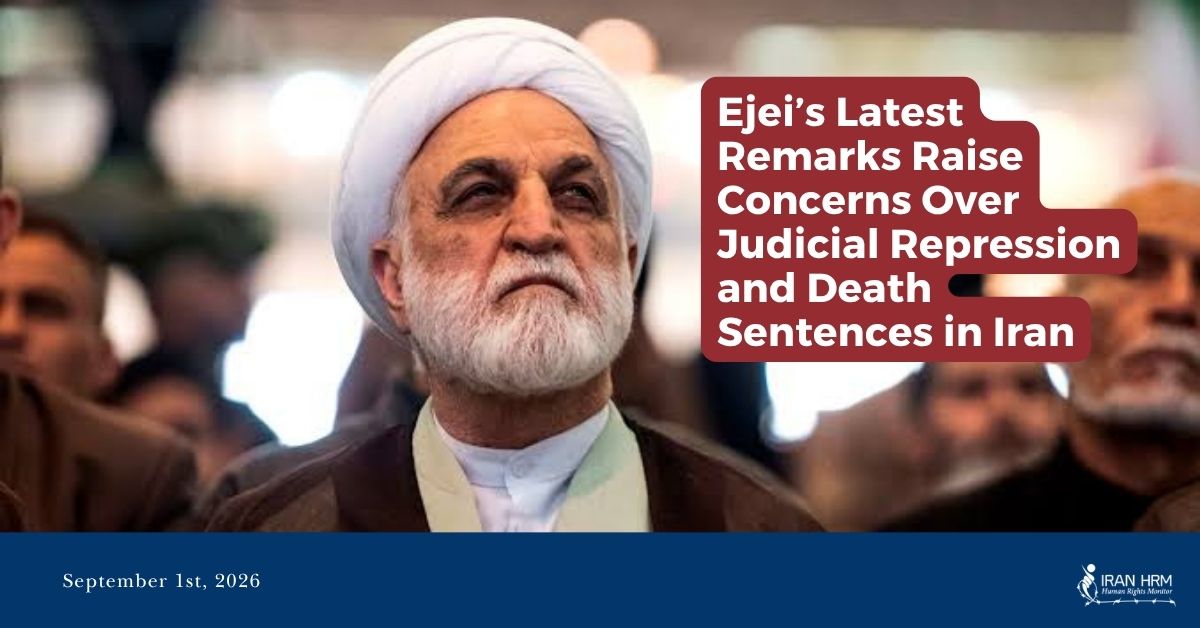
At a meeting of the High Council of the Judiciary on 31 August 2026 (9 Shahrivar 1405), Gholamhossein Mohseni Ejei, Head of the Judiciary of the Islamic Republic of Iran, warned against what he described as “anti-security elements” and “agents of the enemy,” stating that the judiciary would act “more decisively than ever before” against individuals who, in his view, seek to undermine the country’s security. He also instructed judicial authorities to review cases involving qisas (retribution-in-kind) prisoners covered by Article 429 of the Islamic Penal Code and to “determine the status” of prisoners whose cases have remained unresolved.

These remarks come amid years of criticism by international human rights bodies regarding the extensive use of the death penalty in the Islamic Republic of Iran. Particularly following nationwide protests in recent years, serious concerns have been raised about the use of security-related charges to impose severe punishments, including death sentences. In this context, the Head of the Judiciary’s emphasis on dealing “more decisively than ever before” with security-related cases may be regarded as a warning sign of a potential increase in executions.
Although Ejei did not explicitly refer to the issuance or implementation of death sentences, the language used in the section addressing security-related cases, combined with his emphasis on the full readiness of security, intelligence, and judicial institutions to confront what were described as security threats, may be interpreted as an indication of a possible escalation in the judiciary’s repressive approach toward future protests or expressions of social discontent.
At the same time, another part of the Judiciary Chief’s remarks concerned cases falling under Article 429 of the Islamic Penal Code. He instructed judicial officials to re-examine cases involving prisoners sentenced to qisas and to determine the status of those who have remained in prison under uncertain circumstances due to factors including the inability to pay fazel-e dieh (supplementary blood money) or other legal obstacles. Under Article 429 of the Islamic Penal Code, such cases generally involve individuals sentenced to qisas whose execution or final legal disposition has been delayed for various reasons.
Though from a legal perspective, the term “determining the status” does not necessarily mean carrying out a qisas sentence or an execution and it may encompass a range of outcomes, including settlement, forgiveness by the victim’s family, implementation of qisas, or other legal resolutions, nevertheless, the Judiciary Chief’s order for a special review of these cases could result in the reactivation of a significant number of dormant and unresolved cases, some of which carry death sentences as their ultimate punishment.
What heightens concern is not merely either statement in isolation, but their timing and concurrence. On the one hand, the Head of the Judiciary emphasized a tougher response to security-related cases; on the other, he ordered the review and resolution of qisas cases that had remained unresolved. Although there is no direct legal connection between these two categories of cases, taken together they may suggest a renewed focus by the judiciary on the more decisive implementation of severe punishments, including punishments involving deprivation of life.
Given Iran’s long-standing reliance on capital punishment and the continuing concerns expressed by international human rights mechanisms regarding due process, fair trial guarantees, and the use of the death penalty, Ejei’s remarks of 9 Shahrivar 1405 warrant close monitoring and scrutiny. These statements are undoubtedly concerning and may be viewed as an indication of an increased risk of accelerated implementation of death sentences, both in qisas cases and in cases involving security-related charges.
Conclusion
Mohseni Ejei’s statements on 9 Shahrivar 1405, viewed against the backdrop of the Islamic Republic’s decades-long and extensive use of the death penalty, raise concerns about a possible intensification of the government’s punitive approach toward dissent as well as the acceleration of proceedings in cases carrying death sentences.
Although his remarks alone do not constitute definitive evidence of an imminent increase in executions, existing patterns and past practices suggest that they should be treated as a warning sign regarding the risk of heightened judicial repression and a greater use of life-ending punishments. International human rights organizations, United Nations mechanisms, and other relevant stakeholders should closely monitor developments arising from these directives and intensify their efforts to advocate for a halt to executions in the Islamic Republic of Iran.
Footnote
Source of Ejei’s remarks:
Rokna News Agency, 31 August 2026 (9 Shahrivar 1405)
“Ejei Orders the Swift Resolution of Debtors’ Cases and Qisas Prisoners’ Cases”.