Executive Summary
Between August 23- September 15, 2026, the Islamic Republic of Iran executed at least 61 prisoners across detention facilities nationwide. This unprecedented surge demonstrates a systematic escalation in the use of executions as a tool of repression, social intimidation, and political cleansing. During this period, one person was executed every 9.6 hours.

Alongside the wave of non-political executions, two new death sentences were issued against individuals arrested during the 22 December 2025- 22 January 2026), heightening concerns about the use of capital punishment to suppress dissent and intimidate the younger generation.
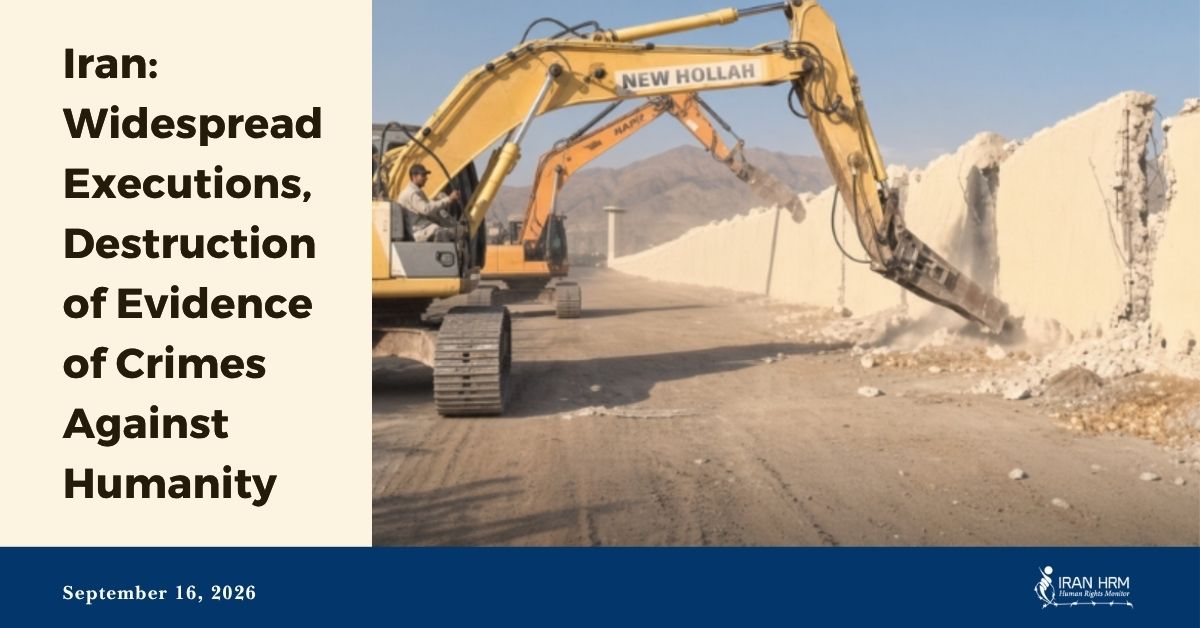
Simultaneously, the government has undertaken the demolition of Gohardasht Prison and the destruction of mass graves of victims from the 1980s and the 1988 massacre in multiple cities. These actions constitute the erasure of evidence of crimes against humanity, obstructing truth-seeking efforts and, under international law, amount to the continuation of the crime.
This report calls for urgent, concrete, and preventive action by United Nations mechanisms to halt the execution machinery, prevent the destruction of evidence, and ensure accountability for these grave human rights violations.
Introduction
In recent years, Iran has recorded the highest number of executions among countries where such figures are publicly documented and reported; in 2025, the country accounted for approximately 80 percent of the world’s recorded executions, with the government employing this punishment as a tool for political control, social repression, and the instilling of public fear. The new wave of executions in September 2026—accompanied by the issuance of death sentences against protesters and the destruction of evidence regarding past crimes—reflects a systematic pattern of human rights violations, including:
- Violation of the right to life (61 executions in 24 days)
- Unfair trials (enforced disappearance, lack of family notification, denial of access to legal counsel; Omidreza Heidari’s case)
- Torture and forced confessions (reports of coercion and torture during interrogations of Omidreza Heidari)
- Political executions (death sentences issued for two protesters: Mohammadreza Majidi-Asl and Omidreza Heidari)
- Destruction of evidence of crimes against humanity (demolition of Gohardasht Prison; leveling of Section 41 of Behesht-e Zahra; destruction of mass graves in Khavaran, and in Tabriz, Mashhad, Ahvaz)
These actions constitute clear violations of the International Covenant on Civil and Political Rights (ICCPR), fair trial standards, and Iran’s obligations under UN human rights mechanisms.
-
The Execution Wave from August 23 to September 15
Execution Statistics
- 61 executions in 24 days
- Average: 2.5 executions per day
- Approximately one execution every 9.5 hours
Characteristics of the Execution Wave
- Broad geographic spread (from Tabriz to Zahedan, from Mashhad to Ahvaz)
- Execution of women, youth, and individuals with children
- Execution of Afghan nationals
Due to the lack of official data and structural opacity within Iran’s judicial system, these figures represent minimum verified numbers, and the actual number of executions is likely significantly higher.
Daily Execution Log (August 23 – September 15)
August 23 – 9 executions
- Majid Adineh – protester from Dey 1404
- Fatemeh Kamal-Zare’ – Karaj
- Ardalan Sabzi – Maku
- Mohammadali Kafashi – Semnan
- Hamed Emami – Semnan
- Mahmoud Talebi – Vakilabad, Mashhad
- Hossein Hessari – Vakilabad, Mashhad
- Navid Mohammadpour – Dehdasht
- Ali Zibaei – Semnan
August 24 – 7 executions
- Arezoo Rostad – 23 – Isfahan
- Saleh Zeidabadi – Isfahan
- Mer’at Zeidabadi (nephew of Saleh) – Isfahan
- Amir Danaei – Isfahan
- Bahram Keshavarzi – Shiraz
- Mosib (surname unknown) – Mashhad
- Shafi’ Shokati – 39 – father of 4 – Shiraz
August 25 – 7 executions
- Saeed Najafi – Ghezel Hesar
- Hamid Najafi (brother of Saeed) – Ghezel Hesar
- Zahra Azizpour – Lakan, Rasht
- Hedayat Jamalzadeh – Lakan, Rasht
- Ali-Asghar Salarzehi – Yazd
- Omid (Aliakbar) Shahouzehi – Zahedan
- Yousef Bavi – Sepidar, Ahvaz
August 26 – 3 executions
- Mostafa Vosoughi – Khorramabad
- Masoud Hemmati – Sari
- Esmail Ajami – Sari
August 29 – 4 executions (Tabriz)
- Yavar Alizadeh – 28
- Hossein Khalilian – 40
- Mojtaba Vahedi – 28 – father of one
- Davoud Tarkhan – 48 – father of four (one disabled)
August 31 – 2 executions (Qom)
- Abbas Mardani – 30
- Mansour Rahiminejad – 38 – father of a young daughter
September 1 – 2 executions
- Sina Alipour – 26 – Zahedan
- Mojtaba Salahi Laqani – Lakan, Rasht
September 2 – 8 executions
- Aziz Roshanayi – Adelabad, Shiraz
- Ali Mirrezai – singer – Babol
- Omid Rakhshani – Vakilabad, Mashhad
- Yaser Momeni – Adelabad, Shiraz
- Ansar Nami – 52 – Afghan national – Vakilabad
- Nazif Rasoulkhandeh – 46 – Afghan national – Vakilabad
- Ahmad Haj-Hosseini – 50 – Gorgan
- Valijan Norzai – 29 – Afghan national – Rafsanjan
September 5 – 1 execution
- Reza Salimi – Semnan
September 6 – 3 executions (Mashhad)
- Mohammadreza Mohammadparast
- Fatemeh Jahangard – 40
- Mehrdad Mokhtari – 24
September 8 – 1 execution
- Ezzat Asgari – Behshahr
September 9 – 4 executions
- Mohammad Yousef Issa-Zehi (Rigi) – 40 – father of 5 – Isfahan
- Shahrukh Pourasmaeili – 27 – Isfahan
- Hossein Ghasemzadeh – 54 – father of 3 – Isfahan
- Mohammadreza Nirang – 30 – Yazd
September 13 – 8 executions
- Hashem Rakhshani – 34 – father of 2 – Zabol
- Amanollah Nazarkhani – Zabol
- Mohammad Mousa-Zehi – 34 – father of 2 – Iranshahr
- Asghar Pish-Ahang – 34 – father of 3 – Zahedan
- Yousef Abil – 27 – father of 2 young children – Jiroft
- Farzad Ahmadpour – 35 – Jiroft
- Khalil Afghan – Afghan national – Zahedan
- Houshang Soltani – 37 – Isfahan
September 14 – 1 execution
- Abdolrahim Narouyi Rozaneh – 47 – father of 9 – Isfahan
September 15 – 1 execution
- Fereydoun Akbarzadeh – Ilam – father of several children
-
Recent Political Death Sentences
Mohammadreza Majidi-Asl – 34 years old
- Arrested during the Dey 1404 protests
- Sentenced to death and confiscation of property
- Supreme Court rejected his appeal
- Charges: “operational action for a hostile state,” “collaboration with hostile groups”
· The Supreme Court had previously overturned the death sentences handed down to him and Bita Hemmati (Mohammad-Reza’s wife) and referred the case to a court of equal jurisdiction for retrial; however, in the recent proceedings, Majidi-Asl’s appeal was rejected.
Omidreza Heidari – 19, student from Izeh
- Arrested during the Dey 1404 protests
- Sentenced to death by the Revolutionary Court of Isfahan
- Enforced disappearance following arrest
- Reports of torture and coercion during interrogation
- Charges include:
- deliberate destruction of public property
- propaganda against the state
- insulting the Supreme Leader
- incitement
- assembly and collusion against national security
-
Destruction of Evidence of Executions and Crimes Against Humanity
A) Demolition of Gohardasht Prison (Karaj)
State media, including Alborz TV and IRGC-affiliated Fars News Agency, broadcast footage on 22 Shahrivar 1405 (September 13, 2026) showing the demolition of Gohardasht Prison in the presence of Heydar Asiabi, head of Iran’s Prisons Organization. He stated:
“By the explicit order of the Judiciary’s leadership, we are here in Karaj today to ensure the demolition of all perimeter walls of the prison. The work has begun and will be completed within a month to prepare the ground for urban development—residential and commercial.”
Gohardasht was one of the main centers of torture and political executions in the 1980s. After Evin, it was the site of the highest number of hangings during the 1988 massacre. Its “death corridor,” “death hall,” and other torture sites have been documented for decades and were presented in detail during the Hamid Nouri trial (1400–1401).
Note to the reader:
The trial of Hamid Nouri—accused of involvement in the mass execution of Iranian political prisoners in the summer of 1988—concluded on May 4, 2022. On July 14, the Stockholm District Court in Sweden sentenced Nouri to life imprisonment for his role in the executions of political prisoners in 1988.
The trial lasted nine months, spanning 92 sessions during which 34 plaintiffs and 26 witnesses testified.
B) Destruction of Mass Graves
· The destruction of Plot 41 at Behesht-e Zahra—the burial site of thousands of political prisoners, the majority of whom were supporters and members of the People’s Mojahedin Organization of Iran (PMOI) executed in 1981 by order of the Islamic Republic—carried out in August 2025 by order of Khamenei.
- Destruction of Khavaran (site of 1988 massacre) and graves of political prisoners in Tabriz, Mashhad, Ahvaz, and other cities
- Bulldozing and leveling with heavy machinery
- Protest by 1,112 family members in a letter to the UN Secretary-General
C) International Documentation
UN Special Rapporteur Javaid Rehman stated in his July 17, 2024 report (SR Iran ):
“Since the early 1980s, the Iranian government has, systematically, demolished individual and mass graves across the country believed to contain the remains of the executed dissidents. The authorities continue to conceal or erase data that could serve as potential evidence to avoid legal accountability. It has been reported that two large burial sites in the Behesht-e Zahra cemetery were systematically destroyed by the authorities in the last few decades.89 These sections (known as sections 41 and 93) contain the remains of hundreds of political dissidents executed between 1980 to 1988.”
These actions constitute the continuation of crimes against humanity under international law.
Conclusion
- The execution wave in Shahrivar 1405 is systematic.
- Political death sentences against protesters violate fair trial standards and reflect the use of capital punishment as a tool of political repression.
- The demolition of prisons and mass graves represents the destruction of evidence of crimes against humanity and an attempt at historical erasure.
Urgent and concrete action by UN mechanisms is required.
Recommendations to UN Bodies
- Immediate halt to the execution wave
- Convene an emergency session of the Human Rights Council
- Apply diplomatic pressure to stop executions
- Establish a dedicated monitoring mechanism for Iran
- Condition international engagement with Iran
- Condition all agreements and cooperation on halting torture and executions
- Impose targeted sanctions on judicial and security officials involved in issuing or carrying out death sentences
- Prevent destruction of evidence
- Immediate halt to the demolition of Gohardasht Prison
- Protect execution sites and mass graves as crime scenes
- Ensure accountability
- Refer political executions and the 1988 massacre to UN investigative mechanisms
- Explore possibilities for international prosecution under universal jurisdiction
- Support families of victims
- Guarantee the right to justice
- Prevent intimidation and harassment of families
- Preserve testimonies and documentation