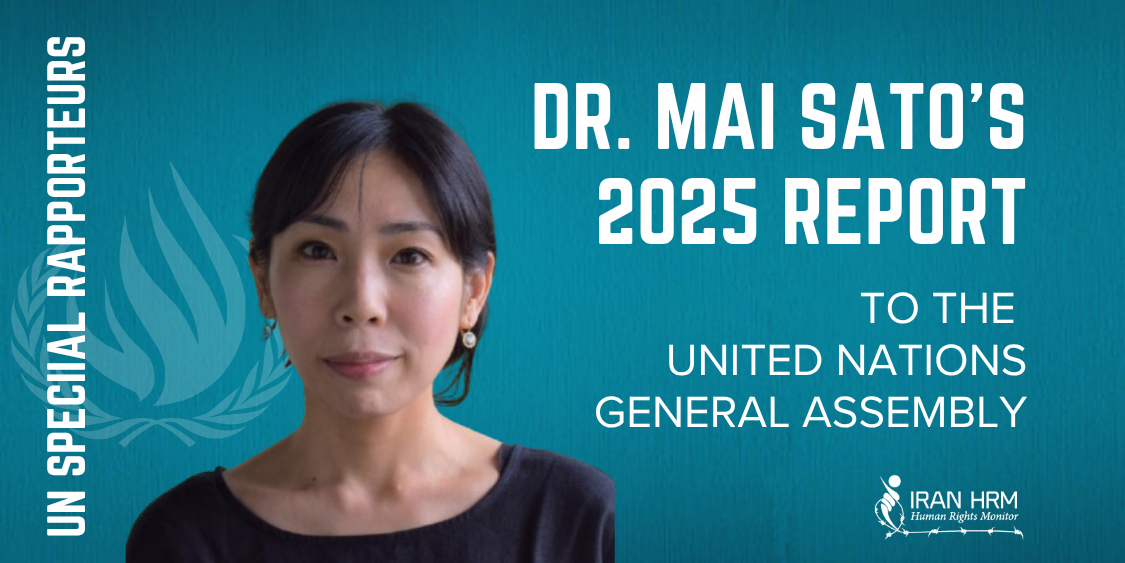
In her report to the UN General Assembly, A/80/349, UN Special Rapporteur on the situation of human rights in Iran Mai Sato documents a deep deterioration in the country’s human rights situation between January and July 2025. She warns that, beyond the immediate crisis, Iranian authorities continue to enforce a broader pattern of systematic repression, including executions, arbitrary detention, discrimination against minorities, and restrictions on fundamental freedoms.

A central concern is Iran’s escalating use of the death penalty. The report identifies more than 700 executions during the reporting period—an average of three to four executions per day. Only 8 percent were acknowledged by official sources. The executions included at least 98 Baloch, 42 Kurds, 8 Arabs and 45 Afghan nationals, highlighting the disproportionate impact of capital punishment on marginalized communities.
The Special Rapporteur also raises serious concerns over fair-trial violations, forced confessions and the lack of transparency surrounding executions. She notes that allegations of procedural violations have been raised in every criminal case reaching her mandate and states that Iran’s application of the death penalty is inconsistent with its obligations under the International Covenant on Civil and Political Rights.
The report further documents deaths in custody, denial of medical care, torture and ill-treatment of prisoners, as well as repression of lawyers, journalists, human rights defenders and their families. It highlights the persecution of ethnic and religious minorities and reports killings of Kurdish border couriers and Baloch fuel porters.
Sato concludes that Iranian authorities must take concrete steps to halt these violations. Her recommendations include establishing a moratorium on the death penalty with a view to its complete abolition, guaranteeing fair-trial rights and access to lawyers, excluding torture-tainted confessions, protecting prisoners from ill-treatment, releasing those detained for exercising fundamental rights, and ending discrimination against ethnic and religious minorities.
The report underscores that the human rights crisis in Iran is not limited to isolated cases but reflects persistent and systemic patterns of state repression requiring transparency, accountability and meaningful institutional change.
A/80/349: Situation of human rights in the Islamic Republic of Iran – Report of the Special Rapporteur on the situation of human rights in the Islamic Republic of Iran
Published 26 August 2025
Summary
The present report builds on the Special Rapporteur’s previous report (A/HRC/58/62), with a focus on human rights developments in the Islamic Republic of Iran from 1 January to 31 July 2025.
Versions
See available official languages
Farsi/Persian: PDF