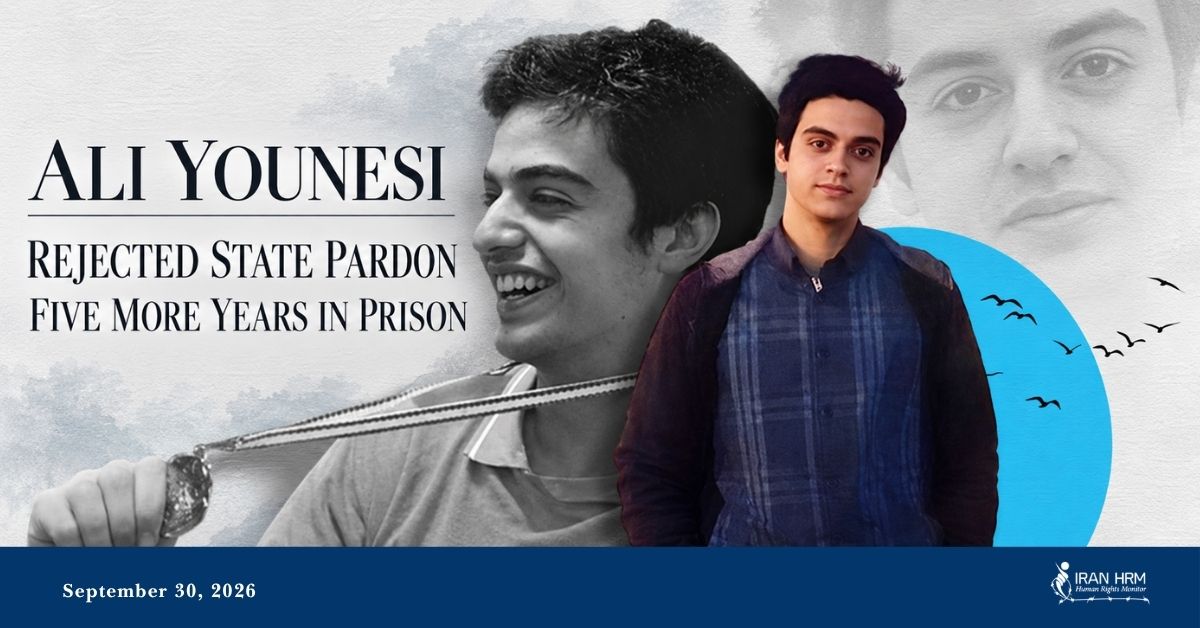
“I have never requested a pardon and never will. Freedom is a stolen right; we do not beg for a stolen right. We fight to reclaim it.”
Ali Younesi wrote these words in a letter from Qezel Hesar Prison. On 11 May 2026, he had been informed that the remaining seven months of his sentence were covered by a pardon announced for the anniversary of the 1979 revolution. Referring to six former fellow prisoners who had been executed, he replied: “They did not bargain for their lives; shame on me if I bargain for my freedom.” Rather than accept the designation of “pardon”, Younesi insisted that freedom was his right.

Now, as that period of imprisonment nears its end, an appeals court has upheld a further five-year prison sentence against him. The news came at the start of the academic year, when Younesi remained separated from university for a seventh consecutive year. Read the report on the appeal decision.
A student whose future took a different course
Younesi is a computer engineering student at Sharif University of Technology. While at secondary school, he won silver and gold medals in Iran’s national astronomy olympiad. In 2018, he was a member of the team that won a gold medal at the International Olympiad on Astronomy and Astrophysics in China. Amirhossein Moradi, a physics student at the same university and an astronomy olympiad medallist, was arrested alongside him. These achievements do not define either man in full, but they show the course of study and the formative years of their lives that the arrests interrupted. Read the account of their academic backgrounds.
Arrest, solitary confinement and grave charges
Ali Younesi and Amirhossein Moradi were arrested on 10 April 2020. According to Ali’s brother, officers beat him during the arrest, leaving visible injuries to his head and face. Amnesty International and a letter from United Nations human rights experts to the Iranian government described the students’ prolonged detention in Ward 209 of Evin Prison, approximately 60 days of solitary confinement at the outset, allegations of beatings and their lack of access to a lawyer during the first 13 months. The UN experts presented these matters as information received and grounds for concern, not as findings of an independent court.
In May 2020, the then judiciary spokesperson accused the two students of links to opposition groups and possession of explosives; their families rejected the allegations. The charge of efsad-e fel-arz (“corruption on earth”), which could have carried the death penalty, was subsequently raised in the proceedings. In 2022, a Revolutionary Court sentenced each student to a total of 16 years in prison. Amnesty International reported that the sentences followed an unfair trial and that both students retracted the “confessions” used against them, saying they had been obtained under torture.
The days when his family did not know where he was
Younesi’s prison experience did not end with the first sentence. On 18 June 2025, he was taken from Ward 4 of Evin Prison to an unknown location. His family did not know where he was being held, and his lawyer had been unable to obtain an answer about his whereabouts. This period of uncertainty occurred during the war and before the 23 June attack on Evin Prison, which heightened prisoners’ families’ fears. On 30 June, after approximately twelve days without news, Younesi briefly called his mother and told her he was being held at Greater Tehran Prison. The Associated Press also spoke to his brother, Reza Younesi, about the transfer and the family’s concerns.
His father, Mir-Yousef Younesi, was also imprisoned. For the family, the loss of contact with Ali was more than a missed telephone call: they were worried about two imprisoned family members at once. Ali was later transferred to Qezel Hesar, the prison from which he wrote his letter rejecting the “pardon”.
Appeals that went unanswered
Calls for Younesi’s and Moradi’s release were made repeatedly during their imprisonment. In a letter dated 18 January 2022, Nobel laureates and academics asked the UN Secretary-General and the High Commissioner for Human Rights to work for their immediate release. The letter also referred to an earlier appeal by 174 professors and department heads at Sharif University.
Amnesty International likewise called for their release. In a letter dated 3 May 2022, UN experts asked the Iranian government to explain the legal and factual basis of the convictions, the evidence used and the steps taken to investigate allegations of ill-treatment and forced confessions. They expressed “serious concern” about charges they described as unsubstantiated and about the judicial process.
Five more years as the previous sentence nears its end
Following further judicial proceedings, the enforceable term in Younesi’s and Moradi’s initial case was reduced to six years and eight months. It was expected to end in December 2026. Yet in August 2025, Branch 29 of the Tehran Revolutionary Court sentenced Younesi to five years in prison in a new case on the alleged charge of “endorsing and strengthening the Israeli regime”, designating Kerman Prison as the place where the sentence would be served. In a separate case, Younesi and Moradi each received a 15-month sentence on a charge of “propaganda activity against the system”. The five-year sentence has now been upheld on appeal. The full text of the judgment and the evidence on which it rests have not been made public. Read the account of the new sentences.
In his letter, Younesi asked: “Are we the ones who should forgive, or are you?” That question now stands beside a legal one: what conduct and evidence led a court to impose another five years of imprisonment just before his previous sentence was due to end? Publication of a reasoned judgment and clarification of how his defence rights were respected would be a first step towards answering it.
Rights violated and rights at risk in this case
Younesi’s detention cannot be assessed solely by counting the years of his sentence. Reports of beatings during arrest, approximately 60 days of initial solitary confinement, the absence of access to a lawyer during the first 13 months, and allegations that a confession was obtained under pressure each raise a separate question about his treatment and the fairness of the proceedings. Amnesty International reported that Younesi and Moradi retracted the confessions attributed to them in court and said the statements had been obtained under torture. In their letter of 3 May 2022, UN experts expressed “serious concern” about these allegations and the lengthy sentences. They asked the government to provide the evidence used to convict the students and the outcome of any investigation into ill-treatment and forced confessions.
Under Article 9 of the International Covenant on Civil and Political Rights, no one may be arbitrarily deprived of liberty. Article 10 requires humane treatment of people deprived of their liberty, while Article 14 guarantees a fair trial, the presumption of innocence and a genuine opportunity to present a defence. Article 35 of Iran’s Constitution recognises the right to legal representation, and Article 37 recognises the presumption of innocence. Referring to these provisions does not amount to endorsing every law applied in the case. The question is whether even these guarantees were respected in practice.
Younesi’s transfer to an unknown location in June 2025, and the days during which his family and lawyer had no information about him, also raise serious concerns about his security and his contact with the outside world. The full judgment and evidence in the new five-year case have not been published. It is therefore not yet possible to reach a definitive conclusion about every aspect of those proceedings. The judiciary must, however, explain what conduct and evidence underpin the new charge, what access Younesi and his lawyer had to the case file, and how the appeals court addressed their arguments.
A call for Ali Younesi’s release
Years ago, Sharif University professors, Nobel laureates, academics and human rights organisations called for the release of Younesi and Moradi. The new judgment shows why those appeals remain urgent. Amnesty International has described the two students as prisoners of conscience and called for their immediate and unconditional release.
We, too, call for the immediate and unconditional release of Ali Younesi and Amirhossein Moradi. Until they are freed, the authorities must ensure regular access to their families and lawyers, protect their health and safety in prison, and independently investigate allegations of ill-treatment and forced confessions. They must also publish the full, reasoned judgments in the new cases and the information needed to assess the proceedings publicly. Younesi wrote in his letter: “Freedom is a stolen right.” The answer to that letter should not be another five years in prison.