Introduction
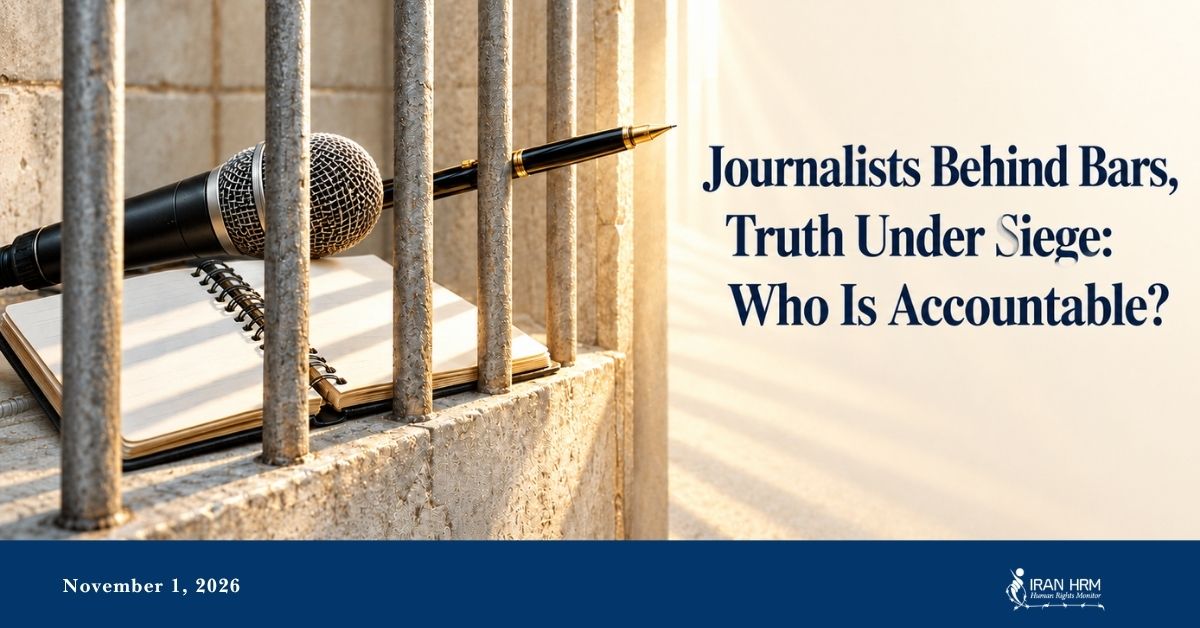
On 18 December 2013, the United Nations General Assembly adopted Resolution 68/163, proclaiming 2 November the International Day to End Impunity for Crimes against Journalists. The date commemorates Ghislaine Dupont and Claude Verlon, two French journalists killed in Mali on 2 November that year. The observance seeks to draw global attention to crimes against journalists and demand effective investigations that establish the truth, hold those who commit and order violations accountable, and secure justice and redress for victims.

In Iran under clerical rule, intimidation, arrest, prosecution, confiscation of equipment and professional bans have become instruments for suppressing freedom of expression and preventing the exposure of human rights violations. This policy targets journalists while depriving the public of access to independent information. The prosecution of Niloofar Hamedi and Elaheh Mohammadi following their reporting on Mahsa Amini, the death of Baktash Abtin after reported delays in medical care, and the execution of Ruhollah Zam in 2020 illustrate different dimensions of this repression. The consequences of reporting and expressing dissent range from threats and imprisonment to the risk of losing one’s life.
Covering January 2022 through the end of October 2026, this report is intended for United Nations mechanisms, the Independent International Fact-Finding Mission on Iran and human rights organisations. It documents violations of journalists’ rights, examines the role of the institutions involved, and calls for independent investigations, accountability and reparations for victims.
The Scale and Methods of Press Repression in Iran
An initial list compiled by the Iran Human Rights Center recorded the summons or arrest of at least 20 journalists and media workers during the first days of the 2022 protests. They included Marzieh Talaei, Ali Khatibzadeh, Khosro Kordpour and Masoud Kordpour in Saqqez; Batoul Balaei and Samira Alinejad in Sirjan; Mojtaba Rahimi in Qazvin; and Mehrnoush Tafian in Ahvaz. In Sirjan, the two journalists were detained after being summoned for questioning. Rahimi was arrested at home after reporting on protesters.
The initial list also included Alireza Khoshbakht, Rouhollah Nakhaei, Fatemeh Rajabi, Hamed Shafiei, Ahmad Halabisaz, Farshid Ghorbanpour and Alireza Jabbari Darestani. It records an early phase of the crackdown and does not establish the individuals’ current status.
By 22 October 2023, the Committee to Protect Journalists (CPJ) had documented the arrest of at least 95 journalists following the protests. Its prison census of 1 December 2022 recorded 62 journalists, including 24 women, behind bars in Iran—the highest number among the countries surveyed. Twenty-two of those women had been arrested after the protests began. The first figure is a cumulative count of journalists arrested; the second is a snapshot of those imprisoned on a specific date.
Internet disruptions and the blocking of social media simultaneously restricted the transmission of news and contact with witnesses. In 2023, the UN Human Rights Committee expressed concern about these restrictions and the prosecution of journalists. The detention of local reporters and disruption of communications impeded visual documentation, independent verification and scrutiny of official accounts.
On 24 March 2026, the International Federation of Journalists (IFJ) identified seven imprisoned journalists. They included Mohammad Parsi, editor-in-chief of Kando magazine, who was detained after being summoned to the Culture and Media Prosecutor’s Office; Somayeh Heydari and Pedram Alamdari of Yul magazine in Tabriz; and Muslim Zarei in Kermanshah. The IFJ condemned threats by judicial and intelligence bodies and restrictions on reporting during the internet blackout. Its figure referred to that point in time, rather than all arrests during the year.
Selected Cases of Journalists Detained and Prosecuted
Niloofar Hamedi and Elaheh Mohammadi
Hamedi, a reporter for Shargh, covered Jina Mahsa Amini’s hospitalisation at Tehran’s Kasra Hospital. Mohammadi, a reporter for Ham-Mihan, covered her funeral in Saqqez. Hamedi was arrested on 22 September 2022 (31 Shahrivar 1401), and Mohammadi on 29 September 2022 (7 Mehr 1401).
On 22 October 2023 (30 Mehr 1402), aggregate prison sentences of 13 years for Hamedi and 12 years for Mohammadi were announced. They received seven and six years respectively for “collaboration with the hostile government of the United States”, with each receiving a further five years for “assembly and collusion against national security” and one year for “propaganda against the system”. These figures represent the combined sentences imposed, rather than the terms to be served in full. CPJ condemned the convictions; its then regional coordinator, Sherif Mansour, described them as evidence of the criminalisation of journalism.
Both were released on bail on 14 January 2024 (24 Dey 1402). On appeal, they were cleared of collaborating with a hostile government, but each still faced an enforceable five-year prison term. Their pardons were announced on 11 February 2025 (23 Bahman 1403).
Yalda Moaiery
The photojournalist was arrested by riot police on 19 September 2022 while covering protests on Hejab Street in Tehran. She subsequently reported that she had been beaten and sexually assaulted during her arrest. Her father, Gholamreza Moaiery, reported that she was transferred to Evin Prison on 14 October and placed in solitary confinement in Ward 2A, under the supervision of the Islamic Revolutionary Guard Corps (IRGC) intelligence apparatus.
On 3 February 2026, IRGC officers raided her Tehran home and confiscated her phone, computer and cameras. In August, a 15-year prison sentence imposed in absentia by Branch 29 of the Revolutionary Court was announced. The case concerned the publication of photographs, interviews and contact with media outlets designated “hostile” by the authorities. Moaiery denied the charges. Front Line Defenders also reported bans on media and political activities, a permanent ban on public service employment, and confiscation of equipment. It linked her conviction to her legitimate, peaceful activities. The IFJ described the sentence as disproportionate and the charges as baseless.
Reza Valizadeh
The Iranian-American journalist returned to Iran in February 2024. Ministry of Intelligence and IRGC agents detained and questioned him on arrival. Following his initial release, repeated summons continued, and he was arrested again in Tehran in September.
In December 2024, Judge Iman Afshari, presiding over Branch 26 of the Tehran Revolutionary Court, sentenced him to ten years in prison for “collaboration with the hostile government of the United States”. According to information documented by CPJ, the hearings on 16 and 20 November lasted approximately half an hour each, and his lawyer, Mohammad Aghasi, was not afforded an effective opportunity to defend him.
Following Valizadeh’s temporary transfer from Evin to Fashafouyeh Prison in 2025, his brother, Mohammadreza Valizadeh, reported overcrowding, polluted water, poor sanitation, shortages of medication, and exposure to smoke and dust. He said these conditions had aggravated his brother’s chronic asthma. In June 2026, CPJ again raised concerns about his medical care after an audio recording from Evin became public. A request for comment from Iran’s UN mission went unanswered. No publicly available outcome of an independent investigation into the reported restrictions on his defence and medical care was found in the materials reviewed.
Baktash Abtin
The poet, filmmaker and member of the Iranian Writers’ Association died on 8 January 2022 (18 Dey 1400) after contracting COVID-19 while serving a prison sentence. A communication by UN experts recorded reports that, after developing symptoms in December 2021, he was denied immediate medical care for four days. On 8 December, he was transferred to hospital in handcuffs and leg restraints without his family being informed; they remained unaware of his condition for two days. After his condition deteriorated further, he was granted medical furlough for transfer to a hospital outside the prison system. He was placed in an induced coma on 1 January and died a week later.
The Prisons Organization cited visits to the prison clinic, prescribed medication, testing and hospital transfer in its account. UN experts expressed concern about delays in treatment, his being shackled to a hospital bed, and inconsistencies in the official account. On 1 March 2022, UNESCO condemned his death and stated that reported delays in access to medical care may have contributed to it.
Vida Rabbani
The freelance journalist was conditionally released in April 2025 after imprisonment connected to the 2022 protests. She was arrested again on 31 January 2026 after signing a statement supporting the protests. Her lawyer, Hassan Asadi Zeydabadi, stated that she was severely beaten at the Sari Intelligence Detention Center on 5 February for refusing to wear the compulsory hijab. He said the bruising had been documented and a formal complaint would be filed. She was transferred to Tonekabon Prison the following day.
Her husband, Hamidreza Amiri, reported seeing extensive bruising, including on her hands, during a visit conducted through a glass partition. Rabbani went on hunger strike to protest her detention outside her city of residence and was released on bail on 17 February. Her lawyer’s account and her husband’s observations support the allegation of ill-treatment. However, it remains unclear whether the announced complaint was filed, how it was handled, what medical examinations established, or whether steps were taken to identify the officers involved.
Artin Ghazanfari and Omid Faraghat
On 28 October 2026, CPJ reported that Ghazanfari had received aggregate sentences totalling 26 years, while Faraghat had been sentenced to ten years and one day. It called for their convictions to be overturned and for their release, warning that legislation intensifying penalties for espionage was being used to criminalise routine media activities.
Ghazanfari, a photojournalist, was convicted by Branch 15 of the Tehran Revolutionary Court. A source familiar with the case told CPJ that 20 years of the aggregate sentence had been imposed under the legislation intensifying espionage penalties. The source also reported that, despite recommendations by prison doctors, his transfer for specialist treatment had not been authorised. The 26-year figure is the sum of the announced sentences; the term to be served is not clear from the materials reviewed.
Faraghat was arrested on 29 June 2026 after responding to a telephone summons and appearing at the Security Police Department. Branch 2 of the Karaj Revolutionary Court sentenced him to ten years and one day in prison and permanently barred him from government and public-sector employment for “media and propaganda activities through producing content and publishing false news online contrary to national security”. CPJ requested comment on the sentences and Ghazanfari’s medical condition but had received no response by publication.
Institutional Responsibility and International Responses
The cases reviewed identify the involvement of security agencies, Revolutionary Courts and prison authorities in arrest, interrogation, sentencing and detention conditions. In Moaiery’s case, riot police, IRGC Ward 2A and Branch 29 of the Tehran Revolutionary Court appear at different stages; in Valizadeh’s case, the Ministry of Intelligence, the IRGC and Branch 26 of the Revolutionary Court are involved. Independent investigations must examine arrest orders, the basis of charges, access to a defence, officers’ conduct and medical decisions, establishing responsibility on the evidence for those who committed or ordered violations and those exercising supervisory authority.
The Human Rights Council and the High Commissioner’s Office: On 24 November 2022, the Human Rights Council adopted Resolution S-35/1, condemning the crackdown on protests and establishing the Independent International Fact-Finding Mission on Iran. The Office of the UN High Commissioner for Human Rights has also called for the release of people detained for peacefully exercising fundamental rights. In 2023, the UN Human Rights Committee expressed concern about the imprisonment of approximately 100 journalists following the protests, prosecutions of journalists, internet disruptions and social media restrictions. It also raised the execution of Ruhollah Zam.
Special Rapporteurs and the Fact-Finding Mission: Reports and communications by independent UN experts have documented security-related prosecutions of journalists and pressure on Iranian journalists working abroad. In February 2024, the Fact-Finding Mission documented the summoning, threatening, detention and prosecution of journalists’ family members to influence their reporting, alongside serious threats to journalists’ lives and online harassment, particularly targeting women. It also examined the detention and prosecution of Hamedi and Mohammadi in the context of action against those reporting on Jina Mahsa Amini’s fate.
On 13 September 2024, the Mission stated that it was unaware of any meaningful or effective domestic criminal investigations into high-ranking officials for violations against women and girls in connection with the “Woman, Life, Freedom” protests. It found that investigations announced by the authorities, including the “Special Committee to investigate the 2022 unrest”, fell short of international standards, and emphasised victims’ lack of access to truth, justice and reparations. Its findings that certain acts constituted crimes against humanity concern the broader crackdown on protests. Whether that legal characterisation applies to an individual case requires assessment of the relevant elements in that case.
The Working Group on Arbitrary Detention: Opinion No. 46/2022 concerning Arash Ganji, Keyvan Bajan, Baktash Abtin and Reza Khandan Mahabadi, and Opinion No. 15/2025 concerning Jina Modares Gorji, provide a specific documentary basis for follow-up on arbitrary detention and violations of fundamental rights. The legal basis for deprivation of liberty, freedom of expression, fair trial guarantees and discrimination are among the issues examined. Implementation of the Working Group’s recommendations, including reparations, must be pursued in follow-up to these cases.
Human rights organisations and journalists’ associations: In September 2024, Amnesty International reported a lack of independent, effective investigations into serious protest-related violations and pressure on families seeking justice. On 24 March 2026, the IFJ called for imprisoned journalists to be released and their safety guaranteed. Its General Secretary, Anthony Bellanger, stressed that imprisoning journalists during a crisis deprives the public of credible information. On 3 March 2026, CPJ also called for their immediate and unconditional release, warning of risks to their safety amid escalating hostilities.
Human Rights Assessment and Calls for Action
The International Covenant on Civil and Political Rights provides the legal framework for this assessment: Article 19 protects freedom of expression and the dissemination of information; Articles 9 and 14 prohibit arbitrary detention and guarantee fair trial rights; Articles 6 and 7 protect the right to life and prohibit torture; and Article 2(3) requires access to an effective remedy, including where violations are committed by officials. In General Comment No. 34, the Human Rights Committee stated that attacks on individuals for exercising freedom of expression are incompatible with Article 19, and called for investigation, prosecution and redress. Invoking “national security” does not, in itself, justify punishing journalism: restrictions must meet the requirements of legality, necessity and proportionality.
In the domestic cases reviewed, no publicly available outcome of an independent investigation into the reported ill-treatment, delayed medical care or contested detentions was found. This conclusion is confined to the public materials examined. The absence of a public outcome does not establish that no judicial steps have been taken; nevertheless, the authorities must identify the investigating body, the measures taken, the outcome and the victim’s avenues for challenging the decision. Release, pardon or completion of a sentence does not substitute for accountability and reparations.
Proceedings must enable victims and their legal representatives to participate and obtain information about the findings of investigations.
This report calls on United Nations mechanisms, human rights organisations and journalists’ associations to pursue the following measures:
- Seek specific responses: The High Commissioner’s Office, the Special Rapporteur on Iran and the Special Rapporteurs on freedom of expression, torture and extrajudicial executions should, within their respective mandates, seek specific answers on the legal basis for detention, access to counsel, detention conditions, medical care and the handling of complaints.
- Preserve evidence and investigate responsibility: The Fact-Finding Mission, within its mandate, and other competent bodies should preserve judicial and medical records, testimony, photographs of injuries, transfer records and orders, and examine direct responsibility, the issuing of orders and the role of supervisory authorities.
- Secure release, medical care and protection: Demand the immediate and unconditional release of individuals imprisoned solely for peaceful media activities, an end to their prosecution and immediate access to specialist medical care. Protect families, lawyers and witnesses against reprisals.
- Investigate transnational threats: States hosting Iranian journalists should investigate threats extending across borders, including funding sources, intermediaries and those who may have ordered the acts.
- Pursue proceedings before competent courts: States should examine avenues for investigating and prosecuting international crimes, including universal jurisdiction where the applicable legal requirements are met. The Fact-Finding Mission also advocated this avenue in September 2024.
- Provide effective reparations: Depending on the case, reparations should include restoration of professional rights, return of equipment and documents, removal of unjustified restrictions, compensation, medical care and rehabilitation. Human rights bodies should monitor implementation and outcomes.
The observance of 2 November must translate into demands for action on specific cases. Accountability requires establishing the truth, independently investigating responsibility and securing justice and redress for victims. International support should be measured by sustained efforts to achieve these outcomes.
The annexed tables present the cases discussed in this report alongside additional examples, outlining the legal status and documentation considerations for each case.
1 Detention and Prosecution Cases from 2022 to 2026
| Name | Media affiliation or field | Date and location | Charges or action taken | Status and documentation notes |
| Niloofar Hamedi | Shargh newspaper; social affairs reporter | 22 September 2022; Tehran | Security-related charges; initial aggregate sentence of 13 years; conviction for collaboration with a hostile state overturned on appeal. | Released on bail on 14 January 2024; pardon announced on 11 February 2025; case addressed in the Fact-Finding Mission’s report. |
| Elaheh Mohammadi | Ham-Mihan newspaper; social affairs reporter | 29 September 2022; Tehran; reported on the funeral in Saqqez | Security-related charges; initial aggregate sentence of 12 years; conviction for collaboration with a hostile state overturned on appeal. | Released on bail on 14 January 2024; pardon announced on 11 February 2025; case addressed in the Fact-Finding Mission’s report. |
| Jina Modares Gorji | Journalist and women’s rights activist | Arrests linked to the 2022 protests; Sanandaj; continued prosecution during the reporting period | “Forming an illegal group” and “propaganda against the state”; lengthy prison sentence. | Subject of Opinion No. 15/2025 of the UN Working Group on Arbitrary Detention (WGAD); case details and latest status require further verification. |
| Atena Farghadani | Cartoonist and satirical artist | 13 April 2024; Tehran | Initial six-year sentence for “insulting religious sanctities” and “propaganda against the state”; ruling revised on appeal. | Released on 10 December 2024; case documented by the Committee to Protect Journalists (CPJ) and PEN. |
| Reza Khandan Mahabadi | Writer and member of the Iranian Writers’ Association | Continued imprisonment and consequences of the case during the reporting period | “Assembly and collusion” and “propaganda against the state” in connection with published material. | Correct name in WGAD Opinion No. 46/2022: Reza Khandan Mahabadi. The opinion concerns four writers. |
| Keyvan Bajan | Journalist and member of the Iranian Writers’ Association | Imprisonment and prosecution during the reporting period; no assertion of uninterrupted imprisonment through 2024 | Security-related charges arising from published articles and books. | Named in WGAD Opinion No. 46/2022; latest status must be established separately. |
| Vida Rabbani | Freelance journalist and analyst | September 2022; rearrested on 31 January 2026; held in Sari and Tonekabon during the latest detention | “Assembly and collusion against national security” and “insulting religious sanctities.” | Released on bail on 17 February 2026; her lawyer and husband reported that she had been beaten; the outcome of the complaint is unclear. |
| Aria Jafari | Photojournalist with the Iranian Students’ News Agency (ISNA) | September 2022; Isfahan; reports differ on the precise date | Detention linked to coverage of protests; details of charges and sentence are not specified in the supplied material. | Case documented by CPJ; the allegation of beating and the reference to Reporters Without Borders (RSF) in the original text require source verification. |
| Cecilia Sala | Italian journalist; Il Foglio and Chora Media | 19 December 2024 to 8 January 2025; Tehran | Detained; details of the charges had not been clearly disclosed. | Released on 8 January 2025; CPJ, RSF and the Italian National Press Federation jointly called for her release. |
2 Historical Cases and Deaths During Imprisonment
| Name | Role and media affiliation | Year or date | Nature of the incident | Accountability and documentation notes |
| Ebrahim Zalzadeh | Director of Me’yar magazine and publisher | Disappeared in February 1997; body identified in March 1997 | Disappearance and killing by stabbing. | Case documented by CPJ; the supplied material does not clarify whether those who ordered the killing were investigated or held accountable. |
| Pirouz Davani | Journalist, analyst and magazine director | 1998 (1377 SH) | Disappearance; reports of killing and involvement of security agents. | His body has not been found; claims that the judicial case was closed and allegations of responsibility require specific documentary support. |
| Majid Sharif | Writer and journalist with Iran-e Farda | 1998 (1377 SH) | Suspicious death in the context of the serial killings; alleged injection of a toxic substance. | The initial account attributed his death to a heart attack; the method of killing and individual responsibility must be attributed to specific evidence. |
| Zahra Kazemi | Iranian Canadian photojournalist | 2003 (1382 SH) | Death following detention in Evin Prison; reports of beating and head injury. | Death-in-custody case; no unqualified claim of “complete impunity” is made without examining the judicial proceedings. |
| Yaghoob Mehrnahad | Journalist and blogger in Sistan and Baluchestan | 2008 (1387 SH) | Executed on the security-related charge of moharebeh (“enmity against God”). | Concerns regarding a fair trial; the claim that he was the “first blogger executed” requires an independent source. |
| Sattar Beheshti | Blogger and independent journalist | 2012 (1391 SH) | Death in the custody of the cyber police (FATA); reports of torture and beating. | One officer was convicted in 2014; CPJ reported a sentence of three years’ imprisonment, two years’ internal exile and 74 lashes. Accountability for those who gave orders remains unclear. |
| Ruhollah Zam | Director of the Amad News channel | 2020 (1399 SH) | Abducted from Iraq, transferred to Iran and executed pursuant to a Revolutionary Court judgment. | Execution pursuant to a Revolutionary Court judgment; internationally condemned and referenced in the UN Human Rights Committee’s assessment. |
| Baktash Abtin | Journalist, poet and member of the Iranian Writers’ Association | 8 January 2022 (18 Dey 1400 SH) | Died in hospital after contracting COVID-19 while imprisoned; reported delays in treatment. | UNESCO statement of 1 March 2022; WGAD Opinion No. 46/2022 on arbitrary detention. Whether denial of treatment was intentional, and its causal relationship to his death, require an independent investigation. |
The following cases are recorded separately from repression attributed to the Iranian authorities because the perpetrator and circumstances differ. Their inclusion concerns the protection of media personnel during armed conflict.
3 Media Personnel Killed in the 2025 Military Attack
| Name | Media affiliation or field | Date and location | Charges or action taken | Status and documentation notes |
| Nima Rajabpour | Editor at IRIB’s news channel | Attack on 16 June 2025; death reported on 17 June; Tehran | Killed in an Israeli airstrike on the IRIB building; media personnel killed in armed conflict. | Condemned by UNESCO’s Director-General on 14 July 2025; recorded separately from repression attributed to the Iranian authorities. |
| Masoumeh Azimi | Administrative employee of the Islamic Republic of Iran Broadcasting (IRIB) | Attack on 16 June 2025; death reported on 17 June; Tehran | Killed in an Israeli airstrike on the IRIB building; media personnel killed in armed conflict. | Condemned by UNESCO’s Director-General on 14 July 2025; recorded separately from repression attributed to the Iranian authorities. |
The next two entries retain all names from the original text. They must not be included in verified report statistics until their identities, dates and original sources have been checked.
4 Entries Requiring Further Documentation
| Name | Media affiliation or field | Date and location | Charges or action taken | Status and documentation notes |
| Yaghmay Fatahi | Media activist and journalist | 1404–1405 SH (2025–2027); described as a new wave of repression | “Disseminating falsehoods with intent to disturb public opinion”; coverage of protests. | Identity and the original report require verification; attribution to a specific organization or report was not confirmed in the current review. |
| Cheshmeh Manouchehri | Media activist and independent reporter | Original text: Farvardin 1405 SH / March 2026; exact day unspecified | “Propaganda against the state” in connection with urban affairs reporting. | Identity and the original report require verification; attribution to a specific organization or report was not confirmed in the current review. |
Verification note: Reza Khandan Mahabadi’s name was corrected on the basis of official Opinion A/HRC/WGAD/2022/46. Opinion A/HRC/WGAD/2025/15 concerns Jina Modares Gorji. Atena Farghadani’s arrest date and Cecilia Sala’s release date were checked against CPJ and PEN material. Sources give different dates in September 2022 for Aria Jafari’s arrest. This compilation does not constitute full verification of every entry.