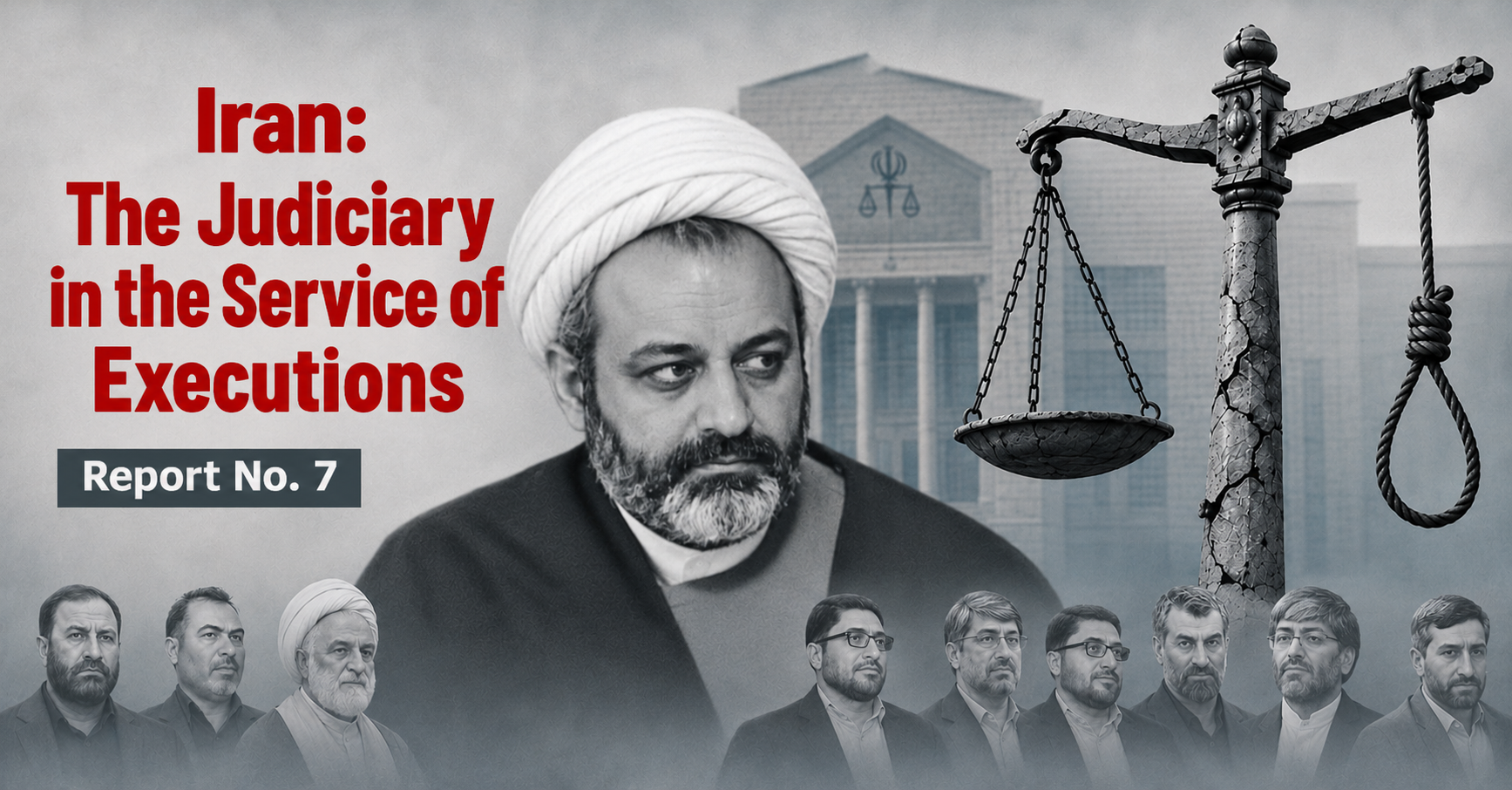
Iran Judiciary in the Service of Executions – Report No. 7
The series Iran: The Judiciary in the Service of Executions examines the role of judicial officials through whom the Iranian authorities enforce imprisonment, repression and execution against protesters and political opponents. Previous reports in this series have demonstrated the importance of examining severe sentences, particularly those imposed following nationwide protests, within the broader operation of the security and judicial institutions and the individual responsibilities of those involved in judicial decision-making.

Gholamreza Akbari-Moghaddam, head of Branch One of the Revolutionary Court in Mashhad, is among the judges whose names have appeared in numerous political and security-related cases involving death sentences, lengthy prison terms, professional disqualifications and other supplementary punishments.
Among these cases, the executions of Ali Hemmati Sistani and Majid Nikandish on 30 September 2026 are of particular significance. Both men were arrested in connection with the January 2026 protests in Mashhad and sentenced to death by the court branch presided over by Akbari-Moghaddam. Earlier, in May 2026, Ebrahim Dolatabadi-Nejad, Mehdi Rasouli and Mohammadreza Miri had also been executed.
These cases raise serious questions about the reliability of evidence, allegations of torture and coerced confessions, the right to an effective defence and compliance with fair trial guarantees in proceedings resulting in capital punishment.
Gholamreza Akbari-Moghaddam: From Neyshabur Prosecutor to the Revolutionary Court in Mashhad
Gholamreza Akbari-Moghaddam assumed the position of Public and Revolutionary Prosecutor of Neyshabur in November 2012. During his tenure, his name was associated with judicial restrictions on cultural activities, including threats of legal action over certain officially authorised concerts.
The precise date of his transfer from the Neyshabur Prosecutor’s Office to Branch One of the Revolutionary Court in Mashhad has not been established through the publicly available records reviewed. However, between 2024 and 2026, he was repeatedly identified as the head of this branch in political and security-related cases.
The branch has issued sentences involving charges such as moharebeh (enmity against God), efsad-e fel-arz (corruption on earth), assembly and collusion against national security, and propaganda against the establishment. Some of these sentences have been carried out, while others, including death sentences, have remained subject to judicial proceedings.
Ali Hemmati Sistani: Executed Following the January 2026 Protests in Mashhad
Ali Hemmati Sistani, 33, son of Hassan, was married and the father of two children. He was among those arrested in connection with the protests of 8–9 January 2026 in the Tabarsi district of Mashhad.
Published reports differ regarding the precise date of his arrest. Following his detention, he was held at Mashhad Central Prison, commonly known as Vakilabad Prison.
The Iranian judiciary accused Hemmati and Majid Nikandish of involvement in violent acts, attacks against members of the Basij militia, destruction of property and setting fire to a shop. Judicial authorities also alleged that the incidents in the Tabarsi district were connected to the deaths of four government security personnel.
However, publicly available information leaves unresolved questions about the direct connection between the acts attributed to the two prisoners and the deaths of those four individuals. In a televised confession broadcast by state media, Hemmati stated that two Basij members who had been injured were still alive when the ambulance arrived.
The full forensic reports, evidence establishing the causes of death and complete judicial rulings have not been made publicly available. Consequently, independent assessment of the alleged causal connection between the defendants’ actions and the deaths of security personnel remains limited.
In May 2026, Branch One of the Revolutionary Court in Mashhad, presided over by Akbari-Moghaddam, sentenced Hemmati to death on the charge of moharebeh. The sentence was subsequently upheld by Branch 39 of the Supreme Court.
On the morning of Wednesday, 30 September 2026, Ali Hemmati Sistani was executed alongside Majid Nikandish. Human rights reports identified Vakilabad Prison in Mashhad as the location of the executions.
Publicly available information remains limited concerning the number of court hearings, the effectiveness of the defence, the defence lawyer’s access to case files and the evidence relied upon by the judge. Given the irreversible nature of capital punishment, these outstanding questions underscore the need for an independent examination of the judicial proceedings.
Majid Nikandish: Three Months in Solitary Confinement, Allegations of Torture and Execution
Majid Nikandish, 25, son of Mohammad Ebrahim, was from Quchan in Razavi Khorasan Province. Before his arrest, he worked as an automotive body repairer.
He was arrested on 10 January 2026 in connection with protests in Mashhad’s Tabarsi district. His name appeared in the same judicial case as Ali Hemmati Sistani, and both were tried on charges of moharebeh.
According to published reports, Nikandish was held in solitary confinement for approximately three months and subjected to torture and physical coercion during interrogation. Informed sources reported that he was suspended by his arms and suffered a fractured jaw and a dislocated shoulder as a result of the alleged ill-treatment.
It was also reported that his confessions were obtained under pressure and that portions were broadcast by state media after his execution. Independent medical documentation substantiating the reported injuries has not been made publicly available.
On 15 May 2026, Branch One of the Revolutionary Court in Mashhad, presided over by Akbari-Moghaddam, sentenced Nikandish to death. Branch 39 of the Supreme Court subsequently upheld the ruling.
According to the official account, the charges concerned destruction of property, setting fire to a bank and a shop, and attacks against Basij personnel. However, independent information concerning the assessment of evidence, forensic findings and the precise connection between the acts attributed to Nikandish and the deaths of four government security personnel has not been released.
Majid Nikandish was executed on the morning of 30 September 2026.
Beyond the judicial responsibility associated with imposing the death sentence, his case raises a further question: whether the court examined the allegations of torture and coerced confessions and independently assessed the admissibility and reliability of statements obtained during interrogation.
Ebrahim Dolatabadi-Nejad: Executed Six Days After Notification of His Death Sentence
Ebrahim Dolatabadi-Nejad, arrested in connection with the January 2026 protests in Mashhad, was tried before Branch One of the city’s Revolutionary Court, presided over by Gholamreza Akbari-Moghaddam.
On 27 April 2026, he was sentenced to death on the charge of moharebeh, and the ruling was formally communicated to him. Allegations of directing protest activities were also raised against him.
Just six days later, on 3 May 2026, Dolatabadi-Nejad was executed at Vakilabad Prison in Mashhad. The judiciary officially announced the execution on 4 May 2026.
Reports also referred to the confiscation of his property.
The exceptionally short interval between notification of the sentence and its execution raises questions about whether he had a genuine and effective opportunity to appeal, obtain legal assistance and exercise the procedural safeguards required before capital punishment is carried out. The full details of these proceedings remain unclear in the publicly available information reviewed.
Mehdi Rasouli and Mohammadreza Miri: Two Further Executions at Vakilabad Prison
Mehdi Rasouli and Mohammadreza Miri were also executed at Vakilabad Prison in Mashhad on 3 May 2026. Their executions, together with that of Ebrahim Dolatabadi-Nejad, were officially announced on 4 May.
The judiciary accused the two men of involvement in acts connected to the killing of a Basij member during the January 2026 protests.
Reports concerning Mehdi Rasouli alleged torture and the extraction of coerced confessions. However, sufficient independent documentation establishing the details of these allegations is not publicly available.
The available information establishes Akbari-Moghaddam’s direct involvement in issuing Dolatabadi-Nejad’s death sentence more clearly than in the cases of Rasouli and Miri. Accordingly, attributing personal responsibility to him for the issuance of their sentences requires caution in the absence of the relevant judicial rulings.
Two Additional Death Sentences: Hossein Nazari and Mahboubeh Shabani
Hossein Nazari, arrested in connection with the January 2026 protests, was sentenced to death by Branch One of the Revolutionary Court in Mashhad in July 2026. The reported charges included efsad-e fel-arz, alleged links with hostile governments or groups, and assembly and collusion.
Mahboubeh Shabani, 33, was also sentenced to death by the same branch. Her sentence was communicated to her on 26 September 2026. Published accounts referred to allegations involving operational activities in support of Israel, the United States and groups opposed to the Iranian authorities.
The full judicial rulings and sufficient information concerning the final status of appeals in these two cases are not publicly available. The issuance of a death sentence must therefore be distinguished from its final confirmation or execution.
Harsh Prison Sentences Against Academics, Lawyers and Civil Society Activists
The judicial record associated with Akbari-Moghaddam’s court extends beyond capital punishment.
Hassan Bagherinia, a university professor and civil society activist, was sentenced on 3 March 2025 to a total of 10 years and nine months in prison. He also received a two-year teaching ban and a two-year prohibition on leaving the country. Five years of his prison sentence were suspended for five years.
Javad Alikordi, a lawyer, was sentenced to a total of 18 years in prison, permanent disqualification from practising law, two years of internal exile in Saravan and a two-year travel ban.
Tayebeh Nazari Makiabadi, a retired teacher, was sentenced on 13 June 2026 to five years in prison, of which four years were enforceable.
Khosrow Alikordi, a lawyer, also reported receiving a sentence of one year in prison, a two-year ban on practising law and a two-year travel ban.
In the case of Amirreza Pedram, arrested during the January protests, reports differ concerning the total prison term imposed, but consistently identify six years and three months as the enforceable sentence. Allegations of torture and flogging during interrogation have also been reported.
Akbari-Moghaddam’s name has additionally appeared in the case of Vahideh Haghparast, involving a sentence of four years and four months in prison, and in the case of Ali Adinehzadeh, in connection with the confirmation of his continued pre-trial detention.
Together, these cases demonstrate the range of penalties imposed in political and security-related proceedings before Branch One of the Revolutionary Court in Mashhad, extending from lengthy imprisonment to professional disqualification, internal exile and restrictions on freedom of movement.
Judicial Responsibility and International Human Rights Standards
In political and security-related cases, the responsibilities of arresting authorities, interrogators, prosecutors, courts and judicial bodies reviewing sentences must be distinguished.
Allegations of torture or ill-treatment during interrogation cannot be attributed to a judge without evidence. Nevertheless, determining guilt, assessing evidence, examining allegations of coerced confessions and imposing punishment fall within the responsibilities of the court.
Iran is a State party to the International Covenant on Civil and Political Rights (ICCPR). Article 6 restricts the death penalty, in countries that have not abolished it, to the “most serious crimes”. Under the interpretation adopted by the United Nations Human Rights Committee, this restriction concerns offences of extreme gravity involving intentional killing.
Article 14 guarantees the right to a fair trial and an effective defence, while Article 7 prohibits torture and cruel, inhuman or degrading treatment or punishment.
In the cases of Ali Hemmati and Majid Nikandish, independent examination of the alleged connection between their actions and the deaths of security personnel, the reliability of confessions and compliance with defence rights is essential to assessing whether the imposition of capital punishment met international legal standards.
In several other cases before Akbari-Moghaddam’s court, the absence of complete judicial rulings limits the possibility of establishing the precise legal basis for the penalties imposed and the individual responsibility of the presiding judge.
The publicly available information reviewed does not provide sufficient evidence concerning independent investigations or proceedings addressing possible complaints about Akbari-Moghaddam’s judicial conduct in these cases. This lack of information does not, in itself, establish that no investigation has taken place, but it substantially restricts public scrutiny of accountability.
Conclusion: The Cycle of Repression, Expanding Authority and Impunity
The judicial record of Gholamreza Akbari-Moghaddam, ranging from harsh prison sentences imposed on academics, lawyers and civil society activists to death sentences arising from the January 2026 protests, raises an issue extending beyond the responsibility of an individual judge: the continued exercise of judicial authority by officials repeatedly named in cases involving serious human rights concerns, without publicly identifiable, independent mechanisms capable of ensuring accountability for their conduct.
Within such a system, the absence of effective accountability risks perpetuating a dangerous cycle. Officials implicated in human rights violations may not only remain in positions of authority but also acquire greater responsibilities and wider decision-making powers, potentially affecting the liberty and lives of even more individuals. Whether participation in repression is associated with the appointment or promotion of judicial officials should itself be examined through independent international investigations.
Akbari-Moghaddam’s record, particularly the executions of Ali Hemmati Sistani and Majid Nikandish, underscores the need to examine the role of judges and other judicial officials alongside that of security agencies and prison authorities. Accountability for human rights violations must not be confined to those carrying out coercive measures. The judicial chain through which death sentences are imposed, upheld and implemented must also be subject to independent scrutiny.
The United Nations Human Rights Council, the Independent International Fact-Finding Mission on Iran, the Special Rapporteur on the situation of human rights in the Islamic Republic of Iran, and other relevant UN mechanisms are urged to investigate and document the role of judicial officials in the imposition and implementation of death sentences, allegations of torture and coerced confessions, failures to uphold fair trial guarantees, and any possible relationship between participation in repression and advancement to positions of greater governmental authority.
International human rights organisations are likewise called upon to pursue these cases, preserve relevant evidence and establish the chain of individual and institutional responsibility, with a view to ending impunity and creating the conditions for accountability for violations of fundamental human rights.