Executive Summary
An examination of recent human rights data and official state news outlets (Mizan News Agency) from early November 2026 reveals an unprecedented and alarming escalation in state repression, particularly targeting protesters in Iran. This repressive wave is built upon three primary pillars:

- Execution of Political Protesters from January 2026 Protests: The execution of two young protesters in Isfahan, bringing the total number of individuals executed in the joint “Meydan Alikhani” case to nine.
- Issuance and Confirmation of New Death Sentences: The imposition of death sentences against protesters in Kerman and Mashhad, and the confirmation of a capital sentence by the Supreme Court for a protester in Tehran.
- Persecution of Justice-Seeking Families: The continued imprisonment and sentencing of mothers and surviving relatives of executed individuals, aimed at deterring society from seeking justice.
- Widespread Non-Political Executions: The execution of at least 34 prisoners on general criminal charges within an eight-day window (October 21 to October 28, 2026 ), utilized as a mechanism for public intimidation and terror.
Introduction and Legal Framework
The recent surge in capital sentences and executions in Iran reflects a targeted judicial-security response by the government to the nationwide January 2026 protests. Analyzing the context in which these sentences are handed down and carried out underscores an escalating pattern of systematic repression—a framework wherein the judiciary functions not as an independent body for justice, but as an operational extension of security agencies to intensify social control.
This repressive strategy relies on two concurrent axes:
- Direct Targeting of Protesters and Their Families: Through the accelerated issuance, confirmation, and execution of death sentences in collective cases (such as the Meydan Alikhani case in Isfahan, alongside cases in Mashhad, Kerman, and Tehran), paired with the arbitrary arrest and imprisonment of justice-seeking family members (such as Somayeh Afshar) to suppress public advocacy and documentation.
- Structural Public Intimidation: Utilizing a sweeping wave of non-political executions (at least 34 executions over eight days in late October 2026) to raise the cost of social mobilization and maintain society in a state of terror and paralysis ahead of the protest anniversary.
From an international human rights law perspective, the proceedings across these cases constitute structural violations of the Islamic Republic of Iran’s international obligations, notably under the International Covenant on Civil and Political Rights (ICCPR):
- Right to Life (Article 6): Under international standards, the death penalty—in states that have not yet abolished it—must be strictly limited to the “most serious crimes” (intentional crimes resulting directly in death). The application of vague, overbroad security charges such as “Moharebeh” (enmity against God) and “Efsad-fil-Arz” (corruption on Earth) against street protesters constitutes an arbitrary deprivation of life and a severe violation of Article 6.
- Right to a Fair Trial and Presumption of Innocence (Article 14): Reliance on confessions extracted under severe physical and mental torture, torture of relatives to compel cross-incrimination, denial of access to independent counsel of choice, arbitrary modification of charges during trial sessions, and the broadcast of forced confessions on state television prior to due process deprive trial proceedings of legal legitimacy.
- Prohibition of Torture and Cruel Treatment (Article 7): The arrest and imprisonment of justice-seeking mothers and family members whose children have been executed constitute direct psychological coercion and cruel, inhuman treatment against victim families.
- Violation of Freedom of Expression and Peaceful Assembly (Articles 19 and 21): A significant portion of the cases analyzed in this report stem directly from the nationwide protests of January 2026—protests conducted within the exercise of citizens’ fundamental rights to express opinions, criticize state policies, and engage in public assembly. The imposition of capital punishment, severe criminal sentences, and judicial prosecution against individuals for protest-related activities raises grave concerns regarding the criminalization of freedom of expression and peaceful assembly. Under international law, states are obligated to respect the rights enshrined in Articles 19 and 21 of the ICCPR even during periods of social unrest, applying any restrictions strictly within the parameters of necessity, proportionality, and legality. Executing and sentencing protesters whose cases are tied directly to participation in public demonstrations indicates that the judicial apparatus is being deployed to criminalize dissent and elevate the cost of exercising fundamental rights. This dynamic exerts a severe chilling effect on public discourse and peaceful assembly, deterring citizens from exercising their Covenant-guaranteed rights.
Relying on official documentation and verified human rights data, this report details the dimensions of this repressive wave, examining the cases of protesters sentenced to death, the persecution of justice-seeking families, and the structural role of widespread non-political executions in instilling public intimidation.
The “Meydan Alikhani” Case (Isfahan): Accelerated Executions and International Violations
According to an official report by the Mizan News Agency (the official media outlet of the Judiciary of the Islamic Republic of Iran) dated November 3, 2026, the judiciary executed two young protesters detained during the January 2026 protests in Isfahan: Amirhossein Maleki (19) and Amirhossein Ebrahimi (20, a medical student).
These executions were carried out based on security indictments charging the defendants with “Moharebeh” and “Efsad-fil-Arz”—vague and overbroad titles deployed without evidentiary support meeting fair trial standards, used primarily to criminalize street protesters.
An examination of the judicial proceedings in the Meydan Alikhani case highlights systematic violations of Iran’s international legal obligations under the ICCPR:
- Arbitrary Deprivation of Life (Article 6): Verified human rights documentation demonstrates that Amirhossein Ebrahimi was arrested solely due to being caught in urban traffic near the protest area, subsequently identified through telecommunications tracking. Applying the death penalty for acts that do not meet the threshold of the “most serious crimes” constitutes arbitrary execution.
- Systemic Torture and Fair Trial Violations (Articles 7 and 14): Televised confessions attributed to these defendants were extracted under severe physical and psychological torture and broadcast on state media prior to trial completion. Furthermore, credible reports confirm that interrogators subjected Ebrahimi’s 16-year-old brother to torture and psychological pressure to compel incriminating statements against him, constituting cruel, inhuman, and degrading treatment.
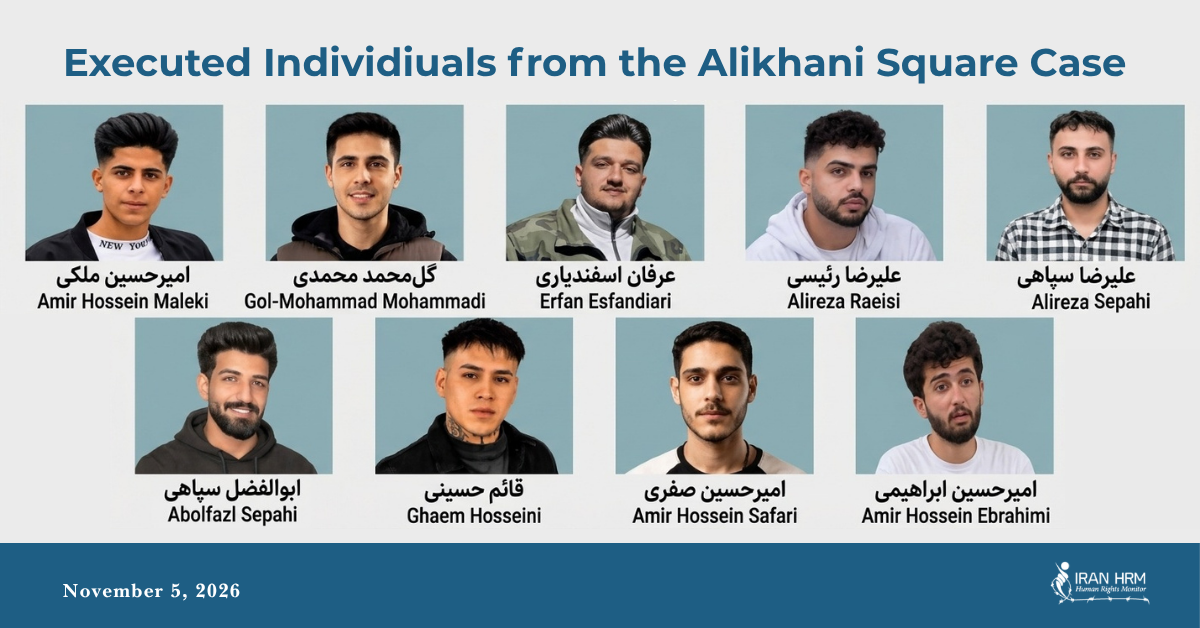
With the execution of these two individuals, the total number of victims executed in the joint 12-defendant Meydan Alikhani case has reached nine:
Executed Defendants in the Meydan Alikhani Case:
- Erfan Esfandiari (Executed: July 19, 2026)
- Gol-Mohammad Mohammadi (Executed: July 19, 2026 )
- Abolfazl Sepahi (Executed: July 28, 2026)
- Amirhossein Safari (Executed: July 28, 2026)
- Ghaem Hosseini (Executed: August 20, 2026)
- Alireza Sepahi (Executed: October 4, 2026 )
- Alireza Raeisi (Executed: October 4, 2026)
- Amirhossein Maleki (Executed: November 3, 2026 )
- Amirhossein Ebrahimi (Executed: November 3, 2026 )
The execution of nine individuals from a single joint case within a span of a few months underscores serious concerns regarding the systematic application of capital punishment within a single legal file and the collective targeting of defendants tied to a specific protest event. The ongoing execution risk facing the three remaining defendants further elevates the likelihood of this pattern being carried out to completion.
Currently, the three remaining defendants in this case—Shervin Bagherian, Ali Dashti, and Abolfazl Ebrahimi—face an imminent risk of execution, requiring immediate and decisive intervention by international human rights mechanisms to stay their sentences.
Persecution of Justice-Seeking Families and the Criminalization of Advocacy: The Case of Somayeh Afshar
Alongside the execution of death sentences, an analysis of the repressive pattern demonstrates new dimensions of severe judicial-security measures against victim families, aimed at severing the chain of justice-seeking and intimidating survivors. The case of Somayeh Afshar, mother of Alireza Sepahi (a protester arrested during the January 2026 demonstrations whose execution was carried out on October 4, 2026), serves as a clear example of this targeted policy.
Ms. Afshar was arrested by security forces in February 2026 (Bahman 1404)—approximately 20 days after her son’s arrest—and was subsequently sentenced to 5 years of discretionary imprisonment by Branch 1 of the Revolutionary Court of Isfahan on charges including “disrupting public order” and “acting against national security.” She is currently serving her sentence in Doulatabad Prison in Isfahan.
The continued imprisonment of this seeking-justice mother constitutes a severe violation of international human rights standards under the International Covenant on Civil and Political Rights (ICCPR):
- Right to Liberty and Security of Person, and Protection Against Arbitrary Arrest (Article 9): The detention and criminal conviction of victims’ parents solely for inquiring about their children’s status or seeking justice constitutes an arbitrary deprivation of liberty, completely lacking legal validity under international standards.
- Prohibition of Torture and Cruel, Inhuman, or Degrading Treatment (Article 7): Imposing a prison sentence on a mother whose child has been executed by the judiciary, while depriving her of the right to mourn, constitutes severe mental torture, cruel treatment, and double punishment inflicted upon victimized families.
- Violation of the Protection of the Family (Article 23): The systematic targeting of survivors of executed protesters represents a direct violation of state obligations to respect and protect the family unit and its members.
The systematic repression of justice-seeking families through prison sentences, preventive detentions, and psychological pressure functions as a strategy to enforce total censorship and prevent the documentation and exposure of human rights violations in execution cases.
The arrest, conviction, and intimidation of parents and relatives of victims solely for seeking justice is not isolated to the case of Somayeh Afshar. In recent years, numerous instances of summonses, detentions, prison sentences, threats, and restrictions targeting families of slain protesters, political prisoners executed, and other victims of human rights violations in Iran have been documented. Within this framework, Somayeh Afshar’s case cannot be viewed as an isolated incident; rather, it reflects a broader, systematic pattern of repression against seeking-justice families designed to halt human rights documentation, silence survivors, and raise the social cost of advocacy.
Furthermore, this pattern raises grave international concerns regarding reprisals against victims and families who engage in advocacy or report violations.
Issuance and Confirmation of New Death Sentences for Protesters in Kerman, Tehran, and Razavi Khorasan Provinces
Documented human rights reports indicate that the judiciary of the Islamic Republic of Iran is accelerating the issuance and confirmation of capital sentences against individuals detained during the nationwide January 2026 protests across various cities. An examination of recent cases in Kerman, Tehran, and Mashhad demonstrates structural violations of Iran’s international obligations at all stages of judicial proceedings:
Kerman: Death Sentence Issued for Shayan Shakibayi
On October 30, 2026, Branch 5 of the Revolutionary Court of Kerman (presided over by Judges Aghayi and Jalali) sentenced Shayan Shakibayi (29) to death. He was arrested on January 8, 2026 at his workplace (an internet gaming center).
- Violation of the Presumption of Innocence and Fair Trial Rights (Articles 7 and 14 of the ICCPR): Prior to the completion of legal proceedings and determination of case facts, Islamic Republic of Iran Broadcasting (IRIB) aired forced confessions attributed to him. Extracting confessions under torture and psychological pressure during initial detention and broadcasting them publicly severely undermines the fundamental presumption of innocence (Article 14, Paragraph 2) and constitutes cruel and inhuman treatment.
- Tehran: Confirmation of Arman Maarefati’s Death Sentence by the Supreme Court
The Supreme Court has confirmed the death sentence of Arman Maarefati (38, from Saqqez and residing in Tehran). Previously sentenced to death by Branch 15 of the Revolutionary Court of Tehran under Judge Abolqasem Salavati, he is currently held in Ward 3, Hall 37 of Ghezel Hesar Prison in Karaj and faces an imminent risk of execution.
- Arbitrary Alteration of Charges and Joint Proceedings: The prosecutor’s representative initially listed his charge as “assembly and collusion.” However, during trial proceedings, the court unilaterally escalated the charge to “participation in operational actions against national security and destruction of property.” Two co-defendants in this joint file (Mehrdad Mohammadinia and Ashkan Maleki) have already been executed. Abruptly altering indictment charges during trial sessions deprives the defendant of effective defense preparation and access to independent counsel, representing an explicit violation of Article 14, Paragraph 3 of the ICCPR.
Mashhad: Three Death Sentences Issued on Charges of “Moharebeh”
Branch 5 of the Revolutionary Court of Mashhad (presided over by Judge Hossein Yazdankhah) sentenced three detained protesters to death on charges of “Moharebeh” (enmity against God). The identity of one defendant, Matin Farniyan (23), has been verified, while the remaining two co-defendants—whose identities are not verified—remain held in Vakilabad Prison in Mashhad.
- Unlawful Application of “Moharebeh” Charges (Article 6 of the ICCPR): Levying broad capital indictments such as “Moharebeh” against street protesters violates the international legal threshold of “most serious crimes” (intentional crimes resulting directly in death), rendering these capital sentences arbitrary deprivations of life.
Parallel Wave of Widespread Non-Political Executions: Capital Punishment as a Structural Instrument of Public Intimidation
Documented data from October 21 to October 28, 2026 reveals an unprecedented surge in the execution of prisoners convicted of general criminal charges across Iran. Within this eight-day window, the judiciary of the Islamic Republic of Iran executed at least 34 prisoners in various facilities.
An assessment of the timing and scale of these widespread executions indicates that the judicial apparatus utilizes capital punishment against non-political prisoners as a structural, complementary strategy to instill general terror, elevate the societal cost of protest, and maintain strict control ahead of protest anniversaries.
This execution wave represents a clear breach of Iran’s international legal commitments:
- Violation of the “Most Serious Crimes” Standard (Article 6 of the ICCPR): Under binding international standards and UN General Assembly resolutions, states that have not yet abolished the death penalty must limit its application strictly to crimes involving intentional killing. Carrying out executions for a broad array of non-political charges constitutes arbitrary deprivation of life.
- Lack of Judicial Transparency and Fair Trial Rights (Article 14 of the ICCPR): A significant portion of these executions is carried out without prior notification to families or legal counsel, lacking transparent judicial review. Proceedings in general criminal cases in Iran are systematically compromised by forced confessions and denial of access to independent defense attorneys.
- Violation of the Right to Life as Collective and Family Punishment: Recent documented cases include the execution of Alireza Afaq (22) in Mashhad Prison, whose two brothers (Javad and Jalal Afaq) were executed in the same facility the previous year. This target pattern inflicts severe structural harm and psychological trauma on surviving family members.
Although these executions do not directly involve political charges, the sharp rise in executions coinciding with intensified crackdowns on protesters and justice-seeking families reflects a deliberate strategy to deploy the death penalty as a broad social deterrent.
Itemized Table of Documented Executions (October 21 – October 28, 2026):
| Execution Date | Count | Names and Locations of Execution |
| October 21, 2026
|
10 | Isfahan: Morteza Jafari, Mobarak Mohammadi, Ghasem Mola-Amini
Ahvaz: Atiyeh Jamei Qezel Hesar (Karaj): Ahmad Baranizadeh and 1 unidentified prisoner Semnan: Mojtaba Gerayi (38) Shiraz: Navid Mehdipour (27), Farshad Jamalabadi, Seyed Borjali Taghizadeh Amirsalari |
| October 25, 2026
|
2 | Shahrekord: Ali Mokhtari
Nishapur: Amirali Eynabadi |
| October 27, 2026
|
15 | Zanjan: Ardashir Karimi, Khalil Gholizadeh
Ilam: Farhad Tavan Karaj: Farshad Ghaderi Rasht: 1 unidentified prisoner Kashan: Davoud Rokhbin Mashhad (5): Habibollah Davoudi (26), Rasoul Eyrek/Brahouyi (67), Habibollah Gholami (24), Alireza Afaq (22), 1 unidentified prisoner Shiraz (5): Ehsan Sobhani (29), Jafar Rostamzadeh Mashhadi, Hashem Memari, Gholamhossein Yari |
| October 28, 2026
|
7 | Qazvin: Faramarz Seyfouri (38), Esmail Moradvand
Semnan: Behnam Moulani (34) Mashhad: Reza Talebi Qezel Hesar (Karaj): Mohammad Tajik, Yaser Shokri Karaj: Amrollah Siri (Hedavand) |
| Total | 34 | Across Iran within an 8-day period |
This high rate of daily executions demonstrates that the state deploys its execution apparatus not as an instrument of justice, but as a mechanism of governance based on fear and preventive repression.
Conclusion and Final Assessment
The evidence presented in this report demonstrates that the Islamic Republic of Iran does not utilize capital punishment merely as a penal sanction but systematically employs it as an instrument within a broader strategy of political repression, silencing justice-seeking demands, and establishing social deterrence. The concurrence of protest-related executions, the issuance of new death sentences, the persistent harassment of victim families, and the nationwide surge in non-political executions provides an alarming picture of the death penalty being used as a mechanism of governance through intimidation—demanding an immediate and decisive response from United Nations human rights mechanisms.