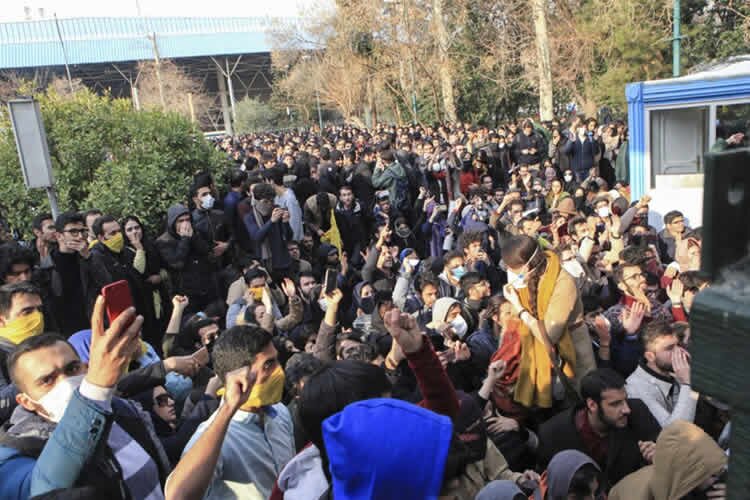
December 2017 through January 2018 saw a mass uprising in Iran that began in the holy city of Mashhad and quickly spread across some 140 cities in the country. Some 30 people were killed in the protests, but officials have still not conducted impartial investigations into their deaths, nor has law enforcement’s excessive use of force to repress protests been addressed.

Demonstrations and protests continue in the country, and since August 2, 2018, authorities have detained more than 50 people during protests in Tehran.
In a statement Human Rights Watch issued on August 31st, the group said that Iranian authorities should drop all charges brought against protesters for peaceful assembly and release those detained on that basis.
Sarah Leah Whitson, Middle East director at Human Rights Watch stated, “The Iranian government is using the authoritarian playbook to respond to protests, criminalize peaceful dissent, and protect security forces from scrutiny.” She added, “Rather than blaming ‘foreign elements’ for protests, Iranian authorities should allow citizens to critique the government through their right to peaceful dissent.”
A new wave of protests against the deteriorating economic conditions and perceptions of government corruption began in July in the city of Esfahan, and expanded to encompass other cities, including Karaj in Alborz province and the capital, Tehran.
A protester identified by social media accounts as Reza Otadi was shot and killed on August 3rd, during protests in Karaj. A special committee to investigate his death, comprised of Revolutionary Guards, police counter intelligence units, and a prosecutor, has been announced by Iranian authorities.
Human Rights Watch said that they were told by informed sources that approximately 50 people were arrested during the August 3rd protests, and they have been detained in Fashafuyeh prison, where they must pay for essentials like water, and where hygiene is nearly non-existent.
An activist who spent a night in detention in the quarantine ward of Fashafuyeh prison, Nader Fotourehchi, posted on Twitter On August 21, regarding the poor conditions of that ward. Fotourehchi tweeted that there is no running water in the prison ward from 4 p.m. to 7 a.m.
Another tweet on August 11, posted by journalist, Mehdi Mahmoudian, said that 15 women were arrested during the August protests were detained at Qarchak prison in Tehran. Sources who asked to remain anonymous stated that when prisoners were taken to the prosecutor’s office, their families saw signs of bruising on their bodies. Mahmoudian tweeted again on August 12th, saying that authorities had found the body of a detainee who had apparently died by suicide in Fashafuyeh prison.
Mostafa Mohebbi, the head of prisons in Tehran province, confirmed the detainee’s suicide on August 18th, claiming the man was not a protestor. Mohebb said that man had been charged with robbery and was addicted to drugs. However, in the cases of two suspicious deaths that happened in January in prisons in Tehran and Arak, authorities made similar claims and declared the causes of death as suicides. As well, authorities even claimed that Seved Kavous Emami, a prominent environmentalist who died under suspicious circumstances in Evin prison on February 9th, also died by suicide, a claim his family vehemently denies.
On August 28th, a video was published on social media that shows families of detainees gathered in front of the Evin prosecutor’s office — they are attempting to gain information about their loved ones.
Detainees charged with national security crimes are restricted from seeing a lawyer during the investigation period, according to Iranian law. In a move that makes obtaining counsel even more difficult for these detainees, last June the judiciary released a list of only 20 lawyers in the province of Tehran, who are permitted to represent detained individuals during investigations into national security charges against them.
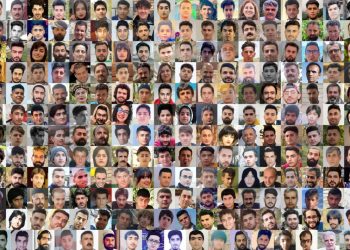
During the waves of ongoing protests across Iran since the December and January uprising, it is estimated that authorities arrested about 4,000 protesters. The Intelligence Ministry authorities also arrested at least 150 students, 17 of whom have been sentenced to prison terms by the courts.
International law guarantees the right to freedom of expression and peaceful assembly, under the International Covenant on Civil and Political Rights (ICCPR), to which Iran is a party. The United Nations Basic Principles on the Use of Force and Firearms by Law Enforcement Officials provides that security forces should apply nonviolent means, such as restraint, before resorting to the use of force. Torture is banned at all times, and evidence obtained by torture or other coercion cannot be used as evidence in a trial.
THE RIGHT TO A FAIR TRIAL IS ALSO REQUIRED BY THE COVENANT, INCLUDING:
– the right to be informed promptly of the nature and cause of the charges
– the right to have adequate time and facilities for the preparation of a defense
– the right to communicate with counsel of one’s choosing
– the right to be present at the trial
– the right to examine the prosecution’s witnesses
“Iranian authorities have repeatedly failed to investigate serious alleged abuses against protesters,” according to Whitson. “While global attention is centered on the nuclear deal and the possible impact of US sanctions, the EU and UN in particular should make clear that human rights are critical to Iran’s international standing.”