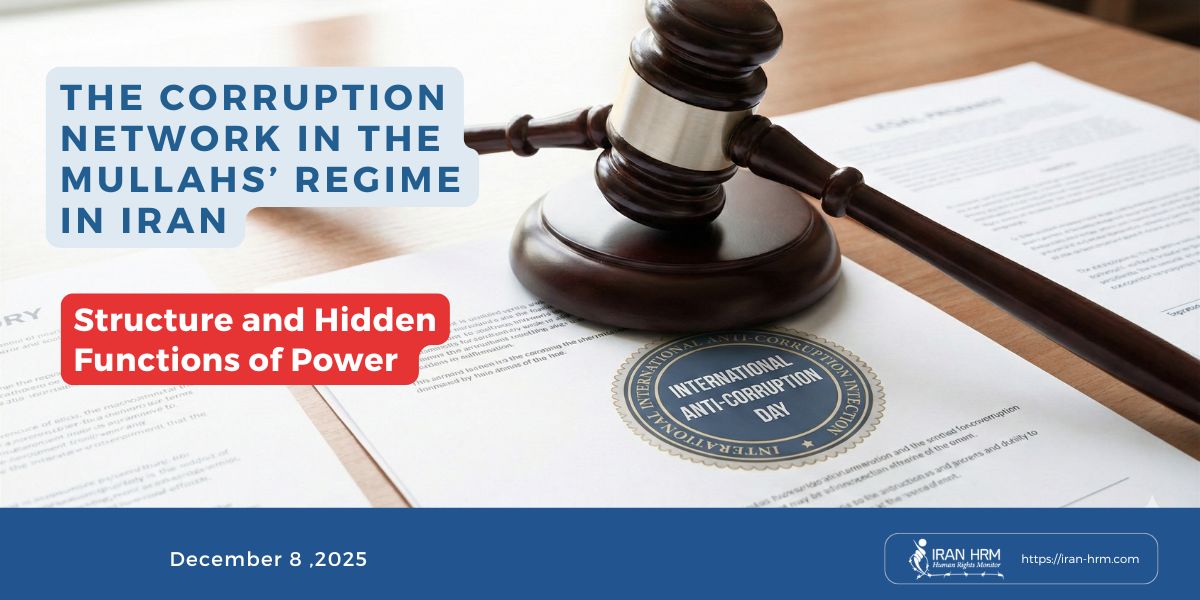
December 9, the International Anti-Corruption Day, is a reminder that corruption is not merely an economic offense; it is a direct threat to human rights, justice, and human development. On this day, the United Nations emphasizes that when corruption takes root at the heart of governance, it leads to poverty, repression, discrimination, and the systematic violation of citizens’ rights.

In recent years, Iran has consistently ranked among the lowest countries on global corruption indexes. Yet the real issue is not the ranking; it is the architecture of corruption itself. In Iran, corruption is not an anomaly but a mode of governance, a tightly interwoven network in which the government, parliament, security institutions, the Islamic Revolutionary Guard Corps (IRGC), the judiciary, economic conglomerates under the Supreme Leader’s authority, and a series of extra-legal structures operate as components of a single system.
The breadth and complexity of this corruption are so vast that a full examination is not possible within a single report. This series is therefore presented in multiple issues, each offering a documented, factual, and analytical exploration of structural corruption in Iran.
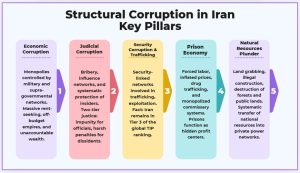
1. Economic Corruption and Colossal Wealth: The Systematic Looting of National Resources
Economic corruption in Iran has effectively become a parallel system of power, consisting of enormous economic foundations, military-controlled enterprises, state officials, and rent-seeking networks tied to political elites. Wealth accumulation by these entities is not the result of productive activity; it stems from massive currency rents, exclusive contracts, extraordinary privileges, and the systematic transfer of public resources into private hands.
Key Fact: The assets of only one institution under the Supreme Leader’s control, the Executive Headquarters of Imam’s Directive (Setad), are estimated at over USD 95 billion.
2. Judicial Corruption and Two-Tier Justice: The Judiciary as a Protective Shield for Corruption
The judiciary has become one of the main pillars enabling and reinforcing corruption. Numerous high-level corruption cases within the judicial system, along with discriminatory treatment of defendants, reveal that justice in Iran is dual and class-based.
On one side, officials and regime affiliates, despite serious criminal cases, benefit from practical impunity. On the other, civil activists, protesters, and ordinary citizens are prosecuted with severe security charges and harsh sentences.
This demonstrates that the judiciary functions not as an institution of justice but as a protective mechanism for the corruption network.
3. Security-Linked Corruption, Human Trafficking, and Exploitation Networks
One of the most disturbing dimensions of corruption in Iran is the direct involvement of security entities in human trafficking and exploitation networks. Credible international reports emphasize that parts of these networks operate with participation or deliberate tolerance from security forces.
The use of “temporary marriage” as a cover to transport women and girls abroad, the employment of “honey trap” networks for political manipulation or suppression, and reports of child recruitment, reveal that corruption in Iran is not merely economic, it is also a security tool for political control and social repression.
The human consequences are severe: women, girls, and children are subjected to systematic exploitation, violence, and complete vulnerability.
4. Corruption in Prisons: Hidden Economies, Forced Labor, and Organized Trafficking
Iranian prisons have diverged from their legal and rehabilitative functions and turned into profit-making centers for state-controlled networks. The Prisoners’ Cooperative Foundation holds a monopoly over the distribution of essential goods selling them at several times their normal price. This transforms inmates and their families into a source of profit.
Simultaneously, prisoners are forced into labor under “employment programs,” performing strenuous work for negligible wages and without legal protections, conditions amounting to modern slavery. Reports also indicate that the entry of drugs into major prisons is impossible without collusion among sections of prison management, revealing how prisons play a role in the broader security–economic corruption cycle.
5. Plunder of Natural Resources: Turning Public Assets into Private Power
Corruption in the field of natural resources is one of Iran’s most critical ongoing crises. Land grabbing, forest destruction, unauthorized construction, illegal land transfers, and the degradation of the Hyrcanian forests are examples of systematic plunder.
Exploitation of legal loopholes and collusion within environmental and land-management agencies has enabled the transfer of significant portions of public resources into the private wealth of power networks.
This pattern not only inflicts irreversible environmental damage but also violates the right to a healthy environment and the rights of future generations
6. Why This Series Is Published in Multiple Issues
Corruption in Iran is a unified system with multiple domains and complex interconnections.
A rigorous and factual examination requires a step-by-step, document-based approach.
Therefore, this series is divided into several issues:
- Issue 2: Economic corruption and rent networks
- Issue 3: Security corruption, human trafficking, and exploitation
- Issue 4: Judicial corruption and two-tier justice
- Issue 5: Prison corruption and modern slavery
- Issue 6: Plunder of natural resources and public assets
Each issue will examine verifiable facts, names, cases, and official documentation from credible domestic and international sources.
Conclusion
International Anti-Corruption Day highlights the reality that corruption, when rooted at the core of governance, leads to widespread human rights violations.
Corruption in Iran is not a temporary crisis nor the result of mismanagement; it is a political architecture through which public wealth becomes private capital for power networks, while security, judicial, and economic institutions align to defend this structure.
This series aims to provide a documented, factual, and multi-dimensional understanding of structural corruption in Iran, an analytical foundation for human rights bodies, international organizations, and researchers working toward accountability and justice.