
Structural Corruption in the Mullahs’ Regime: Hidden Mechanisms of Power in Iran
Corruption in Iran’s governing structure is not confined to particular individuals or periods. It is a consolidated and interlinked system connecting political, security, economic, and judicial institutions.

Rather than upholding its legal duty to protect citizens’ rights and ensure justice, the judiciary of the ruling regime in Iran has, in recent years, become a security shield for power networks and an instrument for killing, executing dissidents, suppressing society, and generating fear. Official indications and available data show that this institution plays a decisive role in safeguarding corrupt officials and structuring political repression.
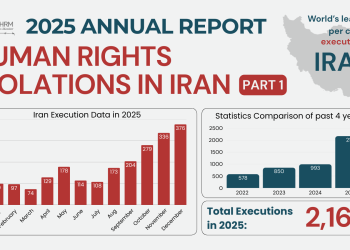
By 2025 alone, at the time of drafting this report more than 1,800 executions had taken place in Iranian prisons, placing Iran at the top global position in the use of the death penalty. The scale, pace, and nature of these executions demonstrate that the judiciary functions not as an institution of justice, but as a mechanism of governance through intimidation and elimination of opposition.
1. Corruption at the Top of the Judiciary: Influence Networks, Bribery, and Manipulation of Cases
The case of Akbar Tabari is a central example of this pattern. For nearly two decades, Tabari held major executive positions within the judiciary and, according to official reports, played a direct role in receiving bribes, influencing judicial rulings, transferring privileges, and managing financial networks tied to significant cases. His conviction never reflected a real confrontation with corruption, as the core power circles he served were never questioned.
State media emphasized that Tabari’s prolonged presence in key roles “without legal expertise” illustrates that judicial authority in Iran is built not on professional competence, but on loyalty to entrenched power structures. This environment creates ongoing opportunities for corruption and systematic abuse.
2. A Discriminatory Judicial Structure: Harsh Repression of the Public, Shielding of Officials
Iran’s judicial system has produced a visibly discriminatory framework:
- For ordinary citizens particularly protesters, civil activists, workers, and journalist’s judicial proceedings result in heavy sentences, rapid trials, coerced confessions, and harsh punishments.
- For officials and individuals close to the centers of power, the law is left unenforced or applied selectively and symbolically.
2.1. Judicial Response to Protesters
Following the protests of 2019 and 2022, hundreds of individuals were sentenced to imprisonment, execution, flogging, or internal exile. Many of these rulings were issued in courts with restricted access to independent legal counsel, and interrogation processes were widely reported to involve coerced confessions. These patterns show that the judiciary prioritizes crushing dissent over ensuring fair trial standards.
2.2. The Azgol Land-Grab Case and Complete Impunity
The illegal transfer of 4,200 square meters of land in Tehran’s Azgol district; where the name of Kazem Seddiqi surfaced is a clear example of a major judicial case left without proper adjudication. Legal experts publicly stated that returning the land would not nullify the criminal act of “transfer of property belonging to others,” yet the case was closed without any summons or investigation. This demonstrates the judiciary’s unwillingness to pursue cases involving political or religious figures close to the ruling establishment.
3. Impunity for Officials: The Core Pillar of Judicial Corruption
The following cases were all reported openly by regime-controlled media. In any other country, they might have triggered political collapse; in Iran, they were abandoned without real judicial action.
3.1. The Missing Oil Rig — USD 87 Million (2015)
Mehr News (14 juin 2015) reported that the Parliament’s Energy Commission announced the disappearance of an 87-million-dollar oil rig.
Khabar Online wrote in Tir that the rig had never entered Iran, and Shargh confirmed that no senior Ministry of Oil official was questioned.
The case was rapidly closed.
3.2. The “Yas” Case — Tens of Thousands of Billions in Misappropriation
Hamshahri (13 juin 2018) and ISNA (aout 2018) reported massive financial irregularities involving the Yas Holding and the Tehran Municipality, with institutions linked to the IRGC playing a role.
No senior figure was ever prosecuted.
3.3. Sixty-Three Accounts of Sadegh Amoli Larijani — A Scandal without Prosecution (2016)
ISNA (11 décembre 2016) confirmed the existence of 63 bank accounts associated with the judiciary.
Ettela’at wrote that their interest revenues amounted to billions.
Despite involving the head of the judiciary, the case was closed with minimal explanation.
3.4. Petrochemical Corruption — EUR 6.6 Billion (2019)
IRNA (3 septembre 2019): €6.6 billion in petrochemical export revenues were never returned.
ISNA highlighted the role of intermediary companies.
Decision-makers were never held accountable.
3.5. Massive Land Grabs — Lavasan, Tehran, Northern Coasts
Fars (14 mai 2019): “the largest land grabs were conducted by powerful institutions.”
Tasnim (Juillet 2019): villa construction in Lavasan was tied to “influential individuals.”
IRNA (juin 2020): public coastal land was seized by persons with power.
No senior figure was prosecuted.
3.6. Illegal Allocations in Kish and Qeshm Free Zones
Shargh (décembre 2014) and Hamshahri (janvier 2015) exposed illegal transfers of valuable property in free zones.
No meaningful judicial action followed.
3.7. The Babak Zanjani Case — Prosecuting the Middleman, Not the Network
IRNA (janvier 2016) quoted Zanjani saying he sold oil “on behalf of others.”
Hamshahri (février 2016) noted that the network behind him remained unexposed.
Only Zanjani was punished; the higher network remained untouched.
3.8. Multiple Cases Involving “Aghazadehs”
Fars (21 juin 2018) reported officials’ children involved in illegal car imports.
ISNA (juillet 2018) reported preferential currency allocations for mobile phone imports to persons close to officials.
No senior authority faced trial.
3.9. Impunity of Major Regime-Linked Economic Institutions
Hamshahri (14 janvier 2021): assets of the Executive Headquarters of Imam’s Directive valued at tens of billions of dollars.
Shargh (10 octobre 2019): Astan-e Qods did not pay taxes despite major revenues.
These institutions operate outside any judicial oversight.
4. The Asset-Declaration Law and Structural Concealment of Power’s Wealth
The 2019 asset-declaration law was presented as an anti-corruption measure. Its implementation, however, reveals a system designed to shield the wealth of those in power rather than expose it.
ISNA (janvier 2020) reported that officials’ asset information is “classified and cannot be made public,” eliminating the most basic condition for transparency. Since its adoption, no annual report has ever been released: no number of cases, no names examined, no data on financial changes.
Credible evidence shows that enormous economic holdings—Setad Ejra’i, the Mostazafan Foundation, Astan-e Qods, and Khatam-ol-Anbiya Headquarters—operate under the direct control of the Supreme Leader’s office and remain outside judicial, financial, and parliamentary scrutiny.
Media such as Entekhab, Fararu, Fars, and Mashregh have repeatedly reported (2019–2023) on oil, maritime, and petrochemical contracts, as well as properties and companies linked to Ali Shamkhani’s family—such as maritime firms operated by his sons and a high-value property in Niavaran. None of these assets have ever been publicly reviewed.
Official documents further show that large real-estate developments in Fereshteh, Niavaran, and Elahiyeh; luxury villas in Lavasan; and the seizure of coastal land in Gilan and Mazandaran by relatives of political and judicial officials have never undergone formal judicial review.
In practice, the asset-declaration law functions as a mechanism for internal political control within the regime and a protective shield for power-linked wealth—not as a genuine anti-corruption tool.
5. The Judiciary’s Role in Executions: A Tool of Governance, Not Justice
The dramatic rise in executions over the past year, conducted without fair-trial guarantees, has triggered condemnation by international bodies including UN mechanisms and Amnesty International. Many of these executions occurred in Qezel Hesar, Raja’i Shahr, and Urmia prisons, disproportionately affecting marginalized and impoverished communities.
The death penalty functions as a method of social control, suppressing dissent and instilling fear. This pattern constitutes a severe violation of the right to life and Iran’s international human rights obligations.
6. Structural Links between Judicial Corruption and Prison Corruption
Judicial corruption directly enables the emergence of a hidden prison economy. Forced labor, internal drug-trafficking networks, pervasive bribery, and the sale of basic facilities flourish under a judiciary that is unaccountable.
The Prisoners’ Cooperative Foundation plays a central role in exploiting inmates as cheap labor and turning prisons into profit-driven enterprises, something that is only possible through judicial complicity.
7. Conclusion
An examination of judicial files, official reports, and the operational behavior of the judiciary shows that it is the central pillar sustaining corruption and repression in Iran. By creating impunity for officials, overlooking grand corruption, issuing harsh sentences for citizens, conducting widespread executions, eliminating financial transparency, and collaborating structurally with centers of power, the judiciary perpetuates the regime’s cycle of corruption and systematic human-rights violations.
The fifth and final report in this series will examine how this judicial corruption manifests inside Iran’s prisons: in forced labor systems, drug-trafficking networks, medical neglect, silent deaths, and the operations of the Prisoners’ Cooperative Foundation dimensions that cannot be fully understood without the findings presented here.