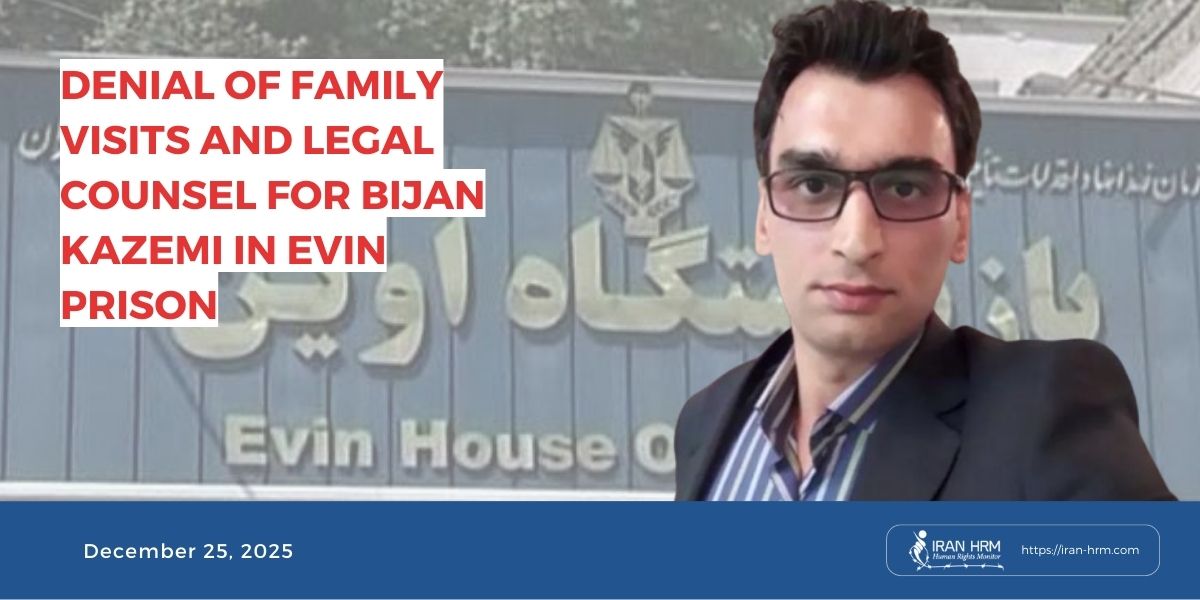
Authorities at Evin Prison have prevented the family of Bijan Kazemi, a political prisoner held at the facility, from visiting him in person, without providing any explanation.
Shahnaz Khosravi, his mother, stated in a recent post on the social media platform X that after five weeks of repeated follow-ups, the family received only a single brief phone call from her son, and no in-person visit has been permitted to date.

According to her statement, this restriction is not limited to family visits; it also includes severe limitations on phone contact and a complete denial of access to legal counsel. Kazemi’s lawyers have not been allowed to review his case file, and the alleged charges against him have not been formally communicated to his family.
Prolonged Legal Limbo and Denial of Basic Rights
Bijan Kazemi has been held in detention for nearly eleven months. Throughout this period, he has been transferred between security detention facilities without formal charges and without effective access to a lawyer. His family reports that phone calls have been sporadic, tightly restricted, and extremely brief, while in-person visits have been entirely prohibited. This situation reflects a state of prolonged legal limbo and the systematic denial of the most basic rights afforded to political prisoners.
Security Targeting and Pressure for Forced Confessions
Based on family accounts and case information, Bijan Kazemi has been subjected to intense psychological and physical pressure throughout his detention. His mother has previously stated that security officials explicitly conditioned his access to basic rights, including legal counsel and regular contact with his family, on his “cooperation.”
Within Iran’s security apparatus, such language is widely understood to indicate pressure aimed at extracting forced confessions.
Extended solitary confinement, exhaustive interrogations, enforced isolation from family members, and the absence of transparency regarding judicial proceedings have collectively turned this case into a clear example of security-driven victimization of a political activist.
Arbitrary Arrest and Case Background
Bijan Kazemi was arrested on Sunday, 19 January 2025, at his private residence in the city of Kouhdasht, without prior summons or judicial notice. Security forces simultaneously confiscated electronic devices belonging to him and his family members.
He had previously been arrested in April 2020 on security-related charges and sentenced to three and a half years in prison. After serving two years, he was released under electronic monitoring. Available information indicates that his prior political activity and history as a political prisoner were significant factors in his re-arrest.
Bail Issue; A Formal Order Without Effect
Despite the issuance of an exceptionally heavy bail order amounting to 4 billion tomans, Kazemi’s family reports that authorities refused to release him even after they attempted to post bail.
Shahnaz Khosravi wrote:
“After months of pretrial detention, Bijan’s interrogation session was held without the presence of the lawyer chosen by the family. The night before, he briefly informed us that a bail order had been issued. However, when I went to deposit the bail, they simply said: your son will not be released.”
This sequence of events, combined with the continued denial of legal counsel and judicial uncertainty, demonstrates that the bail order has been purely symbolic, with security agencies exercising decisive control over the judicial process.
Communication with International Human Rights Mechanisms
According to available information, the case of Bijan Kazemi, including his arbitrary detention and prolonged legal uncertainty, has been conveyed through human rights reporting and correspondence to international bodies, including Amnesty International and United Nations special procedures, and is subject to ongoing rights-based follow-up.
Human Rights Assessment
The case of Bijan Kazemi presents a clear picture of systematic human rights violations against political prisoners in Iran; including arbitrary arrest, denial of family contact, lack of access to legal counsel, pressure for forced confessions, and the effective nullification of bail decisions. The continuation of these practices places his physical and psychological well-being, as well as his family’s stability, at serious risk and underscores the urgent need for sustained international scrutiny of structurally flawed due process practices in Iran.