Behind the Curtain of News
While the recent war remains at the forefront of global headlines, behind the curtain of this war and a digital blackout in Iran—now entering its 49th day—atrocities are being committed against innocent human beings under the rule of the Islamic Republic. It can be said that war and digital silence have become a “blessing” for a regime that is vehemently anti-human rights and repressive, allowing it to advance its crackdown as it pleases.
We are left wondering: why is this issue not at the top of the world’s news regarding Iran? Has the world reached a point where humanity has collapsed, leaving nothing but the hollow shell of organizations founded to protect human rights?
Death Under Torture
Abbas Yavari, a Khuzestani Arab citizen and resident of Shiraz, was arrested in January 2026 during nationwide protests. After a period of detention, he was transferred to Shiraz Central Prison in late February.
According to received reports, he was moved to an undisclosed detention center on March 26, 2026, and only three days later, on March 29, his death was reported to his family. Following their usual pattern, judicial and security authorities have declared the cause of death as “suicide.”
Knowledgeable sources state that Abbas Yavari was subjected to severe physical and psychological torture from the moment of his arrest to coerce a confession for the alleged murder of a Basij member during the Shiraz protests. These sources emphasize that he died as a result of the intensity of this torture, yet prison officials claim he took his own life while in custody.
It must be noted that:
- The prohibition of torture is a “peremptory norm” (Jus Cogens) in international law; this means no government, under any circumstances (including war or state of emergency), has the right to commit torture.
Forced Transfer and Enforced Disappearance
- In recent days, between 10 to 20 political prisoners were transferred from Evin Prison to the quarantine section of Qezel Hesar Prison: a sudden transfer accompanied by a total cutoff of communication between these prisoners and their families. It is likely these individuals are being held in solitary confinement or in Unit 3 of Qezel Hesar Prison. The lack of transparent information regarding their exact location and status has heightened the ambiguity and anxiety of their families.
- On Monday, April 13, 2026 (24 Farvardin 1405), Reza Younesi announced on X (formerly Twitter) that his father, Miryoussef Younesi, was moved from Evin Prison to an unknown location, writing: “Today, my father, Miryoussef Younesi, was transferred from Evin Prison to an unknown location.” Miryoussef Younesi is 73 years old.
-

Miryoussef Younesi - On Sunday, April 12 (23 Farvardin), Mohsen Pirayesh, a political prisoner held in Evin Prison, was transferred to an unknown location along with several other prisoners. Among those transferred are the names of Vahid Sorkhgol, Ali Sheidaei, Mahdi Vafaei-Sani, and Amin Sokhanvar.
-

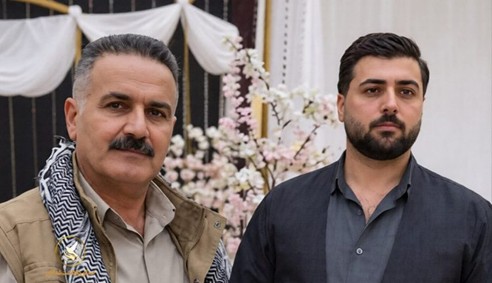
Mohsen Pirayesh More than a week after the arrest of Mohieddin Ghalash and Behnam Ghalash, two Kurdish citizens from Piranshahr, there is still no information regarding their status or whereabouts. This father and son were arrested by security forces without a judicial warrant and taken to an unknown location. They have been denied access to a lawyer and family visits.

It must be noted that:
According to the International Convention for the Protection of All Persons from Enforced Disappearance, concealing the whereabouts of a prisoner is considered a crime.
Death Sentences
- Following the ongoing trend of issuing death sentences in cases related to protests, three individuals arrested in January 2026 in Shiraz were sentenced to death on charges of “setting fire to a base” and “murdering a Special Unit officer.” The identities of two of these individuals have been confirmed as Majid Nassiri, from Jahrom, and Shahab Dadkhah, from Shiraz, an auto mechanic. According to a knowledgeable source, the adjudication process of this case has been fraught with serious ambiguities. Throughout all stages of the proceedings, Shahab Dadkhah denied any involvement in the murder or even presence at the gatherings, stating that he was working at his shop until late at night at the time of the incident. Nevertheless, the court issued the death sentence without regard for the presented defense. Reports also indicate that the proceedings were conducted with extreme haste, bypassing the standard judicial process—disregarding principles of a fair trial.
- In a separate case, two other prisoners named Manouchehr Vafaei (28 years old) and Navid Naghdi (32 years old) have been sentenced to death on charges of murdering two members of the Salman Basij base in 2024 (1403). These two prisoners currently face an imminent risk of execution in the coming days. Based on available information, this case was also processed under conditions where full details were not published, and access to independent information regarding the trial process was restricted. Concerns about the speed of the execution come while the necessity for a meticulous review of the case is emphasized. Among the convicts in this case, Navid Naghdi has a family history of such tragedy; according to reports, his brother was executed in 1992 (1371) on political charges. This fact is noted as part of the background of this case.
Human Rights Violations in These Cases:
- Violation of the Right to a Fair Trial: Lack of transparency in the proceedings, disregard for the defendants’ arguments, and unconventional haste in issuing sentences.
- Deprivation of Effective Access to Counsel: Reports of restrictions on choosing and having free access to independent lawyers.
- Use of Coerced Confessions: Torture was used here as a tool for “manufacturing lies” (confession to the murder of an officer). According to Article 7 of the International Covenant on Civil and Political Rights (ICCPR), any sentence based on torture is fundamentally void.
- Issuance and Execution of the Death Penalty: As an irreversible punishment, especially in conditions where the judicial process has been shrouded in ambiguity.
Essential Reminder and Global Responsibility
We once again remind the world that high-ranking officials of the Islamic Republic have repeatedly spoken of “fast-tracking” the cases of protesters and political prisoners and the “hasty issuance” of death sentences. In one instance, Gholam-Hossein Mohseni-Eje’i, the Head of the Judiciary, addressed his First Deputy, Khalili, saying: “Our sentences, Mr. Khalili, must be issued more frequently. Both regarding the confiscation of property and the issuance of death sentences—really accelerate these.”
This quote is evidence of “Superior Command Responsibility” and demonstrates “Criminal Intent” at the highest level of sovereignty to commit systematic crimes.
The expectation from the international community and human rights organizations is to break this deafening silence and inaction regarding such flagrant violations of human rights under the rule of the Islamic Republic. If the Islamic Republic had been held seriously accountable for the massacres of the 1980s and forced to stop its repression and killing, undoubtedly thousands of lives lost in Iran and across the Middle East due to the actions of this regime would have been saved today.
Stop the inaction. Force the rulers of Iran to stop executions, torture, and their “finger-on-the-trigger” mentality in the streets. This is your moral, conscientious, and human duty.