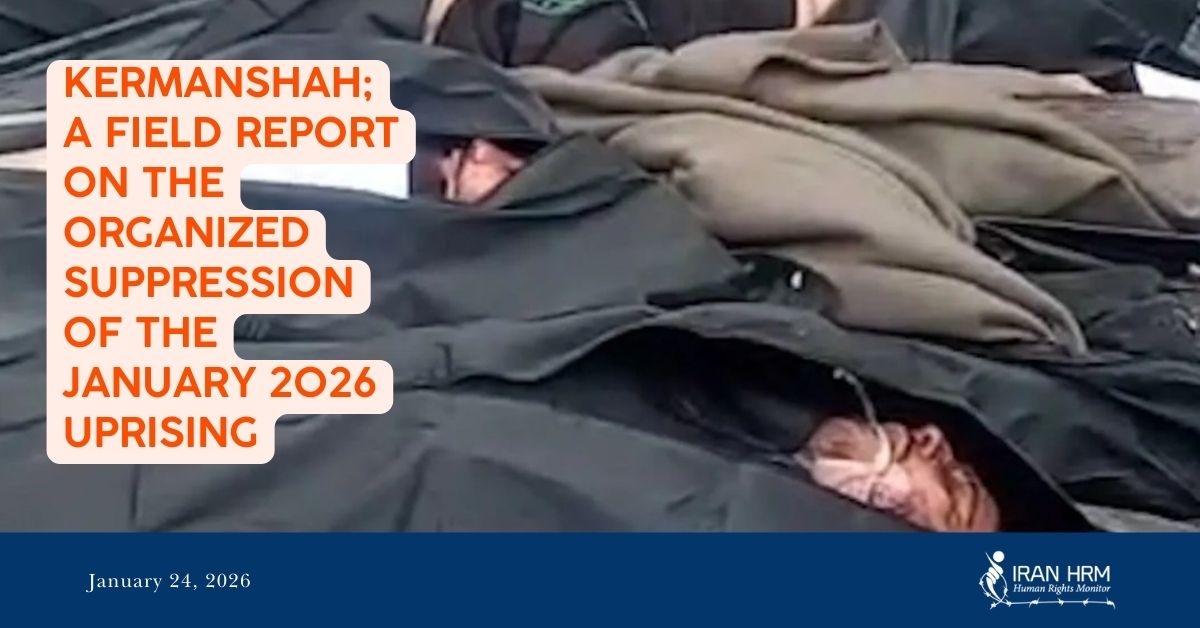
Eyewitness Testimonies of Extrajudicial Killings, Torture, and the Concealment of Bodies
Atrocities that remained hidden from the eyes of cameras turned Kermanshah into one of the darkest scenes of repression during the January 2026 uprising. What unfolded in the city during the peak days of the protests was not a series of isolated security incidents, but a set of deliberate and coordinated acts carried out under conditions of enforced silence, internet shutdowns, and systematic intimidation of families, preventing public documentation and global scrutiny.

This report is based on field testimonies, direct eyewitness accounts, and information obtained from internal sources. It seeks to reconstruct part of the reality of the suppression of the January 2026 uprising in Kermanshah; a reality marked by extrajudicial killings of protesters, systematic torture of detainees, concealment of bodies, and organized pressure on the families of victims.
Context and Background
The large-scale crackdown in Kermanshah intensified in parallel with the expansion of the January 2026 uprising across Iran. From the earliest days, the heavy presence of security and military forces, combined with severe restrictions and, in many cases, a complete shutdown of internet access, transformed the city into a closed and militarized environment. According to local sources, these measures were implemented to prevent the transmission of images and first-hand accounts beyond Iran’s borders.
Multiple testimonies identify the period between 7 and 10 January 2026 as the deadliest phase of the crackdown in Kermanshah; days during which direct gunfire against protesters, mass arrests, and the transfer of bodies without informing families were repeatedly reported.
Field Events and the Pattern of Repression
Eyewitness accounts indicate that the actions of the security forces in Kermanshah went far beyond crowd control or dispersal tactics. Protesters were targeted with live ammunition in various streets and neighborhoods, and in numerous cases, detainees were taken to undisclosed locations and never returned to their families.
According to witnesses, many arrests were accompanied by extreme violence, and detainees were subjected to severe forms of torture after being transferred. The secret movement of bodies, refusal to hand over remains to families, and nighttime burials emerge as recurring patterns, pointing to a systematic effort to conceal the true scale of the killings.
Eyewitness Testimonies
One eyewitness, who reports having personally seen the bodies of victims, stated:
“This was not merely a street crackdown. Those arrested between 7 and 10 January were brutally tortured. I saw with my own eyes that their joints had been drilled; from ankles to knees, wrists, elbows, and shoulders. After that, they were executed with a bullet to the head.”
The same witness described signs of organ removal:
“Many bodies had surgical stitches. Their hearts, kidneys, or livers had been removed. Some were kept alive first, their healthy organs extracted, and only then were they killed. I saw bodies with severed tendons in their hands, fingers stapled together.”
He further described the conditions inside medical and forensic facilities:
“When we went to identify a body, our phones were confiscated. Even doctors were not allowed to carry phones. Cameras had been turned off so no one could document what had been done to the bodies.”
Body Counts and the Use of Public Facilities
Another witness, in contact with medical staff and local sources, reported a much broader scale:
“Approximately 1,400 bodies were counted. Some belonged to people who were still alive when their organs were removed. There was no space to store the bodies, so a sports stadium was used.”
He also emphasized the pressure placed on families:
“Families were told that if they did not remain silent or accept the official narrative, other family members would be arrested.”
Role of Repressive Forces and the Presence of Foreign Militias
According to multiple testimonies, the suppression of the January 2026 uprising in Kermanshah involved not only domestic forces but also individuals speaking non-local and Arabic dialects. Local residents identified these forces as members of Iraqi Popular Mobilization Forces and the Fatemiyoun Division, operating alongside the Islamic Revolutionary Guard Corps.
A resident of Kermanshah stated:
“These were not just police or local forces. We heard Arabic being spoken. Many are certain that foreign militias were brought in to finish the job.”
Internet Shutdown and Enforced Silence
The shutdown or severe disruption of internet access in Kermanshah coincided with the peak of the crackdown and played a decisive role in concealing these atrocities. Witnesses report that the lack of connectivity prevented documentation and the rapid transfer of information to the outside world.
One witness noted:
“If the internet had been working, the world would have seen what they did to people. Everything was carried out in darkness.”
Pressure on Families and the Concealment of Bodies
Testimonies further indicate that families of those killed or forcibly disappeared were subjected to intense pressure. Bans on mourning ceremonies, threats of arrest against other family members, and coercion to accept official explanations for the cause of death formed part of a systematic silencing policy.
In some cases, families were only allowed to retrieve the bodies after committing to absolute silence and agreeing to immediate burial without public ceremonies.
Human Rights Analysis
Based on the testimonies presented in this report, the acts committed in Kermanshah include extrajudicial killings, torture, enforced disappearances, mutilation of bodies, and the systematic concealment of evidence. Under international human rights law, these actions constitute serious violations and meet the defining elements of crimes against humanity, as they were carried out in a widespread and systematic manner against a civilian population, with full awareness and coordination.
Conclusion
The accounts documented in this report demonstrate that the suppression of the January 2026 uprising in Kermanshah was not an isolated or spontaneous reaction, but part of a deliberate policy aimed at instilling fear, physically eliminating protesters, and obscuring the truth. Continued enforced silence and the destruction of evidence significantly increase the risk of further violations.
Documenting these events and bringing them before independent international mechanisms remains essential to preserving evidence and ensuring accountability for those responsible for these crimes.