By Maryam Fakhar

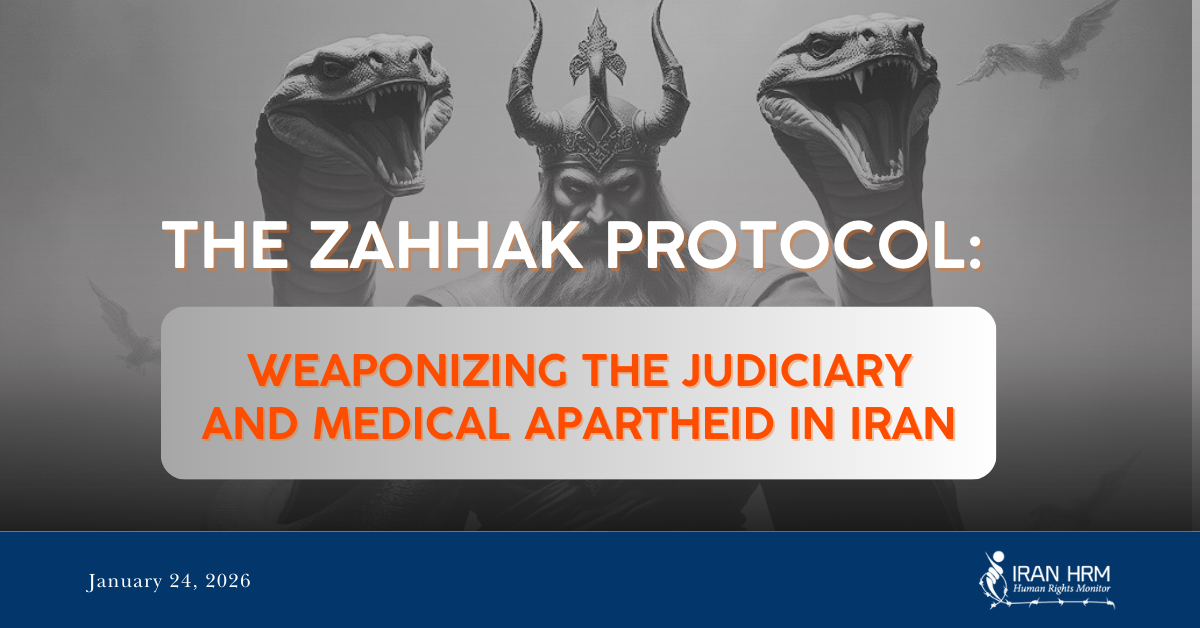
In Iranian mythology, there is a legend of Zahhak (the Serpent-Shouldered Tyrant) and Kaveh the Blacksmith. Zahhak had two serpents growing from his shoulders that required the brains of two youths every day to be fed. If the mythical Zahhak demanded the brains of two youths, the Zahhak of today’s Iran (Khamenei) seeks to consume the minds and wills of 50,000 detained protesters, utilizing “expedited” judicial sentences to guarantee his survival.
When reading the remarks of Gholam-Hossein Mohseni-Eje’i, Khamenei’s Chief Justice, and Radan, his commander of SSF (State Security Forces) —one calling for the rapid processing of over 50,000 detainees “before the impact is lost” and urging judges toward “minute-long trials” (a grim reminder of the 1988 massacre), and the other claiming that many “rioters” have been identified and will be hunted down one by one—one is reminding of Zahhak and the serpents on his shoulders. But what Zahhak then, and Khamenei now, fail to understand is that the greater the crime, the harsher the accountability and the punishment. And now, addressed to Khamenei: Just as the uprising of Kaveh the Blacksmith — against Zahhak, who had sacrificed the children of the land to the serpents on his shoulders — ultimately led to his downfall and left him chained for the rest of his days in Mount Damavand, so too will these spilled blood and the suffering of prisoners bind your fate before the judgment of history, like the chains of Damavand.
One witness, a hospital staff member, stated: “I was on shift. When the number of wounded increased, instead of increasing the staff, they cancelled shifts so they could carry on their crimes without oversight. They extorted money and forced signatures and commitments from families just to return the bodies. A 12-year-old child who had been shot died because they refused him blood. They didn’t even let the family see him; they just told them, ‘We delivered your child to Kahrizak; go find him among the plastic-wrapped corpses.’” This deliberate denial of aid and medical deprivation of the wounded is a clear manifestation of “Medical Apartheid” and a violation of Medical Neutrality, reaching the threshold of crimes against humanity.
Another medical worker, speaking through the wall of censorship, said: “In Borujerd, they forbade the treatment of the wounded and burned some of the bodies to erase all evidence. Pharmacies were even prohibited from selling basic first aid and dressing supplies.”
A witness from Tehran cried out: “Everyone is waiting; many wounded are in homes. People are performing home treatments with pride. By the tears and blood on my jacket, I promise good things will happen. When they threw stun grenades, everyone ran toward the alleys; the suppressive forces were too afraid to enter the alleys. An elderly woman said, ‘It cannot go on like this; they have weapons, and we are empty-handed?!‘”
Perhaps the most accurate conclusion is the words of that elderly lady: “It cannot go on like this; they have weapons, and we are empty-handed?!” This sentence is the sound of a society moving past fear; it is the sound of the last fragments of a regime’s legitimacy shattering—not only for the people of Iran, who have long seen this regime as illegitimate, but in the eyes of the world.
The decision to cut off the internet until Nowruz 2026 is a blatant confession of defeat in the war of narratives. A telecommunications blackout of this magnitude is not merely a restriction; it is the creation of a “darkroom” for the engineering of crimes against humanity and the silent slaughter of citizens in the absence of global eyes. A sovereign that has lost the ability to persuade its citizens sees no choice but to “blind” both society and the world. Unfortunately, the international community, through its silence during these ten days of blackout and the massacre of protesters, is complicit in the blood already shed and the blood that will be shed for Iran’s freedom. Had the world been committed to its human rights obligations, we would now be facing a free Iran, with its victims alive and human values upheld, rather than witnessing Crimes Against Humanity, political massacres, and the betrayal of all human rights treaties.
A free and democratic Iran would have shaped a different world altogether.