From Domestic Repression to a Threat to Global Peace
By: Mohammad Nahid ( Human rights activist)

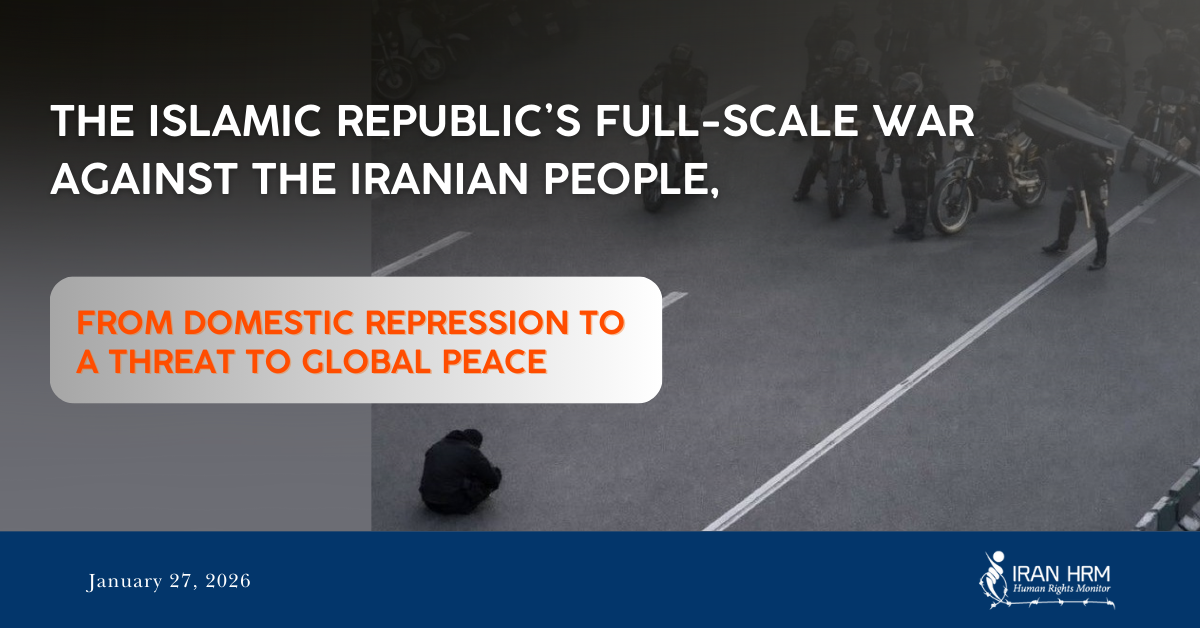
The Islamic Republic of Iran, under the leadership of Ali Khamenei, can no longer be described merely as a human rights–violating government. According to official international evidence, the regime is engaged in a “full-scale and organized war against its own population” [1]. Based on reports by independent human rights organizations and assessments presented to the United Nations Human Rights Council, during nationwide uprisings—particularly since 28 December 2025—thousands of people have been killed, tens of thousands arrested, and large numbers subjected to torture, sexual violence, or enforced disappearance [1].
United Nations experts have described this repression as “the deadliest crackdown against the Iranian people since the 1979 Revolution” [1].
1. A Policy of Killing and Executions: Repression as a Governing Doctrine
The security forces of the Islamic Republic—including the Islamic Revolutionary Guard Corps (IRGC), the Basij militia, and law enforcement units—acting under the direct authority of Ali Khamenei and through the Supreme National Security Council, have used “live ammunition, heavy machine guns, and metal pellets” against unarmed protesters [1]. In its resolution, the United Nations Human Rights Council explicitly states that this repression “has resulted in the deaths of thousands of persons, including children, and the arrest of thousands in connection with nationwide protests” [1].
Simultaneously, the Iranian judiciary, headed by Gholamhossein Mohseni Ejei, has labeled detainees as “baghi” (armed rebels) and “corrupt on earth”, calling for their “swift, decisive, and uncompromising punishment.” This approach has effectively transformed the execution of protesters into an official instrument of political repression, constituting a flagrant violation of the right to life and the right to a fair trial under international law [1].
2. International Confirmation of the Commission of Widespread Crimes
On 23 January 2026, during its Thirty-Ninth Special Session, the United Nations Human Rights Council adopted a resolution strongly condemning the “violent repression of peaceful protests and the killing of thousands of people” [1]. The Council further decided to “extend the mandate of the Independent International Fact-Finding Mission on Iran for an additional two years” and requested the Mission to conduct “an urgent investigation into serious and ongoing human rights violations and crimes committed in connection with the protests” [1].
During this session, United Nations High Commissioner for Human Rights Volker Türk stated:
“The brutality in Iran continues; thousands of people, including children, have been killed in a security crackdown involving the use of live ammunition.” [1]
The Chair of the Fact-Finding Mission likewise described these events as “the deadliest repression of the Iranian people since the 1979 Revolution,” emphasizing that the available evidence points to “arbitrary killings, torture, sexual violence, mass arrests, and forced confessions” [2].
3. An Occupying Regime Confronting Its Own Nation
The core issue for the Iranian people is not limited to economic grievances or demands for limited reforms; rather, it is the “liberation of the country from the grip of an internal occupying regime” that, over the past 47 years, has relied on “bullets, prisons, and gallows” to maintain power [2]. According to numerous international reports, this regime has plundered public wealth and natural resources, diverting national revenues toward “state-sponsored terrorism and the export of fundamentalism across the region and beyond” [3].
Such conduct has objectively transformed the Islamic Republic into “one of the principal threats to regional and international peace and security” [3].
4. The Collapse of Half a Century of Appeasement: The Direct Responsibility of the International Community
The silence and inaction of the international community over the past five decades have effectively facilitated the continuation of crimes committed by the power structure of the Islamic Republic. In its resolution of 22 January 2026, the European Parliament stated that the Iranian regime has entered a new phase of repression by “shifting from deterrence to the strategic elimination of protesters” [3].
Affirming its “full solidarity with the people of Iran,” the resolution called for the immediate cessation of executions, the unconditional release of political prisoners, the expansion of targeted sanctions, and accountability for the regime’s leaders [3].
4. Concrete Action: A Legal Obligation, Not Merely a Moral One
Under international law and the principle of the Responsibility to Protect (R2P), when a state commits widespread crimes against its own population, the international community bears not only the right but a legal obligation to act in order to protect civilians [1].
The clear demands of the Iranian people from the international community are as follows:
- “Immediate action to arrest and prosecute Ali Khamenei and all those responsible for ordering and carrying out repression before international courts”;
- “An immediate halt to executions and the unconditional release of all detainees”;
- Targeted sanctions against Ali Khamenei, the IRGC, and all repressive, diplomatic, and propaganda apparatuses of the regime;
- The designation of the Islamic Revolutionary Guard Corps as a terrorist organization;
- “The closure of all offices and representations of the Islamic Republic worldwide”;
- “The expulsion of regime agents and operatives from democratic countries.”
Conclusion
What is unfolding in Iran today, according to official United Nations assessments, is “not an ordinary internal crisis,” but rather a constellation of “crimes against humanity involving gross human rights violations and serious crimes under international law” [1]. Any concrete action taken against this regime serves, first and foremost, the security and legal interests of the free world itself, while simultaneously constituting a vital step toward assisting the Iranian people in their struggle to free their country from an occupying regime.
The continued inaction of the free world today will be recorded in the memory of history as complicity with an anti-human regime.
References
[1] United Nations Human Rights Council, Thirty-Ninth Special Session,
Human Rights Council Adopts Resolution Extending Mandates of Fact-Finding Mission and Special Rapporteur on Iran,
23 January 2026 – OHCHR.
[2] Statements and reports of the Independent International Fact-Finding Mission on Iran,
Remarks by Sara Hossain, Chair of the Mission, and report submitted to the Human Rights Council, January 2026.
[3] European Parliament Resolution,
European Parliament Condemns Iran’s Brutal Repression of Protesters,
22 January 2026 – European Parliament.