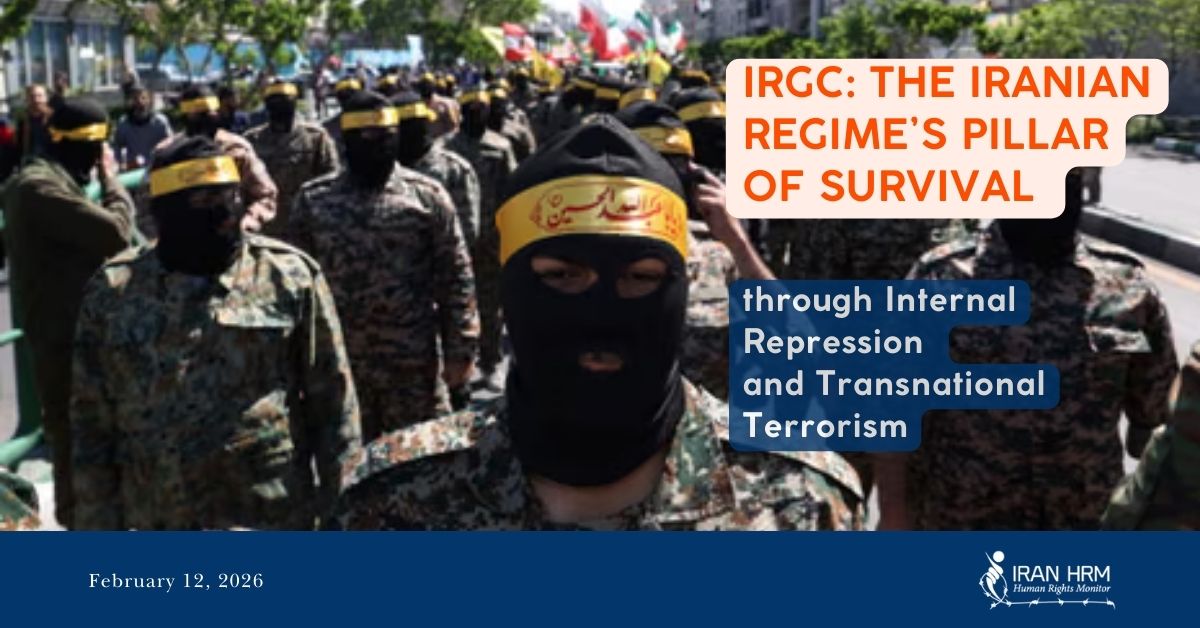
Through Internal Repression and Transnational Terrorism
Since its establishment in 1979, the Islamic Revolutionary Guard Corps (IRGC) was not designed as a national defense force; it was deliberately created as an ideological parallel military structure to secure the survival of the ruling clerical regime in Iran. From its inception, the IRGC’s core mandate has been the systematic suppression of society, the elimination of dissent, and the neutralization of any internal challenge to the ruling structure. Over more than four decades, this mandate has been carried out through escalating violence, entrenched institutional impunity, and deep integration with opaque economic networks.

The nationwide crackdowns of January 2018, November 2019, and most notably the January 2026 uprising reveal a clear pattern of escalation. During these cycles, the IRGC’s role evolved from auxiliary security support to direct command and execution of lethal repression. In January 2026, extensive field evidence, visual documentation, and synchronized eyewitness accounts from across Iran indicate mass killings, large-scale arbitrary arrests, and the deliberate imposition of a nationwide “digital blackout” to conceal the true scale of repression. Preliminary assessments indicate thousands of deaths and approximately 50,000 arrests; figures that remain difficult to independently verify due to enforced communication shutdowns, systematic enforced disappearances, and clandestine burials.
Simultaneously, the same institutional structure responsible for domestic repression operates beyond Iran’s borders through the export of terrorism and the organization of proxy forces. From this perspective, the designation of the IRGC on international terrorist and sanctions lists reflects recognition of a sustained, organized, and transnational pattern of violence, rather than a political or episodic response.
The Foundational Logic of the IRGC; An Institution Designed to Control Society
The establishment of the IRGC was not a response to external military threats; it was a calculated political decision aimed at internal control following the consolidation of clerical rule. The organization was intentionally structured outside conventional military norms to remain insulated from professional standards, legal accountability, and public oversight. Recruitment, training, and promotion within the IRGC have been based primarily on ideological loyalty and willingness to deploy violence against perceived internal enemies.
Within this framework, participation in the suppression of protests has not been treated as an aberration, but as an indicator of loyalty and a pathway to institutional advancement. This organizational logic explains why, during every major protest wave, the IRGC rapidly assumes crisis management authority while civilian and law-enforcement institutions are sidelined.
The IRGC’s Economic Empire; Linking Plunder, Repression, and Exported Violence
Over the past decades, the IRGC has transformed into the largest unaccountable economic actor in Iran. Through a complex network of holding companies and front entities, it has seized control over strategic sectors including oil and gas, petrochemicals, ports and shipping, telecommunications, and major infrastructure projects. This parallel economic system enables the circulation of vast portions of national wealth beyond judicial or parliamentary oversight.
This economic empire directly finances domestic repression; from salaries and bonuses for security forces to weapons procurement and logistical operations. At the transnational level, the same networks facilitate sanctions evasion, money laundering, and the transfer of resources to proxy operations abroad. In practice, the IRGC functions as the central nexus connecting the looting of public resources, internal repression, and the export of organized violence.
Architecture of Repression in January 2026; Command, Forces, and National Coordination
During the January 2026 uprising, repression evolved into a security-military operation under centralized national command. At this stage, the Tharallah Headquarters assumed nationwide control over repression, deploying specialized IRGC units to confront increasingly organized protesters who, in several locations, moved toward occupying government buildings and regime symbols.
Chain of Command and Operational Responsibility
| Level | Official | Role |
| 1 | Ali Khamenei | Commander-in-Chief; central role in authorizing unrestricted use of lethal force |
| 2 | Mohammad Pakpour | IRGC Commander; coordination of ground forces and Tharallah Headquarters nationally |
| 3 | Hossein Nejat | Deputy of Tharallah Headquarters; direct field command in Tehran and Alborz |
| 4 | Majid Khadami | Head of IRGC Intelligence Organization; identification, interrogations, forced confessions |
| 5 | Gholamreza Soleimani | Head of Basij Organization; deployment of Imam Ali and Fatah security battalions |
This structure demonstrates that repression was not the result of isolated actions but was executed through a clearly traceable institutional chain of command, establishing collective and command responsibility.
Geographic Hotspots and Field Evidence
Consistent repression patterns were documented across multiple regions:
- Lorestan and Ilam: Malekshahi, Azna, Dorud, Kuhdasht
- Tehran and suburbs: Punak, Valiasr Square, University of Tehran, Malard, Parand
- Khuzestan: Ahvaz, Dezful, Izeh, Mahshahr
- Fars: Shiraz, Marvdasht, Neyriz
- Kurdish regions: Sanandaj, Kermanshah, Eslamabad-e Gharb
- Khorasan Razavi: Mashhad (clandestine burials and abnormally high corpse releases), Neyshabur, Sabzevar
The synchronization of these incidents with nationwide internet shutdowns indicates that the “digital blackout” functioned as an operational tool to conceal mass killings.
Advanced Repression Tactics During the 2026 Uprising
Use of Toxic Chemical Agents
In cities such as Isfahan and Kerman, witnesses reported deployment of gas agents producing severe respiratory and skin injuries, distinct from standard tear gas, with symptoms resembling exposure to toxic chemical compounds. If verified, such use against civilians carries grave legal implications.
Systematic Blinding
Medical reports reveal a deliberate pattern of targeting protesters’ eyes. Approximately 7,000 eye injuries were registered at Tehran’s Noor Eye Clinic alone, with national estimates exceeding 8,000 cases of severe or permanent vision loss. This reflects a calculated strategy of permanent incapacitation rather than crowd dispersal.
Deployment of Foreign Proxy Forces
Multiple field reports indicate the presence of hundreds of foreign proxy fighters, including members of Iraqi Shiite militias and Afghan Fatemiyoun units, deployed for ground repression. The use of non-national forces significantly increases the severity of violations and aggravates criminal responsibility.
IRGC Intelligence Organization; Torture and Forced Confessions
Following the decline of street protests, the IRGC Intelligence Organization played a central role in completing the repression cycle. Reports document severe physical and psychological torture, systematic humiliation, and the use of unidentified substances with lethal or debilitating effects. These practices aimed not at intelligence gathering alone, but at breaking resistance and producing forced confessions to legitimize repression.
Human Rights Legal Analysis
The accumulated evidence indicates grave violations of the right to life, the absolute prohibition of torture and inhuman treatment, and the principle of command responsibility. The scale, organization, and repetition of these acts necessitate a focus on institutional responsibility rather than individual misconduct.
Responsibilities of the Fact-Finding Mission and the UN Action Framework
1) Documentation of Killings and the Use of Lethal Force
The Fact-Finding Mission should place particular emphasis on cases involving the use of lethal force against unarmed protesters, especially where field and medical evidence indicates targeting of vital parts of the body. This documentation should include:
- Corroboration of eyewitness testimonies with visual and medical evidence
- Examination of recurring patterns of lethal shootings across different cities
- Documentation of the temporal overlap between acts of violence and nationwide internet shutdowns or communication disruptions
Such an approach is essential to enable an independent assessment of unlawful and extrajudicial killings.
2) Investigation of Mass Arrests and Detention Conditions
In light of the arrest of approximately 50,000 individuals during and following the January 2026 protests, the Fact-Finding Mission should:
- Document patterns of neighborhood-based and mass arrests
- Examine conditions in both official and unofficial detention facilities
- Record and analyze cases of torture, ill-treatment, forced confessions, and suspicious deaths in custody
This examination should pay particular attention to the role of security institutions, especially the IRGC Intelligence Organization.
3) Examination of the Role of the “Digital Blackout” in Facilitating Violations
Nationwide internet shutdowns and communication restrictions should be examined as an integral component of the architecture of repression. The Fact-Finding Mission should:
- Identify the authorities responsible for ordering and implementing communication shutdowns
- Assess the impact of these measures on increased fatalities, obstruction of medical assistance, and concealment of killings
- Examine the use of digital blackouts as a facilitating tool for serious human rights violations
4) Focus on the Chain of Command and Structural Responsibility
Investigations must not be limited to direct perpetrators on the ground. Given the organized, widespread, and coordinated nature of the repression, the Fact-Finding Mission should:
- Examine decision-making, command, and oversight structures at national, headquarters, and provincial levels
- Assess the institutional responsibility of the IRGC in the planning and execution of repression
- Document the role of senior commanders within the framework of command responsibility
5) Protection of Witnesses, Medical Personnel, and Information Sources
Given the high risk of intimidation and retaliation, the establishment of effective mechanisms to protect:
- Eyewitnesses
- Medical personnel, morgue staff, and cemetery workers
- Families of victims
is essential. Without such protection, independent and comprehensive verification will be severely undermined.
Conclusion; The IRGC’s Role in Crimes Against Humanity
The documented evidence demonstrates that the repression of the January 2026 protests does not constitute isolated incidents or excessive use of force, but rather a deliberate, organized, and widespread campaign of violence against the civilian population. This campaign meets the core elements of crimes against humanity, including systematic attacks on civilians, targeted killings, torture, enforced disappearances, and severe physical and psychological harm carried out pursuant to a state policy.
At the center of this structure of violence stands the Islamic Revolutionary Guard Corps (IRGC). The IRGC played a decisive role in the design, command, and execution of repression through centralized control, the use of lethal force, targeting of vital organs, systematic blinding, deployment of toxic chemical agents, and the involvement of foreign proxy forces. These actions were aimed not at restoring public order, but at breaking social resistance through terror and permanent harm.
The IRGC Intelligence Organization further consolidated this cycle of violence through torture, forced confessions, suspicious deaths in custody, and intimidation of families. These practices formed part of an integrated system of repression designed to legitimize street-level killings and suppress dissent retrospectively.
Responsibility for these crimes cannot be confined to individual perpetrators. The existence of a clear chain of command and decision-making establishes institutional and command responsibility within the IRGC and its senior leadership, providing a solid legal basis for international accountability.
Accordingly, the events of January 2026 must be examined as a prominent example of organized state violence against a protesting generation. A focused investigation by the UN Fact-Finding Mission into the structural responsibility of the IRGC is essential to dismantle entrenched impunity and to prevent the recurrence of such crimes in the future.