The Leading Role of Women in the January Uprising and Gender-Based Repression
8 March; A Global Benchmark for Equality and Human Dignity
International Women’s Day, rooted in the struggles of women workers in the early twentieth century, is today recognized as a global benchmark for measuring equality, political participation, judicial justice, and women’s human dignity. It is not merely a symbolic occasion; it serves as a reminder of states’ obligations to eliminate structural discrimination and to guarantee the fundamental rights of half of the world’s population.

In many countries, 8 March provides an opportunity to assess progress in women’s participation in political leadership, the judiciary, the economy, and public life. In Iran, however, this day reflects a profound gap between international human rights standards and the prevailing legal and political structures; structures that, over the past 47 years, have institutionalized misogyny within official laws and institutions.
In the current circumstances, as Iran faces severe military tensions and security crises, the situation of women—particularly women political prisoners—has become even more alarming. Confined within closed prison environments, they are deprived of even the most basic means to protect their lives and health.
47 Years of Structural Misogyny; Institutionalizing Discrimination in Law and Power
Following the establishment of clerical rule in 1979, discrimination against women became not merely a social practice but a legal structure. The Constitution and ordinary legislation, while formally referencing “women’s rights,” have incorporated the condition of “Islamic criteria,” thereby creating a framework that enables systematic discrimination.
Constitutional Contradiction; Conditional Equality
Article 20 of the Constitution:
“All members of the nation, both women and men, are equally protected by the law… in conformity with Islamic criteria.”
Article 21:
“The government is obliged to guarantee women’s rights in all respects, in conformity with Islamic criteria.”
The qualification of “Islamic criteria” has served as the legal basis for extensive restrictions on women’s rights in subsequent legislation.
Exclusion from Political Leadership and the Judiciary
Article 115:
“The President must be elected from among religious and political rejal (men).”
Article 163:
“The qualifications and conditions of judges shall be determined according to Islamic jurisprudential criteria.”
Under the Law on the Selection of Judges (1982), judges are explicitly selected from among “qualified men.” Women may serve only as judicial advisers, without authority to issue final rulings.
Legal Male Authority within the Family
Article 1105 of the Civil Code:
“In relations between spouses, the headship of the family is the prerogative of the husband.”
Article 1117:
The husband may prevent his wife from engaging in an occupation he deems incompatible with family interests.
Article 1133:
The husband has unilateral authority to divorce.
Article 1041:
Marriage of a girl under 13 years of age is permitted with the consent of her guardian and court approval.
Article 907:
A son inherits twice the share of a daughter.
Legalized Violence and Control Over Women’s Bodies
Article 147 of the Islamic Penal Code:
The age of criminal responsibility for girls is set at 9 lunar years.
Article 301:
Retaliation (qisas) is not applied if the perpetrator is the father or paternal grandfather of the victim.
Article 550:
The blood money (diya) for a woman is half that of a man.
Note to Article 638:
Failure to observe compulsory hijab is criminalized and punishable by imprisonment or fines.
Iran has also not acceded to the Convention on the Elimination of All Forms of Discrimination against Women (CEDAW).
Executions of Women; The Apex of Structural Violence in Recent Years
In recent years, the execution of women has become one of the most visible manifestations of structural violence within Iran’s judicial system. The implementation of the death penalty against women has significantly increased, particularly during periods of intensified political and social crisis.
Since 2021, at least 167 women have been executed in Iran. This figure is unprecedented in a global comparison.
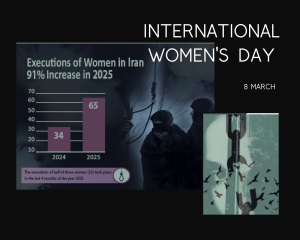 18 executions in 2021
15 in 2022
26 in 2023
34 in 2024
65 in 2025
In the first two months of 2026 alone, 9 women have been executed, demonstrating that the rise in executions is not an anomaly but the continuation of an established penal policy.
The persistence of this pattern over consecutive years indicates that the death penalty against women is not an isolated occurrence, but part of a sustained pattern of repression.
Women in the January 2026 Uprising; Widespread Participation and a Heavy Toll
The January 2026 uprising witnessed the broad participation of women from all generations and social backgrounds. From schoolgirls aged 8 to 17 to women in their 50s and 60s; from students and teachers to athletes and homemakers; women from major cities and smaller towns took part in the protests. Their presence was not symbolic; it was decisive. Women stood at the forefront and refused to retreat.
As of the time of writing, at least 259 women have been killed in the suppression of the January 2026 uprising.
Among them were:
Sonia Salehi-Rad, a 34-year-old teacher in Shiraz;
Arezoo Abedi, a 50-year-old mother in Isfahan;
Arnika Dabbagh, a 15-year-old from Gorgan;
Maedeh Moradi-Kia, 22, in Tehran;
and Zahra Bahlouli-Pour, an 18-year-old university student in Tehran.
Reports document direct gunfire at unarmed protesters, targeting vital organs, and the use of live ammunition against peaceful gatherings. The mass arrest of women and children, the issuance of severe sentences, and death penalties against some protesters have prompted serious concern from UN experts, Amnesty International, and UNICEF.
If the large-scale killing of civilians, including women and children, occurred within the framework of an organized policy aimed at suppressing a civilian population, such acts may be assessable under the definition of a “widespread or systematic attack against a civilian population,” a key element of crimes against humanity in international criminal law.

Gender-Based Repression in the Streets
During the January 2026 uprising, repression against women was not merely part of the broader crackdown; in numerous instances, it assumed explicitly gender-based dimensions.
In one documented case, Sara Ebrahimi (also known as Darya Ebrahimi), born in 1980, was pursued by security forces in Tehran and fell to the ground. CCTV footage shows that while unarmed and defenseless, she was subjected to direct blows; one plainclothes individual kicked her in the head and face, while another struck the back of her head with a bladed weapon resembling a machete. She later died from the severity of her injuries.
Similar reports emerged from Shiraz, Mashhad, Karaj, and Rasht. Raids on women’s dormitories and the transfer of female detainees to facilities operating outside transparent oversight indicate that the control and punishment of protesting women formed part of a deliberate security strategy.
Women Political Prisoners; Resistance Behind Prison Walls
What began in the streets has continued behind prison walls. The widespread arrest of women and the issuance of long prison sentences indicate that repression has not been a temporary reaction; rather, it forms part of a sustained policy aimed at containing and silencing women protesters. For more than a year, a number of women prisoners have carried out hunger strikes every Tuesday as part of the “No to Executions” campaign; an action that has continued despite their deteriorating physical conditions.
The death sentence issued against Zahra Tabari, a university professor, prompted reactions from Amnesty International and the UN Special Rapporteur, Mai Sato.
Prisons have become instruments used to silence women’s voices; yet the continuation of protests inside prison demonstrates that resistance has not been extinguished.
Recent reports from prisons such as Evin, Qarchak (Varamin Women’s Prison), Qezel Hesar, and other detention facilities across the country indicate that with the intensification of security and military crises, concerns about the situation of prisoners have grown significantly. Prisoners are held in completely closed environments and, in emergency situations, they have neither the possibility of leaving nor independent access to food, medicine, or medical care. Under such conditions, prisoners; particularly women prisoners and those suffering from illness; remain entirely defenseless against the risks posed by war, shortages of basic necessities, and violence by prison authorities.
Legal Analysis; Gender-Based Repression and International Obligations
Right to Life
The use of live ammunition against unarmed protesters constitutes a direct violation of the non-derogable right to life under the International Covenant on Civil and Political Rights, to which Iran is a State Party.
Prohibition of Torture
Severe beatings, coerced confessions, and denial of access to legal counsel contravene the absolute prohibition of torture and cruel, inhuman, or degrading treatment under international law.
Prohibition of Gender Discrimination
Targeting women through gender-based threats, abuse, and exclusion violates international obligations to ensure equality before the law and equal protection.
Rights of the Child
The killing and prosecution of minors in connection with protests are incompatible with Iran’s obligations under the Convention on the Rights of the Child.
Command Responsibility
Where the coordinated use of lethal force and mass detention occurs pursuant to an organized policy, responsibility may extend beyond direct perpetrators to those who ordered, knew of, or failed to prevent such violations, consistent with recognized standards of international criminal law.
In sum, if these acts constitute a widespread or systematic attack against a civilian population, they may fall within the scope of crimes against humanity.
Conclusion; 8 March in Iran — Equality in the Shadow of Repression
In Iran, 8 March is not merely a symbolic commemoration; it is a reminder of the cost women have paid for demanding fundamental freedoms. The link between structural discrimination in law and lethal violence in the streets is unmistakable.
In this context, March 8 in Iran is not only a reminder of the cost of freedom, but also a call to defend the full spectrum of women’s rights that have been denied; from equality before the law and participation in political and social life to the rights to life, security, and human dignity.
Given the obligations arising from international human rights treaties, relevant UN bodies, Special Rapporteurs, and member states are expected to call for an immediate halt to executions, particularly of women and individuals under 18, and to demand the release of those detained in connection with the protests.
Protecting the right to life, ensuring fair trial guarantees, and ending impunity for serious human rights violations are prerequisites for equality and justice.