While global attention regarding Iran is currently consumed by ongoing wartime tensions, the judicial and security apparatus of the Islamic Republic is exploiting this emergency to launch a systematic strategy of “physical elimination of political opponents” within the country’s prisons. This trend—characterized by rushed executions, flagrant violations of the right to a fair trial, and the refusal to return the bodies of the deceased—constitutes a clear example of “Crimes Against Humanity” and a systematic violation of the International Covenant on Civil and Political Rights (ICCPR). The enforced disappearance of executed prisoners’ remains is not an incidental occurrence, but a long-standing state policy designed to psychologically torture families and prevent the graves of protesters from becoming hubs of justice-seeking. Under international conventions, this practice itself constitutes “torture” against the survivors and a violation of human dignity.

Enforced Disappearance of Bodies and Violation of Survivors’ Rights
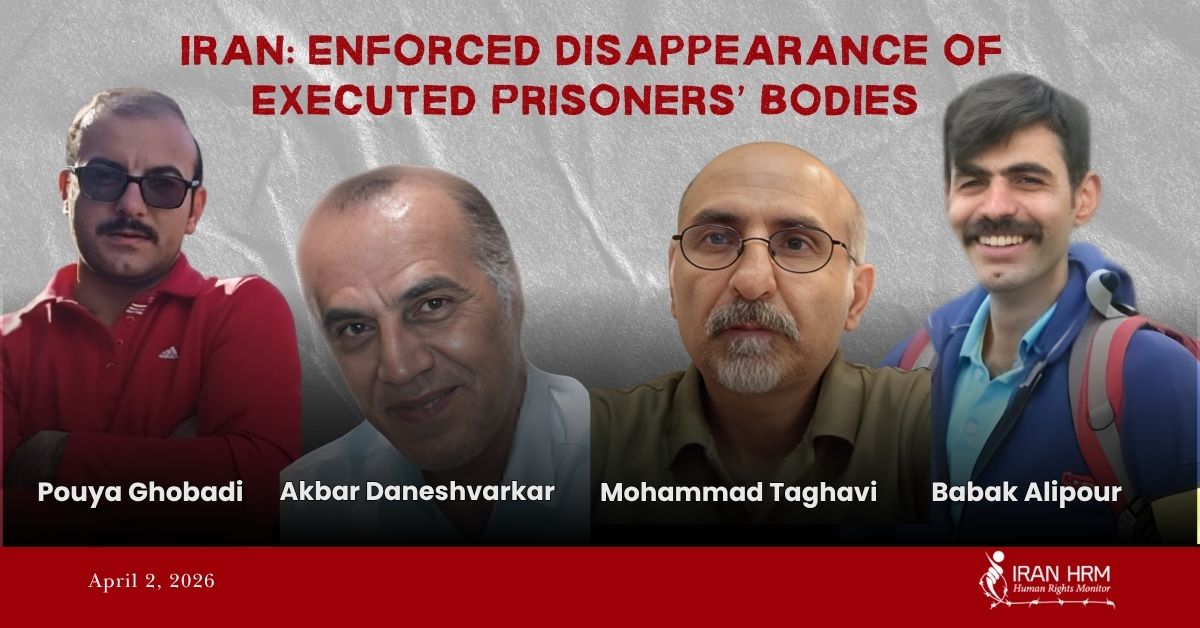
According to reports from Iran Human Rights Monitor (IRAN HRM), a few days after the execution of four political prisoners—Babak Alipour, Mohammad Taghavi, Akbar Daneshvarkar, and Pouya Ghobadi—the judiciary continues to refuse to return their bodies to their families. Despite repeated inquiries to various institutions, the families have been met with absolute silence and a lack of accountability.
This practice is a continuation of a consolidated policy previously applied to Mehdi Hasani and Behroz Ehsani (executed in August 2025), whose burial locations remain undisclosed to their families after several months. From the perspective of international law, the refusal to return remains and the concealment of burial sites violate Articles 7 and 17 of the ICCPR and fall under the category of “Enforced Disappearance,” inflicting continuous and inhumane suffering upon the families.
Documentation of Serial Executions in Qezel Hesar
Within 48 hours, the execution machine claimed the lives of four political dissidents:
- Monday, March 30, 2026: The sudden execution of Mohammad Taghavi and Akbar Daneshvarkar.
- Tuesday, March 31, 2026: The execution of Pouya Ghobadi and Babak Alipour.
These sentences were carried out without any prior notification or legal summons served to their lawyers or families. The sudden implementation of these sentences deprived the convicts of their right to seek a “retrial” or a “stay of execution,” categorizing these acts as “extrajudicial and arbitrary executions.”
Imminent Danger to Vahid Bani Amerian and Abolhassan Montazer
Vahid Bani Amerian is one of the defendants in a joint case involving six individuals who were tried in Branch 26 of the Tehran Revolutionary Court, presided over by Judge Iman Afshari (October 2024). Following the execution of four of his co-defendants (Taghavi, Daneshvarkar, Ghobadi, and Alipour), he and Abolhassan Montazer are now at the forefront of the execution queue.
Olivier Grondeau, a French citizen who was imprisoned with Vahid for 900 days in Evin Prison, released a poignant video speaking of Vahid’s character and warning about the danger of his execution, stating:
“Vahid is my friend. We aren’t compatriots, we aren’t colleagues, and our political outlooks are different, but he is my friend—a very polite, wise, and courageous young man. We never grow tired of the friends we made in the torture chambers. We never grow tired of the friends we met in prison.”
Vahid Bani Amerian, along with his co-defendants, was sentenced to death, imprisonment, and internal exile in December 2024. The transfer of Vahid and Abolhassan Montazer to solitary confinement following the anti-riot guard’s raid on Ward 4 on March 29 indicates the security apparatus’s determination to execute these two political prisoners as soon as possible. On Sunday night, March 29, 2026, the Qezel Hesar anti-riot unit raided the political prisoners’ unit (Ward 4), transferring all 22 prisoners to unknown locations. Subsequently, Mohammad Taghavi and Akbar Daneshvarkar were executed on March 30, followed by Babak Alipour and Pouya Ghobadi on March 31.
Issuance of Death Sentences and Fabricated Charges Amidst Crisis
The pace of issuing and upholding death sentences for other political prisoners has also accelerated:
- Mansour Jamali (Choobindar Prison, Qazvin): The death sentence for this 56-year-old prisoner, charged with “Moharebeh (Enmity against God) through membership in the PMOI,” has been upheld. The charge was served to him 15 months after his initial arrest by an interrogator named “Hokmi,” indicating fabricated case-building and a violation of the defendant’s right to a defense. His sentence was originally issued by Branch 1 of the Qazvin Revolutionary Court, presided over by Esmail Asadi.
- Raoof Sheikh Maroufi (24) and Mohammad Farji (23): These two political prisoners from Bukan, after three years of limbo in the city’s central prison, were sentenced to death by Branch 1 of the Mahabad Revolutionary Court on charges of “Moharebeh” and “Corruption on Earth.” The sentences were served to them on Tuesday, February 24, 2026; informed sources report the use of severe physical and psychological torture to extract forced confessions.
Transfer of January 2026 Protesters to Unknown Locations
Amnesty International has warned about the situation of five young protesters: Mohammad-Amin Biglari, Ali Fahim, Abolfazl Salehi Siavashani, Amir-Hossein Hatami, and Shahin Vahed-Parast Koulou. These individuals, who have been subjected to torture including flogging, prolonged solitary confinement, and death threats at gunpoint, were moved from Ward 4 of Ghezel Hesar to an unknown location. This clandestine transfer likely signifies that these prisoners have entered the execution implementation stage.
International Reactions and the Necessity for Urgent Action
Volker Türk, the UN High Commissioner for Human Rights, reacted to the execution of the four political prisoners, writing on the UN’s official X account:
“As if pain & suffering of war are not enough, Iranians are being arbitrarily rounded up, jailed, subjected to unfair trials & even executed by own Govt. This is outrageous. All executions must be halted immediately. The human rights of the Iranian people need to be the top priority.”
Amnesty International also warned of a new wave of executions, stating that at least seven other prisoners face imminent death. Diana Eltahawy, Amnesty’s Deputy Regional Director for the Middle East and North Africa, emphasized that the continuation of executions while people are embroiled in war and bombardment proves that the death penalty is being used as a tool to suppress dissent.
Urgent Action: A Call for International Accountability
We call upon all international bodies, the UN Special Rapporteur on Iran, and member states of the Human Rights Council to go beyond mere statements of condemnation and pursue the following actions:
- Dispatch an International Fact-Finding Mission to investigate the status of prisoners in Ward 4 of Ghezel Hesar and prevent the execution of Vahid Bani-Ameryan and the seven other prisoners at risk.
- Exert Legal Pressure to End the “Disappearance of Bodies”: The Iranian government is obligated under human rights standards to return the remains of the executed and respect the right to burial and mourning.
- Judicial Prosecution of Perpetrators: Activate the Universal Jurisdiction mechanism for judges such as Iman Afshari and Esmail Asadi, as well as senior judicial officials who issued and implemented these arbitrary execution orders.
The international community must understand that every moment of silence is complicity in a crime that, under the cover of war, takes the lives of the most noble children of this land. The responsibility to stop this killing machine is an international legal obligation, not a political choice.