Escalation of Systematic Repression Against Female Political Prisoners
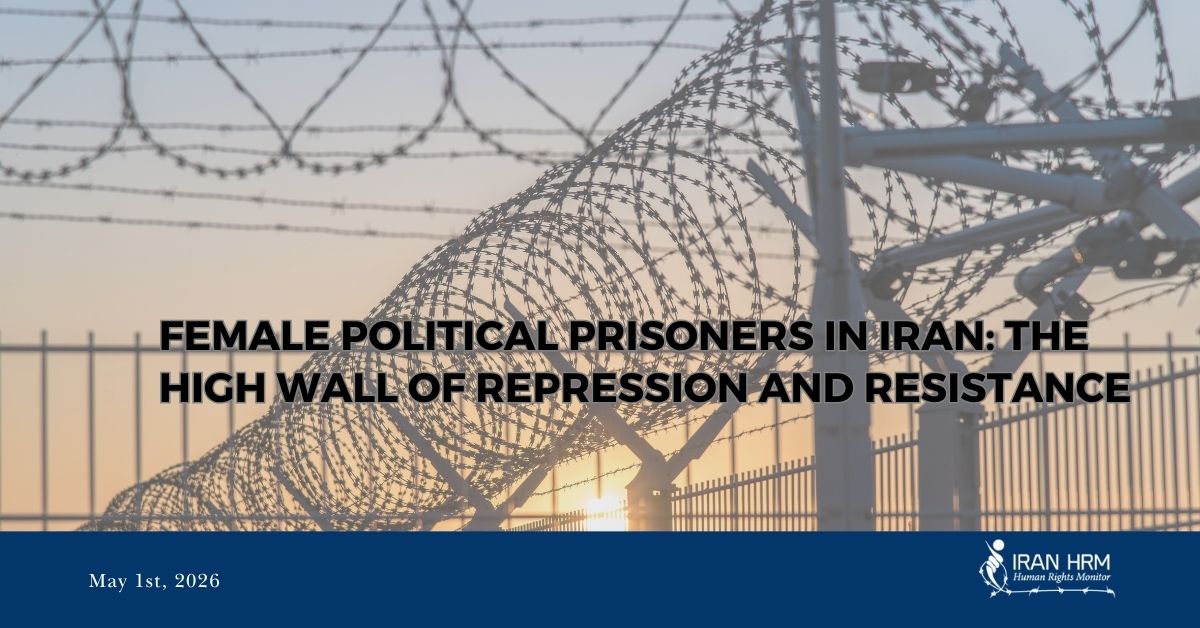
The situation of female political prisoners in Iran has reached a new critical stage in recent months, coinciding with the security shifts of 2026 (1404-1405 SH). Reports from various prisons across the country indicate that the judiciary, in collaboration with security agencies, has adopted a brutal strategy to suppress female political prisoners. This strategy ranges from repeated “parallel” case-building during imprisonment and acute medical deprivation to the revocation of citizenship and torture in solitary confinement. This report examines the cases of six women who currently stand against this machinery of repression.

- Forough Taghipour and Varisheh Moradi: The Engineering of Extended Sentences in Evin
In Iranian prisons, the “engineering of extended sentences” is utilized to prevent the release of political prisoners. Forough Taghipour, an accounting graduate, is a prime example of a female political prisoner falling victim to the influence of interrogators over judges. Although her initial 15-year sentence (on charges of Baghi) was previously reduced to 5 years, she recently faced a new case and was sentenced to an additional year in prison for issuing a statement on “Student Day.” This sentence was communicated to her inside the prison by Judge Sharifi-Nasab.
Simultaneously, Taghipour has faced disciplinary restrictions. According to reports, on February 17, she was informed of a one-month ban on phone calls and visits for allegedly “publishing false content.” This “disciplinary punishment” was implemented on February 21, aiming to break the prisoner’s morale and coerce her into silence.
At the same time, female political prisoners Varisheh Moradi faces ongoing case-building and new convictions. She was sentenced to two additional 6-month terms for participating in a statement marking the anniversary of the 2022 protests and for protesting the execution of political prisoner Reza Rasaei on August 6, 2024. While her initial death sentence (issued by Judge Salavati) was overturned by the Supreme Court, the judiciary aims to keep her in permanent limbo through these “drip-feed” additional sentences. These actions demonstrate the direct influence of security interrogators in judicial rulings, intended to keep female political prisoners isolated from Iran’s evolving society.
- Mahshar Parandin: Silent Murder via Medical Deprivation
One of the most horrific dimensions of human rights violations against female political prisoners is the deliberate denial of medical treatment. Mahshar (Mohtaram) Parandin, a Christian convert held in Evin, suffers from acute heart disease and two tumors—one near the cerebellum and another in the throat. The cerebellar tumor has caused significant impairments in balance, movement, and speech (notable pauses in speech).
Due to the lack of medical care, the tumors have grown, and the swelling in her throat is now clearly visible. Despite her deteriorating condition, she has been denied medical leave and the prosecutor has rejected her request for conditional release for treatment. This “silent execution” approach places her at imminent risk of death.
- Zahra Mousavi: Revocation of Citizenship and Judicial Apartheid in Mashhad
The case of Zahra Mousavi, a 21-year-old protester arrested during the January 2026 protests and held in Vakilabad Prison, Mashhad, reveals a new dimension of repression. She was sentenced by the Mashhad Revolutionary Court to a total of 10 years and 6 months in prison. Under the law of aggregation of sentences, 4 years are executable, while the remainder is suspended. Her charges include “forming a group,” “training and manufacturing incendiary devices (Molotov cocktails),” and “inciting individuals to disrupt national security.”
Crucially, despite being born in Iran and serving as her family’s primary breadwinner while working as a restaurant cashier in Fariman, the Iranian government has revoked her ID card.
- Shakila Ghasemi and Anisa Fanaeian: Double Pressure on Religious Minorities
Shakila Ghasemi, a 26-year-old Baha’i citizen in Kerman, is under extreme psychological pressure. She endured 47 days of interrogation in an IRGC intelligence detention center followed by solitary confinement in Kerman Prison, with a total cutoff from her family. After more than 100 days of limbo and isolation, she has suffered severe nerve attacks and is currently being treated in the prison infirmary; however, authorities continue to deny her release on bail.
In Semnan, Anisa Fanaeian faces “economic terrorism” in addition to being imprisoned for her faith. Alongside an 8-year sentence, she faces the confiscation of her family’s assets—a clear instance of plundering citizens’ property based on their beliefs.
Violations of International Law and the Necessity for Global Advocacy
The cases of these seven female political prisoners are merely a glimpse into the widespread situation across Iran. These actions constitute a clear violation of the following international treaties:
- Violation of the Right to Life and Health (Articles 6 and 7, ICCPR): The medical deprivation of Mahshar Parandin and the psychological torture of Shakila Ghasemi are direct violations of the prohibition of cruel and inhumane treatment. According to the “Mandela Rules” (Rule 24), the state is responsible for providing healthcare to prisoners.
- Violation of the Right to a Fair Trial (Article 14, ICCPR): Repeated case-building in prison against Forough Taghipour and Varisheh Moradi without access to independent counsel has turned judicial justice into a tool for retaliation.
- Violation of Freedom of Expression (Article 19, UDHR): Sentencing Motahareh Goune-ie and Forough Taghipour for union activities and political statements is a fundamental violation of freedom of expression.
- Violation of the Convention Against Enforced Disappearances: Prolonged solitary confinement and the cutting off, of family contact (as seen with Shakila Ghasemi and Zahra Mousavi) are tools used to create a “paralyzing shock” in society.
In many political cases, the Iranian judiciary lacks independence and functions under the influence of the IRGC and the Ministry of Intelligence. Interrogators dictate the primary decisions, while judges merely execute the demands of intelligence agencies.
The international community and human rights organizations must move beyond verbal statements and increase diplomatic pressure on judicial officials. Inaction in the face of these crimes serves as a green light to the machinery of repression against female political prisoners in Iran.