The Impact of Regional Warfare on the Arrest of Protesters and Prison Conditions
According to reports received by Iran Human Rights Monitor (IranHRM), following the outbreak of military conflicts and rising regional tensions, security agencies have unprecedentedly intensified pressure on civil activists, protesters, and dissident citizens. The Islamic Republic is attempting to foster an atmosphere of terror and construct fabricated security cases to prevent the formation of another wave of nationwide uprisings—protests whose resurgence is highly probable given the collapsing economy and widespread public discontent.

Coinciding with this heightened post-war security clampdown, reports regarding the arrest of protesters and prison conditions reveal systematic mass detentions across Mashhad, Qasrqand, Shahin Shahr, Urmia, Ahvaz, and Hormozgan. Many of these detainees face severe, fabricated charges such as “espionage,” “collaboration with Israel,” and “acting against national security.” Over the past months, it has become evident that these accusations serve merely as legal pretexts to issue and execute death sentences against protesters and dissidents.
The depth of this systematic crackdown is corroborated by official statistics. According to the chief of the SSF (State Security Forces), Ahmad Reza Radan, at least 500 individuals in February-March 2026 (Esfand 1404) and more than 1,800 individuals in March-April 2026 (Farvardin 1405) were arrested during operations targeting what he labeled “hostile, espionage, and disruptive elements.” Furthermore, in Farvardin 1405 alone, more than 900 other citizens were officially “identified” or subjected to security confrontations.
Section 1: Nationwide Wave of Mass Arrests of Protesters
- Mass Arrests of Women in Khorasan Razavi Province (Vakilabad Prison, Mashhad)
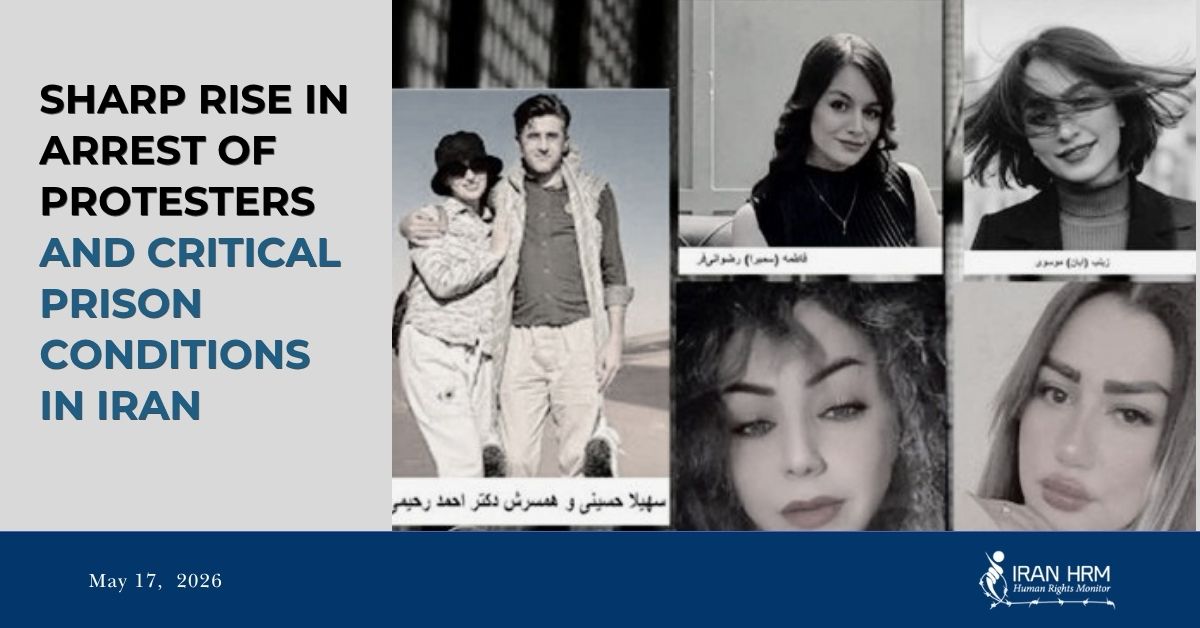
Reports indicate that at least 30 women were arrested during the December 2025-January 2026 (Dey 1404) protests and the concurrent wartime security operations in Khorasan Razavi province. A number of these women continue to be held under immense pressure inside the security wards of Vakilabad Prison in Mashhad. The names and statuses of some of these detainees include:
- Sima Anbai Freimani: A poet, theater actress, and holder of a master’s degree in law, arrested by security forces on March 15, 2026.
- Bi Bi Zahra Mousavi: A 21-year-old resident of Fariman, arrested during popular protests on January 20, 2026.
- Seyedeh Zeinab Mousavi (known as Aban): A civil activist arrested alongside her brother by state agents.
- Mahsa Bahadori: Detained solely for lighting candles on the graves of slain December 2025-January 2026 protesters; she currently faces charges of “assembly and collusion” and “propaganda against the state.”
- Azar Yahoo Torghabeh: 39 years old, arrested on March 5, 2026, for allegedly expressing joy over the death of Ali Khamenei.
- Asiyeh and Adaleh Naeimi: Two sisters, aged 45 and 50, arrested for calling into a live broadcast of a foreign satellite television channel. Reports indicate that Asiyeh developed severe neurological issues following her arrest, while Adaleh was undergoing active treatment for breast cancer prior to her detention.
- Najmeh Amini: 22 years old, held in severe limbo inside the security ward of Vakilabad Prison for nearly three months. She was brutally beaten during her arrest near the Ferdowsi Arcade in Mashhad and has been subjected to intense pressure and physical torture during interrogation.
- Military Raid and Mass Arrests in Chandookan, Qasrqand
On Wednesday, May 13, 2026, state security forces and plainclothes operatives launched a heavy military raid on Chandookan village in Qasrqand county, Sistan and Baluchestan. Deploying dozens of personnel and multiple vehicles, forces besieged the village in the early morning hours, raiding private residences without judicial warrants. Numerous local residents were brutally beaten and transferred to undisclosed locations.
- Fabricated Security Charges and Arrests in Shahin Shahr, Isfahan
In Shahin Shahr, Isfahan province, three citizens—including one woman—were detained by law enforcement and security units. The deputy commander of the provincial police alleged that the individuals were linked to foreign media outlets, accusing them of “transmitting classified information and photos of military installations” and generating a “negative psychological atmosphere” during the funerals of slain December 2025-January 2026 protesters.
- Detention of Forouzan Eslami, a Kurdish Blogger in Urmia
On Wednesday, May 13, 2026, Forouzan Eslami, an English language instructor, director of the “Nojavan” Language Academy, and a prominent Kurdish blogger in Urmia, was arrested by security forces. Agents carried out the arrest without presenting any legal warrant, and no information regarding her current location or physical well-being has been released.
- Mass Arrest of 42 Citizens in Ahvaz
Security agencies in Ahvaz carried out a coordinated mass arrest of 42 individuals. Authorities claimed the detainees were filming sensitive centers and transmitting data abroad. To date, no clear details regarding the identities of the arrested individuals, their legal procedures, or their access to independent defense counsel have been made available.
The aforementioned arrests are merely the tip of the iceberg of detentions that have leaked out of Iran, particularly under the current digital blackout. Documenting the entirety of the arrests that have managed to filter out of the country falls beyond the scope of this report.
Section 2: Critical Conditions of Prisons and Detention Facilities
- Qezel Hesar Prison: Extreme Overcrowding and Looming Executions
- Imminent Risk of Execution: Approximately 100 detainees from the December 2025-Janaury 2026 nationwide protests are being held in Ward 37 of Ghezel Hesar Prison (located in Unit 3, adjacent to the notorious “Security Ward” 35). Many face heavy capital charges and are at immediate risk of having death sentences issued or carried out.
- Deprivation of Amenities and Communication: Ward 37 suffers from severe population density, a lack of adequate space, minimal sanitation infrastructure, and a lack of basic bedding. The majority of these inmates are completely barred from telephone communication and regular family visitations.
- Nutritional Crisis in Unit 2: Conditions in Unit 2 (housing ordinary crime convicts) have deteriorated sharply. Following the onset of regional conflicts and the worsening economic crisis, prison stores have been depleted and prices have skyrocketed, leaving a vast number of inmates unable to afford basic food items or essential hygiene products.
- Sheiban Prison in Ahvaz: Communication Blackouts and Secret Centers
- Surging Inmate Influx: The continuous transfer of newly arrested protesters into the general and quarantine wards of Sheiban Prison has led to extreme overcrowding, severely compromising basic living conditions.
- Information Blockade: Stringent communication limits, combined with persistent internet disruptions and security monitoring, have severely hampered human rights organizations from documenting the accurate condition of the detainees.
- Off-site Security Detention Facilities: Reliable accounts indicate that a significant number of recent detainees are being held in undeclared intelligence detention facilities outside Sheiban Prison, entirely cut off from legal oversight.
- Security Ward “Aramesh” in Vakilabad Prison: The Underground Burial of Dissidents
- Inhumane Infrastructure of Aramesh: Dozens of women arrested during the December 2025-January 2026 protests are confined to this underground dungeon. The facility contains only 12 two-tiered bunk beds, features a critically low ceiling, and entirely lacks windows, proper ventilation, and standard sanitation or shower facilities. Former inmates describe the space as an “ant nest.”
- The Quarantine Ward: Another group of female protesters is held in a quarantine section characterized by severe neglect and a toxic stench, referred to by prisoners as the “urinal room” (Shash-khaneh).
- Violation of the Separation of Crimes Principle: Due to maximum capacity constraints, political and protest-related detainees are mixed directly with general criminals convicted of violent offenses, threatening their physical safety. Furthermore, astronomically high bail amounts prevent families from securing temporary releases.
- Evin Prison: Acute Hygiene Crisis and Pest Infestations
- Infestations of Bedbugs, Rats, and Insects: With rising summer temperatures in May 2026, the failure to conduct seasonal pest control, coupled with incomplete structural repairs following the bombardments, has resulted in massive insect and rodent infestations across the wings.
- Psychological Exhaustion: Inmates are unable to rest at night due to rats and insects crawling over their sleeping areas. Living in this highly contaminated environment has caused widespread sleep deprivation, severe psychological fatigue, and a high risk of infectious disease outbreaks.
- Babel Prison: Exploitation of Inmates for State Propaganda
- Forced Street Demonstrations: State authorities are forcing groups of ordinary inmates out of prison at night using electronic ankle monitors, equipping them with state flags, and parading them through city streets to film propaganda footage showcasing simulated “regime supporters.”
- Coercion via Terror: Due to the absolute fear of disciplinary actions, revocation of furloughs, or enhanced criminal sentences, the inmates are structurally incapable of refusing these illegal state directives.
Section 3: Violations of International Law and Human Rights Treaties
The actions executed by the Iranian regime regarding the arbitrary mass arrest of citizens and the abusive environment of the prisons violate core international treaties to which Iran is a state party:
- Violation of the Right to Life and Prohibition of Arbitrary Execution (Article 6, ICCPR): Utilizing fabricated espionage accusations to pursue capital convictions against civil protesters constitutes a direct violation of the right to life.
- Prohibition of Torture and Cruel Treatment (Article 7, ICCPR & Article 5, UDHR): The severe physical abuse of Najmeh Amini, the confinement of women in the unventilated underground ward “Aramesh,” and the medical neglect of breast cancer patient Adaleh Naeimi constitute definitive acts of torture.
- Prohibition of Arbitrary Arrest and Requirement of Warrants (Article 9, ICCPR): Besieging Chandookan village and detaining Forouzan Eslami without presenting judicial warrants are clear instances of state-sponsored kidnapping and arbitrary detention.
- Failure to Separate Inmate Categories and Provide Humane Conditions (UN Standard Minimum Rules for the Treatment of Prisoners – The Mandela Rules): Housing civil protesters alongside violent offenders (Rule 11), the unhygienic conditions of Evin and Vakilabad (Rule 13 and Rule 1 regarding core hygiene), and blocking family contact directly contravene the Mandela Rules.
- Prohibition of Exploitation and Forced Labor (Article 8, ICCPR): Forcing inmates at Babel Prison to participate in state political rallies constitutes political exploitation, forced labor, and severe psychological abuse.
- Lack of Judicial Independence (Article 14, ICCPR): The absolute domination of IRGC and Ministry of Intelligence interrogators over judges like Salavati and Sharifi-Nasab strips the judiciary of independence, rendering it an executive branch of the security apparatus.
Section 4: Duty of the International Community and Human Rights Bodies
As the ruling establishment exploits regional military crises and the fog of war to purge domestic opposition and execute protesters, international silence functions as an endorsement for further atrocities. International bodies must execute the following actions:
- Immediate Intervention by the UN Human Rights Council: The UN Fact-Finding Mission and the Special Rapporteur on the situation of human rights in Iran must immediately investigate the recent mass arrests in Ahvaz, Qasrqand, and Mashhad, demanding unhindered access to Ghezel Hesar, Sheiban, and Vakilabad prisons.
- Targeted Sanctions on Judicial Personnel and Prison Wardens: Judges issuing arbitrary death sentences, law enforcement commanders (such as Ahmad Reza Radan), and prison directors who systematically deny inmates essential medical care and basic sanitary living conditions must face severe international human rights sanctions and legal accountability.
- Diplomatic Coercion by Democratic Nations: Western governments and international human rights coalitions must condition all diplomatic and economic interactions with Tehran on an immediate halt to the wave of arbitrary arrests, the unconditional revocation of death sentences issued against December 2025- January 2026 protesters, and the complete remediation of the catastrophic hygiene and safety conditions inside the prisons.