During the crackdown on the protests of December 2025–January 2026 and the judicial handling of political and national-security cases, Gholam-Hossein Mohseni-Eje’i, the head of the Islamic Republic of Iran’s judiciary, called on judicial officials to expedite proceedings, issue judgments and enforce sentences. The country’s highest judicial authority’s emphasis on accelerating proceedings in cases that may result in the deprivation of life raises serious concerns that speed and security considerations are being prioritised over independent investigations, the effective exercise of defence rights and the guarantees of a fair trial.

On Tuesday, 14 July 2026, Tehran Prosecutor Ali Salehi stated that cases relating to the 12-day war, the protests of Dey 1404 and arrests carried out during the recent conflict had been processed, on the instructions of senior judicial officials, with “precision and speed,” and that some had resulted in the issuance and enforcement of death sentences and other final judgments. Despite this official acknowledgment, he provided no figures concerning the number of people executed or sentenced to death, their identities, the charges brought against them, the evidence used to establish guilt, or the extent to which their defence rights had been respected.
In these circumstances, the individual documentation of each death-row case is a matter of urgency. These cases should not be viewed merely as isolated incidents; they may reflect a broader pattern involving the use of vague national-security charges, reliance on confessions obtained under coercion, denial of access to lawyers of the defendants’ own choosing, closed or televised trials, disregard for evidentiary contradictions and the absence of independent evidence, and the use of the death penalty to suppress dissent and instil fear in society.
This series has been prepared to identify, document and regularly update the cases of individuals whose names and fate have remained concealed in official reporting and who face the risk of execution.
Case Number: IR-DRC-0001
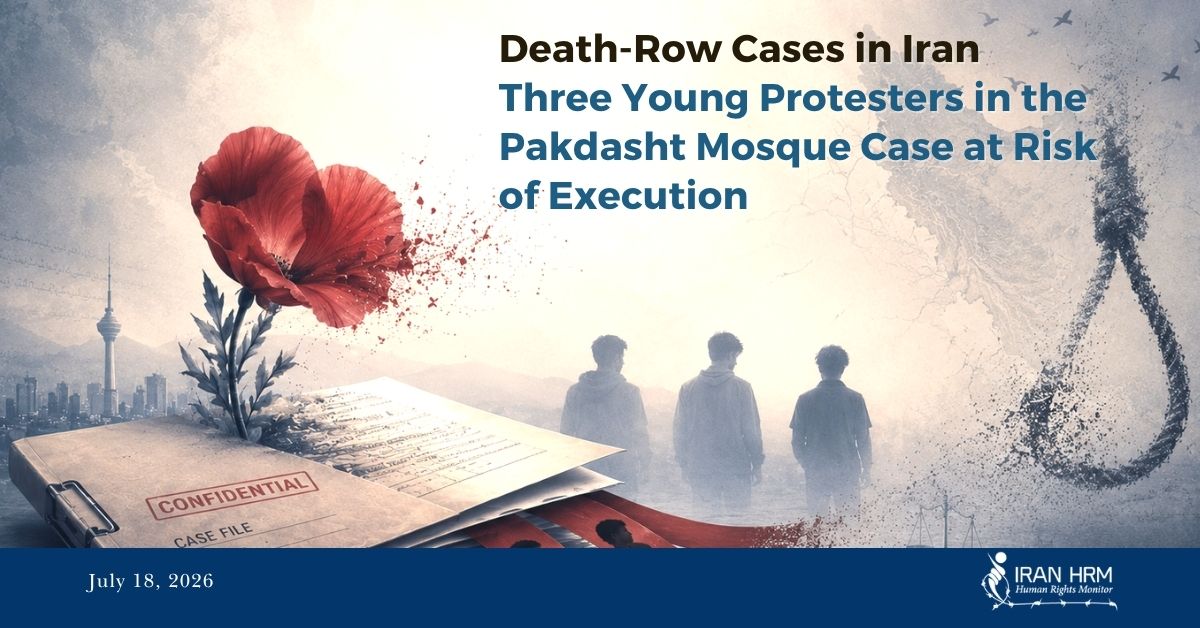
Ehsan Hosseinipour Hesarloo, Erfan Amiri and Matin Mohammadi—three teenagers and young men arrested in connection with the protests of Dey 1404—have been sentenced to death in a joint case. The proceedings against them have been marked by serious allegations of torture and coerced confessions, denial of access to lawyers of their own choosing, a lack of independent evidence, and the selective broadcast of court proceedings on state television.
Key Case Information
Case Status: Critical
Number of Defendants: Three
Number of Death Sentences: Three
Place(s) of Detention: Ghezel Hesar Prison, Karaj (confirmed for Ehsan Hosseinipour Hesarloo); the current places of detention of Erfan Amiri and Matin Mohammadi have not been independently confirmed.
Last Updated: 17 July 2026.
Case Background
During the protests of Dey 1404 (December 2025–January 2026), a mosque in Pakdasht County caught fire. The authorities of the Islamic Republic of Iran described the incident as an organised act of sabotage and accused Ehsan Hosseinipour Hesarloo, Erfan Amiri and Matin Mohammadi of participating in the attack.
Their case was heard before Branch 15 of the Tehran Revolutionary Court, presided over by Judge Abolqasem Salavati. The court convicted all three defendants on charges of enmity against God (moharebeh), corruption on earth (efsad-e fel-arz), assembly and collusion against national security, membership in a rebellious armed group (baghi), and setting fire to and destroying a mosque, sentencing each of them to death.
According to publicly available information, all three defendants denied the charges brought against them and stated that the confessions attributed to them had been extracted under torture and coercion. Reports have also raised serious concerns regarding their lack of effective access to lawyers of their own choosing, the absence of independent evidence supporting the prosecution’s allegations, and the selective broadcasting of court proceedings by state media.
Denial of Access to a Lawyer of One’s Own Choosing
Milad Panahipour, the lawyer retained by the family of Ehsan Hosseinipour Hesarloo, has stated that when he accompanied the family to Branch 26 of the Tehran Revolutionary Court, Judge Iman Afshari refused to recognise his legal representation.
At the same time, the court-appointed lawyer reportedly maintained no meaningful communication with the family. As a result, Ehsan Hosseinipour was effectively deprived of independent and effective legal representation in proceedings that ultimately resulted in a death sentence.
Disputed Confessions and Allegations of Torture
According to statements made by the family’s chosen lawyer, three court hearings were conducted in the presence of cameras operated by the Judiciary and the Islamic Republic of Iran Broadcasting (IRIB).
During the first two hearings, Ehsan Hosseinipour denied all charges and stated that his earlier confessions had been obtained through violence, including by forcing a firearm into his mouth, and therefore had no evidentiary value.
No video or official account of those two hearings has been released.
Only the third hearing, recorded on a Friday, was later broadcast on state television. During that session, Ehsan Hosseinipour appeared to confess to setting fire to the mosque and to the killing of two individuals.
The withholding of the hearings in which the defendant rejected the allegations, while broadcasting only the session containing his alleged confession, reinforces concerns that the televised proceedings were intended not to inform the public but to reinforce the official narrative and prepare public opinion for the imposition of the death penalty.
Key Contradictions in the Case of Ehsan Hosseinipour Hesarloo
According to information published by the lawyer retained by Ehsan Hosseinipour Hesarloo’s family, several significant inconsistencies exist in the prosecution’s case:
- Ehsan Hosseinipour was reportedly arrested at 9:30 p.m. on 8 January 2026, whereas, according to the official narrative, the fire at the mosque began at approximately 10:30 p.m. the same evening.
- State television broadcast footage showing a group of protesters attacking the entrance of the mosque; however, Ehsan Hosseinipour does not appear in any of the published images.
- According to his family, a court-ordered examination of his mobile phone location data indicated that he was not in the vicinity of the mosque at the time of the incident.
- No independent witness testimony, video evidence or forensic material has been publicly presented linking him to the scene of the fire or to the alleged attack on the mosque.
- The prosecution’s case appears to rely primarily on confessions that Ehsan Hosseinipour has repeatedly repudiated, stating that they were extracted under torture, violence and threats.
- The two court hearings during which he denied all allegations have never been made public, whereas the hearing in which he appeared to confess was selectively broadcast by state television.
Profiles of the Defendants
Ehsan Hosseinipour Hesarloo
Case ID: IR-DRC-0001
Prisoner ID: IR-DRP-0001
Ehsan Hosseinipour Hesarloo, a resident of Pakdasht, was born in 2007 and was approximately 18 years old at the time of his arrest. He was arrested in Tehran on 8 January 2026 and was subsequently transferred to Ghezel Hesar Prison in Karaj.
In this case, he was convicted of enmity against God (moharebeh), corruption on earth (efsad-e fel-arz), assembly and collusion against national security, membership in a rebellious armed group (baghi), and setting fire to and destroying a mosque, for which he was sentenced to death.
According to published reports, he was repeatedly subjected to torture and other forms of coercion during detention and was forced to incriminate himself. His family has stated that the death sentence has been formally communicated to them and that he is currently at risk of execution, although no execution date has been publicly announced.
Erfan Amiri
Case ID: IR-DRC-0001
Prisoner ID: IR-DRP-0002
Erfan Amiri was 17 years old at the time of his arrest on 8 January 2026. He was tried jointly with the other defendants in this case and sentenced to death on charges including enmity against God (moharebeh), corruption on earth (efsad-e fel-arz), assembly and collusion against national security, membership in a rebellious armed group (baghi), and setting fire to and destroying a mosque.
At present, publicly available information concerning his exact place of detention, access to a lawyer of his own choosing, conditions of interrogation, and other case-specific circumstances remains limited and has not been independently verified.
Matin Mohammadi
Case ID: IR-DRC-0001
Prisoner ID: IR-DRP-0003
Matin Mohammadi, a resident of Pakdasht, was 17 years old when he was arrested on 8 January 2026. He was prosecuted alongside the other defendants and sentenced to death on charges of enmity against God (moharebeh), corruption on earth (efsad-e fel-arz), assembly and collusion against national security, membership in a rebellious armed group (baghi), and setting fire to and destroying a mosque.
During a court hearing, excerpts of which were later broadcast by state media, he was reportedly asked to identify himself in footage obtained from surveillance cameras. According to available reports, however, the individual appearing in the footage could not be independently identified without relying on the defendant’s own statements.
Information regarding his exact place of detention, access to legal counsel of his own choosing, and the conditions under which he was interrogated also remains incomplete.
Timeline of Events
8 January 2026 – Protests took place in Pakdasht, during which the Seyyed al-Shohada Mosque was set on fire. Ehsan Hosseinipour Hesarloo, Erfan Amiri and Matin Mohammadi were arrested.
8 January 2026, 9:30 p.m. – According to published information, Ehsan Hosseinipour was arrested.
8 January 2026, approximately 10:30 p.m. – According to the official account, the fire at the mosque began.
January–February 2026 – At least three court hearings were held in the presence of cameras operated by the Judiciary and the Islamic Republic of Iran Broadcasting (IRIB).
14 February 2026 – Selected footage from the court proceedings was broadcast on Iranian state television.
Following the trial – The family of Ehsan Hosseinipour Hesarloo was informed that a death sentence had been issued and that he had been placed at risk of execution.
8 May 2026 (latest verified case information available in the file) – The death sentences imposed on all three defendants remained in force, while the timing of any possible execution remained unknown.
Human Rights and Fair Trial Violations
- Reliance on Coerced Confessions
According to available reports, the defendants have stated that their confessions were obtained through torture, threats and other forms of coercion. Under international human rights law statements obtained in such circumstances must not be admitted as evidence in criminal proceedings. Reliance on such confessions in a capital case raises serious concerns regarding the fairness and integrity and reliability of the proceedings.
- Denial of Access to a Lawyer of One’s Own Choosing
Published information indicates that the defendants were denied effective access to lawyers of their own choosing. In proceedings carrying the death penalty, denial of the right to freely choose legal counsel and to communicate confidentially with that counsel constitutes a serious violation of the right to defence and the guarantees of a fair trial.
- Lack of Independent Evidence
With respect to Ehsan Hosseinipour Hesarloo, publicly available information indicates that no independent witness testimony, video evidence or forensic material has been presented linking him to the alleged offence. Furthermore, the reported timing of his arrest and the available mobile-phone location data appear inconsistent with the official account of the incident.
- Televised Proceedings and the Presumption of Innocence
The selective broadcasting of court proceedings and alleged confessions by state media before the conclusion of judicial proceedings is inconsistent with the presumption of innocence and the right to an impartial trial. Such broadcasts may prejudice public opinion and undermine the fairness of criminal proceedings.
- Death Sentences Imposed on Defendants Who Were Under 18 Years of Age
According to available information, Erfan Amiri and Matin Mohammadi were 17 years old at the time of their arrest. Should it be established that either defendant was under the age of 18 at the time of the alleged offence, the imposition or execution of the death penalty would be incompatible with Iran’s obligations under international law.
Even where uncertainty exists regarding a defendant’s age, judicial authorities are required to determine age independently and transparently before any death sentence is carried out.
- Risk of Imminent Execution
The lack of transparent official information regarding the status of the proceedings, the timing of any execution, and the current conditions of detention—together with the reported transfer of Ehsan Hosseinipour Hesarloo to Ghezel Hesar Prison—has heightened concerns that the death sentences could be carried out without adequate prior notice.
Urgent Action
The international community, United Nations human rights mechanisms, governments, diplomatic missions, and human rights organisations are urged to take immediate action to prevent the execution of Ehsan Hosseinipour Hesarloo, Erfan Amiri and Matin Mohammadi.
In particular, they are urged to:
- Call on the authorities of the Islamic Republic of Iran to immediately halt the execution of all three defendants.
- Urge the Iranian authorities to quash the death sentences and ensure that any further judicial proceedings fully comply with international fair trial standards.
- Request an independent, impartial and effective investigation into the allegations of torture, ill-treatment and coerced confessions.
- Call for the exclusion of any statement or confession obtained through torture or other forms of coercion from judicial proceedings.
- Ensure that the defendants have prompt and effective access to lawyers of their own choosing and to confidential communication with their legal representatives.
- Urge the Iranian authorities to respect their obligations under international human rights law, including the International Covenant on Civil and Political Rights (ICCPR) and the Convention on the Rights of the Child (CRC).
- Closely monitor the case and publicly raise concerns regarding any imminent risk of execution.
Applicable International Human Rights law
The issues documented in this report engage, among others, the following international human rights law:
- Universal Declaration of Human Rights (UDHR)
- Article 3 (Right to life)
- Article 5 (Prohibition of torture)
- Article 10 (Right to a fair and public hearing)
- Article 11 (Presumption of innocence)
- International Covenant on Civil and Political Rights (ICCPR)
- Article 6 (Right to life)
- Article 7 (Prohibition of torture and cruel, inhuman or degrading treatment)
- Article 14 (Right to a fair trial)
- Convention on the Rights of the Child (CRC)
- Article 37(a), which prohibits the imposition of capital punishment for offences committed by persons below eighteen years of age.
- Convention against Torture (CAT)
- Although Iran is not a State Party to the Convention against Torture, the prohibition of torture is recognised as a fundamental principle of international law and is reflected in multiple international human rights instruments.
Conclusion
The available information raises serious concerns regarding the fairness of the proceedings that resulted in death sentences against Ehsan Hosseinipour Hesarloo, Erfan Amiri and Matin Mohammadi.
The reported allegations of torture, the reliance on disputed confessions, the absence of publicly available independent evidence, concerns regarding access to legal representation, and the selective broadcasting of judicial proceedings collectively call into question compliance with internationally recognised fair trial guarantees.
The reported ages of Erfan Amiri and Matin Mohammadi at the time of the alleged offences further heighten concern regarding Iran’s obligations under international human rights law concerning the prohibition of capital punishment for persons who were under the age of eighteen at the time of the alleged offence.
Pending independent judicial review conducted in accordance with international human rights law, every possible measure should be taken to prevent the implementation of the death sentences imposed in this case.
Sources
- Judiciary of the Islamic Republic of Iran (Mizan News Agency)
- Islamic Republic of Iran Broadcasting (IRIB)
- Statements published by the lawyer retained by the family of Ehsan Hosseinipour Hesarloo
- Publicly available judicial documents and court records, where available
- International Covenant on Civil and Political Rights (ICCPR)
- Convention on the Rights of the Child (CRC)
- Universal Declaration of Human Rights (UDHR)
- Reports and documentation issued by United Nations human rights mechanisms and other publicly available human rights sources, where applicable.