Human Rights as a Tool to Cover Up Repression in the Islamic Republic of Iran
In recent years, the Judiciary of the Islamic Republic of Iran has repeatedly emphasized “adherence to citizenship rights,” “guaranteeing the rights of defendants,” “prohibition of torture,” and “fair trial standards” in official state media and affiliated publications—including IRNA, Iran Newspaper, Mizan News Agency, the Human Rights and Citizenship Journal of Imam Sadiq University, and the Research Institute for Islamic Culture and Thought.

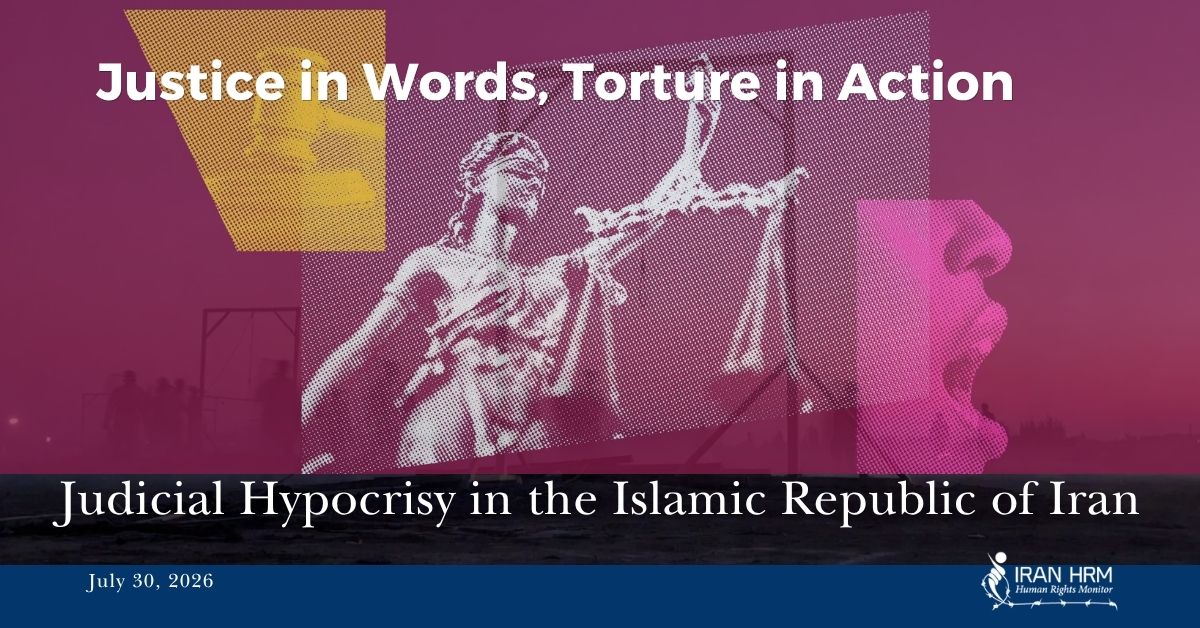
However, extensive and documented evidence demonstrates the systematic violation of these very rights in practice. The escalation of executions, particularly political executions such as the public hanging of two protesters arrested during the January 2026 (1404) protests—whose sentences were issued based on forced confessions under torture and without the right to due process—serves as the most recent example of “Justice in Words, Torture in Action: Judicial Hypocrisy in the Islamic Republic of Iran.”
Citing the Constitution of Iran, domestic legislation, international human rights instruments, and credible international reports, this report examines the fundamental contradiction between the official rhetoric and the actual conduct of the Iranian judicial system.
Official Claims of the Judiciary Regarding Citizenship Rights (Based on State Media)
IRNA News Agency – “Key Measures of Iran in the Field of Human and Citizenship Rights”
In numerous reports, IRNA claims that:
- Prisoners’ rights are fully observed;
- Regular and continuous inspections of prisons are conducted;
- Torture is strictly prohibited;
- Judicial proceedings are conducted in accordance with the law;
- Legitimate freedoms of citizens are guaranteed.
Human Rights and Citizenship” Journal – Imam Sadiq University
In articles such as “Analysis of Freedom of Assembly in Iran’s Legal System” and “Mechanisms for Restoring Public Rights,” this journal claims:
- The Islamic Republic maintains a “desirable status” regarding citizenship rights;
- Freedom of assembly and expression is guaranteed within the framework of the law;
- The Judiciary acts as the defender of public rights.
- Torture is strictly prohibited
Legal Obligations of the Islamic Republic of Iran
Constitution of Iran
- Article 32: Prohibition of unlawful arrest and detention.
- Article 35: Right to legal counsel.
- Article 38: Prohibition of torture for extracting confessions.
- Article 39: Prohibition of insulting or abusing the dignity of prisoners.
Domestic Legislation, Code of Criminal Procedure (2014 / 1392 AP):
- Article 5: Respect for the rights of the defendant.
- Article 7: Prohibition of forced confessions.
- Article 190: Right of access to legal counsel from the outset of investigations.
International Commitments
Iran is a state party to the International Covenant on Civil and Political Rights (ICCPR). Key obligations include:
- Article 7: Prohibition of torture or cruel, inhuman, or degrading treatment.
- Article 9: Right to liberty and security of person.
- Article 14: Guarantee of a fair and public trial.
- Article 19: Freedom of expression.
Contradiction Between Official Rhetoric and Operational Reality of the Judiciary
Torture and Forced Confessions
Despite Article 38 of the Constitution, numerous reports document:
- Physical beatings;
- Threats;
- Prolonged solitary confinement;
- Sleep deprivation;
- Severe psychological pressure;
- Threats against family members used to extract confessions.
International Sources:
- Amnesty International Annual Report on Iran (2023–2024);
- Reports of the UN Special Rapporteur on the situation of human rights in Iran.
These reports emphasize that televised and judicial confessions in Iran are routinely obtained under duress and torture.
Unfair Trials
Despite official media claims regarding “due process,” in practice:
- Political defendants are denied access to independent legal counsel;
- Court proceedings last only a few minutes;
- Defense attorneys of choice are disqualified;
- Severe sentences are handed down without evidentiary proof;
- Trials are held behind closed doors without the presence of independent media.
Violation of Freedom of Assembly and Expression
While official publications speak of “freedom of assembly,” protests in 2009, 2017, 2019, 2022 and 2026 were met with:
- Severe repression;
- Mass arrests;
- Use of live ammunition;
- Expedited trials;
- Heavy sentences including execution decrees.
Conditions in Prisons
Contrary to claims of “prison oversight,” credible reports demonstrate that:
- Denial of medical care;
- Overcrowding;
- Physical abuse;
- Degrading treatment;
- Prolonged solitary confinement are widespread in Evin, Qarchak, Qezeh Hessar, Dastgerd, Zahedan, etc, and security detention centers.
Legal Analysis of the Contradiction
Violation of the Absolute Prohibition of Torture
Torture is strictly prohibited under any circumstances (Article 38 of the Constitution, Article 7 of the ICCPR). The reliance on forced confessions constitutes a direct violation of this principle.
Violation of the Right to a Fair Trial
Denial of counsel, closed-door trials, and convictions based on forced confessions violate Article 14 of the ICCPR as well as Articles 35 and 165 of the Constitution.
Violation of Freedom of Expression and Assembly
The violent suppression of protests and the arrest of protesters violate Articles 19 and 21 of the ICCPR and Article 27 of the Constitution.
International Legal Responsibility of the Iranian State
Under Article 2 of the International Covenant on Civil and Political Rights (ICCPR), states are obligated to:
- Stop violations;
- Hold perpetrators accountable;
- Provide effective remedies and reparations.
Failure to execute these obligations engages the international legal responsibility of the state.
Prime Examples of “Justice in Words, Torture in Action”: Judicial Hypocrisy in the Islamic Republic of Iran
Examples of official defense regarding recent executions, which, according to various human rights organizations, lacked due process, violated the prohibition of torture for forced confessions, and constituted severe breaches of human and citizenship rights, clearly illustrate the primary objective of this judicial hypocrisy: the suppression and deterrence of protests.
Conversely, instances of the instrumental exploitation and whitewashing of human and citizenship rights, frequently emphasized in public forums by the Islamic Republic, are presented below to fully expose this judicial hypocrisy. These examples are directly cited from state media publications:
Mizan News Agency – July 30, 2026
Head of the Isfahan Province Representatives Assembly: Confronting the Perpetrators of the Alikhani Square Crime Is the Judiciary’s Decisive Response to Public Demand
The Head of the Isfahan Province Representatives Assembly described the action against the perpetrators of the Alikhani Square crime as the Judiciary’s decisive response to public demand, stating: “The execution of these sentences can serve as a deterrent for individuals influenced by enemy propaganda and actions, preventing the recurrence of such incidents in the future.”
On July 28 of this year [July 28, 2026 / 6 Mordad 1405], the death sentences of Abolfazl Sepahi Badjani and Amir Hossein Safari Hosseinabadi, two of those accused in the Shahid Alikhani Square case from January 2026 events, were carried out.
Hojjat-ol-Islam Mohammad Taqhi Naqd-Ali, in an interview with Mizan, referred to the execution of the perpetrators of the Alikhani Square incident in Isfahan, calling it a response to public demands for decisive action and emphasizing: “Carrying out these sentences plays a deterrent role in preventing the recurrence of such crimes.”
The Head of the Isfahan Province Representatives Assembly stated that the events of January 8 and 9 were unprecedented in the country, adding: “These actions, which involved the killing and assault of law enforcement and Basij forces, wounded public sentiment, generating a nationwide demand, particularly in Isfahan province, for the punishment of those responsible.”
He added: “One of the primary demands of the public was the acceleration of judicial proceedings and sentence execution. However, the procedures outlined in the Code of Criminal Procedure—such as appeal stages, revisions, and Supreme Court reviews—do not allow for the rapid issuance and execution of sentences.”
[Legal Analysis]: The official’s explicit admission that the formalities of the Code of Criminal Procedure (such as appeals and Supreme Court review) “do not allow for the rapid issuance and execution of sentences” serves as proof of political pressure exerted on the judicial system to expedite proceedings, bypass due process guarantees, and deprive defendants of effective defense rights to rush the execution of death sentences.
He expressed gratitude for the Judiciary’s performance in handling this case, stating: “The execution of the punishment and its manner were carried out in response to public demand, and we commend the actions of the Judiciary and law enforcement forces in this regard.”
In conclusion, the Head of the Isfahan Representatives Assembly stated: “Executing these sentences serves a deterrent function for individuals influenced by enemy propaganda, preventing similar incidents in the future.”
Mizan News Agency – July 29, 2026
Decisive and Uncompromising Action Must Be Taken Against Those Who Endanger Public Safety, Lives, Officers, and Protesters
On July 28 of this year [July 28, 2026 / 6 Mordad 1405], the death sentences of Abolfazl Sepahi Badjani and Amir Hossein Safari Hosseinabadi, two individuals accused in the Shahid Alikhani Square case in Isfahan from January 2026 events, were executed.
In an interview with Mizan, Abolfazl Abutorabi described the execution of the death sentences of these two individuals as a sign of the Judiciary’s decisiveness in dealing with disruptors of public security, emphasizing that those who target the security, lives, and property of the people should not be granted Islamic leniency.
Referring to the January events, he stated: “Individuals who were among the protesters but acted under the influence of foreign currents with the aim of creating insecurity must be dealt with decisively, and the Judiciary has demonstrated a defensible performance in this regard.”
Supporting the crackdown on agents of insecurity, Abutorabi called on the Judiciary to act with equal severity in investigating the illicit wealth of officials and to inform the public of the outcomes.
The member of the Isfahan Province Representatives Assembly highlighted widespread amnesties in previous years, stating: “The Islamic system has treated many convicts with clemency and forgiveness. However, there is no room for leniency regarding individuals who put public security, lives, law enforcement officers, and even protesters at risk, and decisive action is imperative.”
He further noted honoring fallen law enforcement personnel and certain protesters, asserting that a distinction exists between ordinary protesters and perpetrators of crime and violence, and that those committing criminal acts must face the maximum penalty.
[Legal Analysis]: The explicit statements by these officials indicating that the objective of carrying out death sentences is to “create deterrence” and “prevent the recurrence of protests” constitute, under international criminal law, an unintended admission of the instrumentalization of the death penalty. According to international standards, capital punishment must never be utilized as a “weapon of political intimidation and general deterrence” against protesters. These admissions prove that the Isfahan executions did not stem from an independent criminal process, but were political executions aimed at instilling fear and terror in society.
Mizan News Agency – Comprehensive Explanation of Citizenship Rights, Oversight Mechanisms, and Penalties for Violations
Fakhraddin Kord-Alivand, Judicial Deputy of Lorestan Province Justice Department and Secretary of the Provincial Citizenship Rights Board, elaborated in an interview with Mizan on the concept, dimensions, importance, supervisory structure, and legal guarantees of citizenship rights within the judicial system of the Islamic Republic of Iran, describing it as a primary metric of societal development…
Comprehensive Examples of Citizenship Rights in the Judiciary:
The Secretary of the Provincial Citizenship Rights Board categorized these rights as broad and governing relations between individuals and the Judiciary during legal proceedings, emphasizing that these rights are detailed in both the Constitution and ordinary statutes, including the Code of Criminal Procedure and the Law on Respect for Legitimate Freedoms.
He outlined these examples in two main categories:
- A) Rights Related to Due Process: Individuals possess the right to seek justice, easy access to courts, and a fair and impartial trial. The principle of legality of crimes and punishments, special attention to the presumption of innocence, and the right to legal counsel or the right to remain silent during proceedings are among these rights—such that an accused person’s silence shall not be construed as an admission of guilt.
- B) Rights Related to Privacy and Human Dignity: Prohibition of arbitrary arrest and detention, prohibition of torture during proceedings, and respect for human dignity—meaning that even if a person is a convict, they remain human and must be treated according to human dignity as the highest creation. Furthermore, safeguarding personal privacy from infringement is another core component.
Criminalization and Penalties for Violations of Citizenship Rights:
Addressing whether violations of citizenship rights are criminalized, Kord-Alivand cited Article 7 of the Code of Criminal Procedure (enacted 2014, amended 2015), which mandates compliance with citizenship rights set forth in the Law on Respect for Legitimate Freedoms and Safeguarding Citizenship Rights by all judicial authorities, judicial police, and actors in judicial proceedings. Violators are punishable under Article 570 of the Islamic Penal Code (enacted 1996, amended 2008), unless a harsher penalty is prescribed elsewhere.
He continued: “The penalty under Article 570 includes dismissal from service, prohibition from holding government positions for 1 to 5 years, and 5th-grade discretionary imprisonment (ranging from 2 months to 3 years). For instance, if an interrogator blindfolds an accused person, it falls under the scope of this article.”
Explaining the legislature’s strictness, Kord-Alivand noted: “The reason for the legislator’s strictness is that judicial authorities, judicial police, and other agents of the judicial process are state representatives operating under the Judiciary. Therefore, for a power that claims to support individual and social rights under Article 159 of the Constitution and holds the primary duty of restoring public rights and expanding justice and legitimate freedoms, such offenses—standing in direct opposition to the Judiciary’s goals—cannot be condoned.”
Conclusion: The Duty of the International Community and International Human Rights Bodies Regarding the Dual Approach of the Islamic Republic of Iran
A comparison between official documents, laws on paper, and claims made by judicial authorities of the Islamic Republic with the realities unfolding inside Revolutionary Courts and security detention centers unveils a systematic judicial hypocrisy.
On one hand, the Iranian Judiciary speaks of “citizenship rights,” “prohibition of torture,” and “human dignity” in public forums and academic journals—going so far as to criminalize the blindfolding of a detainee. On the other hand, in political and protest-related cases, branches such as Branch 1 of the Isfahan Revolutionary Court are transformed into hubs of torture, forced confessions, and mass death sentences.
The explicit admissions by members of parliament and judicial officials that the expedited execution of death sentences in the “Isfahan Alikhani Square” case was carried out to “create deterrence” prove that capital punishment in the Islamic Republic is not an instrument of justice, but rather a weapon of political repression and a tool for societal intimidation.
In the face of this hypocrisy and dual structure, the international community, the United Nations, and international human rights organizations have a duty to:
- Refuse to be misled by paper claims and showcase reports issued by the Iranian Judiciary regarding citizenship rights.
- End inaction and silence, refusing to allow the apparatus of repression to utilize human rights terminology as a cover for crimes and arbitrary executions.
- Recognize cases of torture and rampant executions in Iran—particularly the recent Isfahan sentences—as Crimes Against Humanity and initiate practical measures including targeted sanctions against judges who violate the right to life (including Judge Mohammad Reza Tavakoli in Isfahan Alikhani Sq. Case), activation of the principle of universal jurisdiction, and conditioning all diplomatic relations with the Iranian government upon an immediate halt to executions.