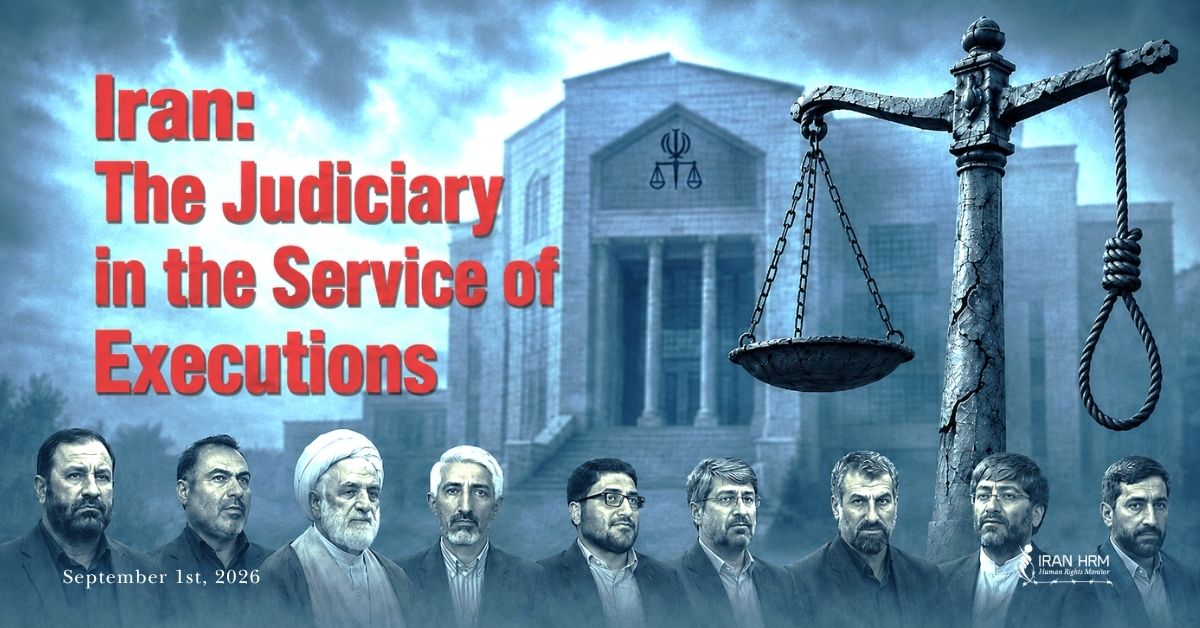
The Role of the Head of the Judiciary, Judges and Prosecutors in the Surge in Executions Following the January 2026 Uprising

The unprecedented acceleration in the use of the death penalty is the starting point for this series. At least 977 people were executed in Iran during the first seven months of 2026, almost equalling the 993 executions recorded throughout 2024. The number of executions in 2025 had reached 2,167. The trend continued in the following months: at least 23 prisoners were executed during the first four days of Shahrivar 1405 (23–26 August 2026), an average of approximately one execution every four hours.
In July 2026, Amnesty International reported an escalation in arbitrary executions and death sentences against protesters, describing them as part of a policy to punish and suppress dissent following the January 2026 uprising. In August 2026, the United Nations High Commissioner for Human Rights, Volker Türk, also warned that the Islamic Republic of Iran was using the death penalty to instil fear and suppress dissent. These figures and assessments indicate that the cases are not isolated; they reflect the extensive and sustained use of capital punishment in the context of political repression.
Numerous reports concerning political and security-related cases have documented arbitrary arrest, torture and coerced confessions, denial of effective access to legal counsel, closed or expedited trials, and death sentences. In such cases, the judiciary converts the Government’s security policies into indictments, imprisonment and capital punishment.
Article 156 of the Constitution of the Islamic Republic of Iran describes the judiciary as an ‘independent’ power. Under Article 157, however, its head is directly appointed by the Supreme Leader for a five-year term. The Head of the Judiciary exercises broad authority over judicial policy, senior appointments and a system that includes prosecutors’ offices, Revolutionary Courts, the Prisons Organisation and sentence-enforcement units. The country’s highest political authority therefore stands at the apex of the chain of judicial appointments and decision-making.
From the mass executions of the 1980s and the 1988 massacre of political prisoners to the suppression of protests in 2009, 2017, 2019 and 2022, and the January 2026 uprising, charges such as moharebeh (‘enmity against God’), efsad-e fel-arz (‘corruption on earth’) and baghy (‘armed rebellion’) have been used in cases marked by serious concerns regarding torture, coerced confessions, lack of effective access to counsel and violations of fair-trial standards.
An execution is not the result of a single person’s decision or action. It is the final stage in a chain encompassing arrest, interrogation, preparation of the indictment, issuance and confirmation of the sentence, and its implementation. This series examines the roles and powers of the Head of the Judiciary, judges, prosecutors, prison officials and sentence-enforcement personnel in that process. The first report concerns Gholam-Hossein Mohseni-Ejei, a longstanding intelligence and judicial official who was reappointed as Head of the Judiciary in July 2026.
Report No. 1: Gholam-Hossein Mohseni-Ejei — Four Decades at the Intersection of Intelligence, the Judiciary and Repression
From the Revolutionary Prosecutor’s Office and the Ministry of Intelligence to Reappointment as Head of the Judiciary
The decree reappointing Gholam-Hossein Mohseni-Ejei was issued on 4 July 2026 and announced the following day. In the decree, Mojtaba Khamenei praised what he called Ejei’s ‘valuable and sincere efforts’ and appointed him to another term as Head of the Judiciary. The decision followed the January 2026 protests and came amid an increase in arrests, expedited trials and executions.
Ejei has served in judicial and intelligence institutions since late 1979. His positions have included service in the Revolutionary Prosecutor’s Office; responsibility for recruitment screening and representation of the judiciary within the Ministry of Intelligence; Prosecutor of the Special Court for the Clergy; membership of the Press Supervisory Board; Minister of Intelligence; Prosecutor-General; spokesperson and First Deputy Head of the Judiciary. He was appointed Head of the Judiciary in July 2021 and reappointed in July 2026.
Activities in the 1980s and the Massacre of Political Prisoners
Ejei began his judicial career in the Revolutionary Prosecutor’s Office and worked during the early 1980s alongside Assadollah Lajevardi, then Revolutionary Prosecutor of Tehran and the official in charge of Evin Prison. This period was marked by mass arrests, brief and closed trials, and the execution of political opponents.
Ejei later confirmed that he had accompanied Lajevardi to a meeting with Hossein-Ali Montazeri, held in response to criticism concerning the treatment of prisoners. In his account, Ejei defended Lajevardi and described him as ‘more tender-hearted’ than the image of him held by the public.
In 1984 and 1985, Ejei was responsible for recruitment screening at the Ministry of Intelligence. From the second half of 1985 until 1988, he served as the judiciary’s representative within the Ministry. His tenure coincided with the massacre of political prisoners in the summer of 1988. Available information does not identify him as a known member of the ‘death commissions’, and further evidence would be required to attribute direct participation in the issuance or implementation of the sentences to him. His position at the institutional interface between the judiciary and the Ministry of Intelligence nevertheless warrants examination of his knowledge, authority and possible role.
The 1990s: Security Cases, the Special Court for the Clergy and the Press
From 1991 to 1994, Ejei again represented the judiciary within the Ministry of Intelligence. In 1998, the killings of Dariush Forouhar, Parvaneh Eskandari Forouhar, Mohammad Mokhtari and Mohammad-Jafar Pouyandeh exposed part of a wider series of political killings. On 5 January 1999, the Ministry of Intelligence acknowledged the involvement of personnel from within the Ministry, although the official proceedings were confined to four killings.
Ejei’s name has appeared in allegations concerning the disappearance of Pirouz Davani and the killing of Majid Sharif. Hossein Davani, Pirouz Davani’s brother, has claimed, citing information provided by lawyers in the case, that the two names were removed from the official case file and that Ejei was involved in issuing religious authorisation for the killings. The allegation has not been adjudicated by an independent court and has not resulted in a judicial ruling against Ejei.
Ejei served as Prosecutor of the Special Court for the Clergy from 1998 to 2005. Mohsen Kadivar and Hassan Yousefi Eshkevari were among the dissident clerics prosecuted and imprisoned by that court. Eshkevari was initially sentenced to death. The sentence was reduced on appeal, but following an objection by Ejei, his punishment was increased to five years’ imprisonment.
Ejei simultaneously served as the judiciary’s representative on the Press Supervisory Board. Between 1998 and 2000, the Board was involved in closing publications and restricting the work of journalists. Referring to the press, Ejei said that officials had concluded that in some instances ‘the interests and considerations of the system are being disregarded and actions are being taken against national security’.
The Ministry of Intelligence and the 2009 Protests
Ejei served as Minister of Intelligence from August 2005 to August 2009. Following protests over the results of the June 2009 presidential election, Ministry of Intelligence personnel participated in the arrest and interrogation of hundreds of political activists, journalists, students and protesters. Reported violations included detention without notification of charges, solitary confinement, beatings, threats against family members and the extraction of coerced confessions.
On 15 July 2009, Ejei stated the following regarding the broadcast of televised confessions by detainees:
“This matter depends on the judge’s view, and the judicial authorities determine and decide whether the confessions should be broadcast by state television and other media.”
Source: Islamic Republic News Agency (IRNA), 15 July 2009; republished by the Government Information Portal under the title ‘Broadcasting Confessions Depends on the Judge’s View’.
The European Union listed Ejei on 12 April 2011 and the United States designated him on 29 September 2010 for responsibility for, or involvement in, serious human rights violations. The stated grounds for these measures referred, among other matters, to his conduct as Minister of Intelligence and to the Ministry’s role in arresting, torturing and extracting coerced confessions from protesters following the 2009 election.
Prosecutor-General: Oversight of Prosecutors’ Offices and Action Against Opponents
Ejei was appointed Prosecutor-General on 25 August 2009 and remained in office until 2014. For most of his tenure, Article 17 of the Law Amending Certain Justice Laws designated the Prosecutor-General as responsible for supervising provincial and district prosecutors’ offices and promoting coordination among them. Powers delegated by the Head of the Judiciary in 2004 also enabled the Office of the Prosecutor-General to inspect prosecutors’ offices and pursue coordination and consistency of practice.
In that capacity, and concurrently as spokesperson for the judiciary, Ejei made direct public statements concerning political restrictions and cases. On 11 October 2010, he declared the dissolution of the Islamic Iran Participation Front and the Mojahedin of the Islamic Revolution Organisation to be ‘final’. On 28 February 2011, he said restrictions had been imposed on the movement and communications of protest leaders, raised the prospect of further measures, and stated that participants in ‘illegal’ gatherings would face action.
Sources: Article 17 of the Law Amending Certain Justice Laws; Islamic Republic News Agency (IRNA), 11 October 2010 and 28 February 2011.
Spokesperson, First Deputy Head and Head of the Judiciary
Ejei served as spokesperson for the judiciary from 2010 to 2019 and as First Deputy Head of the Judiciary from August 2014 to July 2021. After security personnel raided Ward 350 of Evin Prison on 17 April 2014, he rejected reports that prisoners had been beaten and stated that individuals who had made ‘false statements’ about the incident would be prosecuted and cases opened against them.
He was appointed Head of the Judiciary in July 2021. During his tenure, the 2022 protests were met with mass arrests, trials of protesters before Revolutionary Courts and executions. Updated European Union records also refer to his statements opposing leniency towards protesters during the 2022 and 2023 protests.
Ejei’s Record on Women’s Rights: From the Zahra Kazemi Case to Compulsory Hijab
The Zahra Kazemi Case and the Arbitration Panel
Zahra Kazemi, an Iranian-Canadian photojournalist, was arrested in July 2003 while photographing families of prisoners outside Evin Prison. She died after sustaining severe injuries in custody. Iranian government officials confirmed that her death resulted from a blow to the head. The only defendant tried in connection with the case was acquitted, while requests by the family’s lawyers to summon and investigate Saeed Mortazavi, then Tehran Prosecutor, produced no result.
Ali Younesi, the Minister of Intelligence at the time, later stated that an arbitration panel comprising Ebrahim Raisi, Gholam-Hossein Mohseni-Ejei and Gholam-Hossein Elham had been formed amid a dispute between the Ministry of Intelligence and the Tehran Prosecutor’s Office over responsibility for Kazemi’s death. Some reports have alleged that the panel, including Ejei, was involved in a process that resulted in Mortazavi not being prosecuted. No publicly available document has been established as showing that Ejei personally issued or signed a decision acquitting Mortazavi. His role should therefore be recorded as membership of the arbitration panel and as the subject of a documented allegation that he contributed to Mortazavi’s impunity, rather than as proven judicial responsibility.
Women’s Rights and Related Cases
On 6 June 2011, Women’s Link Worldwide named Mohseni-Ejei as a recipient of an international ‘Bludgeon Award’. The award formed part of a programme identifying the worst judicial decisions and conduct affecting the rights of women and girls. Ejei was described as the ‘most sexist judge in the world’, and his support for restricting women’s right to divorce, including through conditions stipulated in marriage contracts, was cited as a reason for the decision.
Reyhaneh Jabbari, a 26-year-old interior designer, was executed on 25 October 2014 after approximately seven years in detention. She had been convicted of killing Morteza Abdolali Sarbandi, a former Ministry of Intelligence employee, and maintained that she had acted in self-defence against sexual assault. Before the execution, Ahmed Shaheed, then United Nations Special Rapporteur on the situation of human rights in Iran, called for it to be halted and raised concerns about an inadequate investigation, failures to observe fair-trial safeguards and the failure to examine her claim of self-defence. Jabbari was executed while Ejei was First Deputy Head and spokesperson of the judiciary; however, available evidence is insufficient to attribute the decision to carry out the execution directly to him.
In his various official capacities, Ejei has described compliance with compulsory hijab laws as a legal obligation and supported judicial action against conduct that Iranian officials characterise as ‘unveiling’ or ‘promoting indecency’. These positions, together with his role in setting judicial policy, form part of his record in implementing state restrictions affecting women.
Orders to Expedite Judicial Action Following the January 2026 Protests
On 7 January 2026, Ejei instructed courts and prosecutors’ offices not to extend leniency to participants and organisers of the protests:
“Those who are issuing calls, those who come into the streets, and those who are directing them: none of them has any excuse now. Therefore, I say to the courts and prosecutors’ offices that this is no time for leniency towards these individuals.”
Source: Mizan News Agency, 7 January 2026.
On 14 January 2026, during a five-hour visit to prisons in Tehran, he emphasised the need for immediate action against detainees:
“These individuals actually beheaded people, burned people and set things on fire. If we want to take action, we must act quickly and do it in a timely manner. If, excuse me, the action is delayed, even if we take the same action two months later, it will no longer have the effect it would have if we were able to act today. If we act two or three months later, it will not have that effect.”
Source: Televised report on Gholam-Hossein Mohseni-Ejei’s visit to prisons in Tehran, 14 January 2026.
On 4 March 2026, Ejei stated:
“We are now at war. They have declared war and formally started it. If anyone uses any words or carries out any act in line with the wishes of this criminal enemy, namely the United States and the Zionist regime, they are on the enemy’s side and must be dealt with in accordance with the same revolutionary and Islamic principles applicable in wartime.”
Source: Transcript of remarks by Gholam-Hossein Mohseni-Ejei, 4 March 2026.
On 20 July 2026, he also stated:
“It may be that if we do not take a decision today, tonight or tomorrow will be too late, and important interests and matters may be lost because of the delay in decision-making. In my view, it is therefore rational and necessary for officials responsible for implementation to be granted powers.”
Source: Transcript of remarks by Gholam-Hossein Mohseni-Ejei, 20 July 2026.
Gholam-Hossein Mohseni-Ejei’s Judicial and Intelligence Positions
| Period | Position and institution | Relevant event or area |
| From late 1979 | Interrogator and judicial official, Revolutionary Prosecutor’s Office | Began work during the mass arrests and executions of the 1980s |
| 1984–1985 | Head of recruitment screening, Ministry of Intelligence | Participated in establishing the Ministry’s personnel structure |
| Second half of 1985–1988 | Judiciary representative, Ministry of Intelligence | Tenure coincided with the 1988 massacre of political prisoners |
| 1989–1991 | Head of the Tehran Economic Affairs Prosecutor’s Office | Continued service within the judicial system |
| 1991–1995 | Judiciary representative, Ministry of Intelligence | Served during an expansion of security cases against opponents |
| 1995–1997 | Prosecutor, Tehran Special Court for the Clergy | Prosecution of dissident clerics |
| 1998–2005 | Prosecutor-General, Special Court for the Clergy | Issued and pursued sentences against dissident clerics |
| 1998–2000 | Judiciary representative, Press Supervisory Board | Closure of publications and restrictions on journalists |
| August 2005–August 2009 | Minister of Intelligence | Suppression of the 2009 protests and mass arrests |
| August 2009–2014 | Prosecutor-General | Judicial handling of cases involving protesters and opponents |
| 2010–2019 | Judiciary spokesperson | Public defence of judicial policies and conduct |
| August 2014–July 2021 | First Deputy Head of the Judiciary | Senior oversight and management within the judiciary |
| July 2021–July 2026 | Head of the Judiciary | The 2022 protests, trials of protesters and increased executions |
| Since July 2026 | Reappointed Head of the Judiciary | Continuation of expedited judicial action following the January 2026 protests |
Human Rights Assessment
The reappointment of Gholam-Hossein Mohseni-Ejei as Head of the Judiciary, amid intensified arrests, death sentences and executions, was not merely the extension of a judicial administrator’s tenure. His record in intelligence and judicial institutions, his broad authority over judicial policy and his public instructions to expedite proceedings and the implementation of punishments place him in a significant position within the chain of decision-making and repression.
The increase in executions during Ejei’s tenure does not, in itself, establish his individual responsibility in every case. It does, however, require scrutiny of his role in setting policy, appointing judicial officials, overseeing courts and prosecutors’ offices, and enabling the expedited implementation of death sentences. Determining his legal responsibility requires examination of orders, correspondence, administrative hierarchies, and the extent of his knowledge and authority in each case.
Insistence on expediting proceedings is not, in itself, incompatible with the right to a fair trial. It becomes incompatible with fair-trial guarantees, however, where it limits adequate time to prepare a defence, effective access to legal counsel, full examination of the evidence, or an effective opportunity for review. These safeguards assume particular importance in cases resulting in the death penalty because of its irreversible nature. Under Articles 6 and 14 of the International Covenant on Civil and Political Rights, a death sentence imposed following proceedings that violate these guarantees may also amount to a violation of the right to life.
Conclusion
Ejei’s reappointment, together with the extensive powers vested in the Head of the Judiciary and his public insistence on expediting judicial proceedings and the implementation of punishments, heightens the need for sustained scrutiny of cases involving protesters and people sentenced to death. The preservation of evidence and an independent examination of the chain through which death sentences are issued, confirmed and implemented are essential to determining individual and institutional responsibility.