
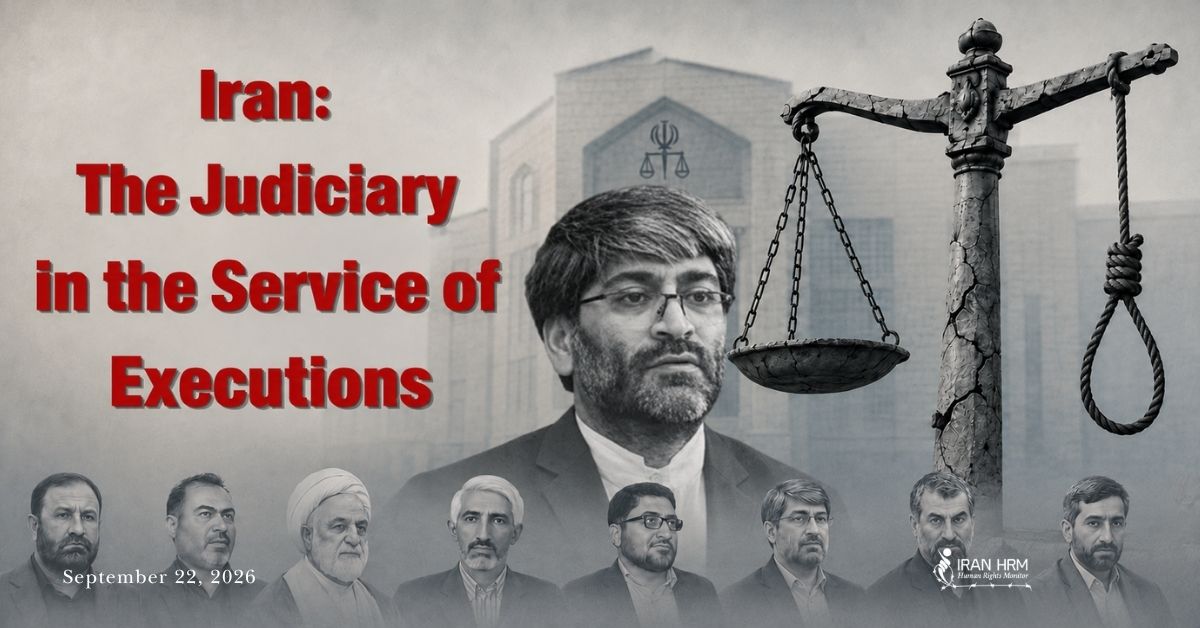
Iran: The Judiciary in the Service of Executions – No. 4

The death penalty in Iran is not the result of a decision by a single judge or court branch. Prosecutors’ offices, provincial chief justices, Revolutionary and criminal courts, the Supreme Court, sentence enforcement units and the Prisons Organisation form links in a process that may extend from arrest and the opening of a case to the execution of a death sentence.
Part four of the series ‘Iran: The Judiciary in the Service of Executions’ concerns Seyed Nasser Atabati. After years of service as a prosecutor and chief justice in Ardabil and West Azerbaijan provinces, he was appointed on 19 August 2026 (28 Mordad 1405) as President of Branch One of the Court of Appeal and Chief Justice of Tehran Province. His periods in office have coincided with executions, the amputation of prisoners’ fingers, flogging, the arrest of protesters, the prosecution of ethnic activists and restrictions on freedom of expression.
Atabati’s transfer to Tehran was part of simultaneous changes within the principal components of the judiciary; the changes also encompassed the Judicial Deputy, the Protection and Intelligence Centre, the Prisons Organisation and several other sensitive divisions. The judiciary presented these transfers as measures to improve efficiency. Their coincidence, however, with Gholamhossein Mohseni Ejei’s emphasis on expediting proceedings in security cases and cases involving severe sentences raises concern that Atabati’s experience in the judicial management of protests and corporal punishment may have been one factor in his selection for the country’s most important judicial jurisdiction. No direct connection between this appointment and possible future protests has been officially announced; this assessment is based on the context of the appointment and his previous record.
This report examines Atabati’s judicial record, public statements and documented events during his periods in office, and distinguishes between direct involvement, managerial responsibility and the mere occurrence of an event during his tenure.
The Role of a Senior Judicial Official in Executions and Corporal Punishment
Nasser Atabati’s Judicial Career
Nasser Atabati, born in 1975 in Takab and educated in criminal law and criminology, served for nearly five years as Public and Revolutionary Prosecutor of the provincial capital of Ardabil. He subsequently became Chief Justice of Ardabil Province and, on 20 May 2021 (30 Ordibehesht 1400), was appointed Chief Justice of West Azerbaijan Province.
As prosecutor, Atabati supervised criminal prosecutions, the issuance of indictments and the enforcement of sentences. As a provincial chief justice, he was also the province’s most senior judicial administrator and was responsible for administrative and judicial oversight of the courts and prosecutors’ offices. That position alone does not establish that he personally signed every sentence issued in the province. His public statements, participation in enforcement decisions and response to allegations of torture, deaths in custody and violations of the right to a defence are, however, relevant to assessing his direct and managerial responsibility.
Executions during His Tenure as Ardabil Prosecutor
Part of Atabati’s record in Ardabil concerns the announcement and oversight of the enforcement of sentences depriving individuals of life. On 3 September 2016 (13 Shahrivar 1395), in his capacity as Ardabil Prosecutor, he announced the execution of a prisoner’s qisas sentence, or retribution-in-kind, in Ardabil Central Prison. The prosecutor’s official announcement of the execution demonstrates the institutional role of the prosecutor’s office at the enforcement stage, although public information about the court’s judgment, the quality of the defence and the convicted prisoner’s access to a lawyer was limited.
On 23 May 2017 (2 Khordad 1396), Davar Hamdard, a prisoner aged approximately 50, was executed in Ardabil Prison on a drug-related charge. Babak Rezaei was also executed on 16 May 2018 (26 Ordibehesht 1397) on charges of ‘armed robbery and murder’. Meysam Saber, aged 27, was executed in the same prison on 21 October 2018 (29 Mehr 1397), and Vali Zandian, aged 45, on 18 April 2019 (29 Farvardin 1398).
On 12 June 2019 (22 Khordad 1398), Atabati also announced the enforcement of a qisas sentence against a person accused of killing two police officers in Bileh Savar. Available public documents do not establish his personal role in issuing the judgments in these cases. Nevertheless, the prosecutor’s office’s position in overseeing the enforcement of sentences depriving individuals of life, together with Atabati’s official statements, engages his institutional responsibility at the enforcement stage. The absence of complete information about the proceedings, evidence, access to a lawyer of choice and an effective appeal has also limited independent assessment of these irreversible sentences.
Amputation of Prisoners’ Fingers in Urmia
The enforcement of amputation sentences in Urmia Central Prison is the most serious documented aspect of Atabati’s record in West Azerbaijan. On 24 June 2024 (4 Tir 1403), Atabati and the Urmia Prosecutor met a number of prisoners sentenced to finger amputation. According to published information, their requests for pardon were denied and the prisoners were told that the sentences were about to be enforced.
At that time, at least seven prisoners, Hadi Rostami, Mehdi Sharafian, Mehdi Shahivand, Shahab Teymouri, Mehrdad Teymouri, Kasra Karami and Morteza Esmaeilian, faced the amputation of four fingers of their right hands. In a letter, Hadi Rostami wrote that he and his two co-defendants, Mehdi Sharafian and Mehdi Shahivand, had been tortured after their arrest to make them admit to thefts they had not committed. This allegation required an independent investigation, but no findings from any impartial examination of the origin of the confessions and the alleged signs of torture were published.
In Aban 1403, finger-amputation sentences were enforced against Shahab and Mehrdad Teymouri, two imprisoned brothers, in Urmia Prison. Then, on the evening of 30 July 2025 (8 Mordad 1404), four fingers of the right hands of Hadi Rostami, Mehdi Sharafian and Mehdi Shahivand were amputated using a mechanical device. Reports indicated that, after initial bandaging and without the completion of specialist care, they were transferred to other prisons, where they faced severe pain and a risk of infection.
There is no evidence that Atabati was present when these sentences were enforced or that he personally gave the final order for each enforcement. Nevertheless, the sentences were enforced during his tenure, and his earlier meeting with the convicted prisoners, the denial of their requests for pardon and the warning that the punishment would soon be carried out establish a clear connection between his managerial position and the sentence-enforcement process. Amputation is a punishment that deliberately causes severe pain and permanent disability and cannot be justified under the absolute prohibition of torture and other cruel, inhuman or degrading punishment.
Flogging and Support for Corporal Punishment
In Mehr 1403, Atabati announced the enforcement of prison and flogging sentences against 13 people in Urmia. They had been arrested and convicted following a group altercation in the Pol-e Qoyun area. Public information about the number of lashes, the conduct of the proceedings and the physical condition of those convicted is limited. The chief justice’s announcement of the enforcement of the punishment, however, indicates that the use of corporal punishment within the structure under his management was not a concealed event but an officially endorsed measure.
Flogging and amputation are both carried out with the purpose of inflicting physical pain and humiliating the convicted person. Article 7 of the International Covenant on Civil and Political Rights, to which Iran is a party, prohibits torture and cruel, inhuman or degrading treatment or punishment without exception.
Deaths of Mousa Esmaeili and Peyman Golvani after Arrest
In Tir 1402, reports emerged of the deaths of Mousa Esmaeili and Peyman Golvani, two Kurdish citizens, after their arrest in West Azerbaijan. Mousa Esmaeili was arrested on 7 May 2023 (17 Ordibehesht 1402), and his family learnt of his death after 62 days without news of him. Peyman Golvani was violently arrested at his family home in Mahabad on 25 June (4 Tir). After being transferred from the detention facility to hospital, he fell into a coma and died on 9 July (18 Tir).
After images of Golvani’s body were published and allegations were made that it bore signs of torture, judicial officials rejected this account. Atabati described him as a person accused of fraud and called the report that he had died under torture ‘a lie’. These statements were made before the findings of an independent, impartial and reviewable investigation were published.
No comprehensive public report was published on an independent autopsy, a review of surveillance-camera footage from the place of detention, the questioning of officials or the families’ participation in the investigation. The province’s senior judicial official had a duty to investigate allegations of torture and any death connected with detention promptly and independently. Publicly rejecting the allegations without presenting the findings of a credible investigation does not discharge Atabati’s supervisory responsibility.
Suppression of Protests and Civil Activities
During the December 2017 and January 2018 protests in Ardabil, Atabati announced the arrest of approximately 40 people and, before the judicial proceedings had concluded, described those detained using terms such as ‘instigator of unrest’ and ‘hostile to the state’. Several citizens were arrested solely for publishing online calls for a gathering. A judicial official’s use of criminal labels before a final judgment is delivered conflicts with the presumption of innocence and may prejudice the proceedings against the accused.
During the same period, Azerbaijani activists including Saeed Sadeqifar, Tohid Amir-Amini, Saleh Pichganlou, Meysam Joulani and Mohsen Mohsenzadeh were arrested after protesting against the content of a television programme, and each was sentenced to three months and one day in prison. Members of Abbas Lisani’s family were also summoned, while Ali Vaseghi and Saeed Sadeqifar were summoned to court on a security charge. These cases demonstrate that activities connected with ethnic identity, language and cultural protest met with criminal and security responses within the judicial jurisdiction for which Atabati was responsible.
Freedom of Expression and Online Activity
In his capacity as Ardabil Prosecutor, Atabati announced the arrest of administrators of Telegram channels on charges including ‘disturbing public opinion’, ‘insult’ and ‘portraying state institutions in a negative light’. Faramarz Shabanzadeh Lamer, the administrator of a Telegram channel, was sentenced to three months and one day in prison on a charge of ‘propaganda against the system’. Rahim Gholami, a poet and writer from Ardabil, also received a one-year prison sentence on a charge of ‘insulting the Supreme Leader’.
In Khordad 1397, he announced that the number of people arrested in connection with what he called ‘cyberspace crimes’ had reached 413. Published information does not clarify how many were arrested for recognised criminal offences and how many solely for expressing views, publishing news or criticism. Nevertheless, the bringing of vague charges against channel administrators, poets and writers indicates the use of criminal powers to restrict peaceful expression.
Pressure on Women and Interference in Social Life
During Atabati’s tenure as prosecutor, joint patrols by the morality police and other law-enforcement units operated in Ardabil to confront what was called ‘improper hijab’ and ‘improper dress’. In Shahrivar 1395, Atabati announced the arrest of more than 20 people in connection with modelling activities, and the closure of four women’s beauty salons and six photography studios.
Closing businesses and arresting people because of their clothing, make-up, photography or professional activity restricts the rights to work and privacy and the freedom to choose one’s way of life. Measures against breaking the fast, music and the holding of concerts also demonstrated the expansion of judicial interference in citizens’ cultural and social lives during his tenure.
The Significance of Atabati’s Appointment in Tehran
The Tehran Province judiciary oversees a large proportion of the country’s political, security, media and protest-related cases. Tehran’s prosecutors’ offices and courts hear cases involving political activists, journalists, students, women protesters, families seeking justice and social-media users, while Evin, Greater Tehran, Qarchak and Qezel Hesar prisons are connected with many of these cases.
In addition to managing the provincial judiciary, Atabati now serves as President of Branch One of the Tehran Court of Appeal. This dual position gives him both managerial authority over the province’s judicial structure and judicial authority to hear cases referred to the branch over which he presides. His record in the two provinces where he previously served, particularly his defence of criminal measures against protesters, endorsement of corporal punishment and non-transparent response to allegations of torture and deaths in custody, heightens concern about the approach of the Tehran judiciary in the new period.
Legal Assessment and Atabati’s Responsibility
The evidence concerning Atabati’s role is not the same in every case. In a number of the Ardabil executions, public information establishes only that the sentence was enforced during his tenure or that its enforcement was announced by the prosecutor’s office; there is no available document bearing his personal signature on a death sentence. In the case of the amputations of prisoners’ fingers in Urmia, the meeting with the convicted prisoners, the rejection of their requests for pardon and the warning that the sentences would soon be enforced bring his managerial role more clearly into focus. In Peyman Golvani’s case, the public rejection of the torture allegation without presenting the findings of an independent investigation relates directly to his personal position.
The enforcement of a death sentence following proceedings about which insufficient information has been published concerning access to a lawyer, the reliability of confessions or the possibility of an effective appeal places the rights to life and to a fair trial at risk of violation. Amputation and flogging are incompatible with Article 7 of the International Covenant on Civil and Political Rights. The arrest of individuals because of protest, ethnic activity or the expression of views also engages Articles 9, 19, 21 and 27 of the Covenant concerning the prohibition of arbitrary detention, freedom of expression, peaceful assembly and minority rights.
Under domestic law, Article 35 of the Constitution provides for the right to legal counsel, Article 37 for the presumption of innocence and Article 38 for the prohibition of torture and compelled confessions. The responsibility of a provincial chief justice is not confined to personally issuing or signing a sentence. Oversight of prosecutors’ offices and courts, the investigation of torture and deaths in custody, guaranteeing the right to a defence and preventing the unlawful treatment of prisoners are among the managerial duties of this official.
Conclusion
Nasser Atabati’s record, from his tenure as Ardabil Prosecutor to his leadership of the West Azerbaijan judiciary, has coincided with executions, the amputation of five prisoners’ fingers, flogging, the prosecution of protesters and ethnic activists, the arrest of online users and pressure on women. The extent of his personal role is not the same in every case, but his public statements and managerial powers demonstrate that he was not merely an outside observer of these processes.
Atabati’s appointment as Chief Justice of Tehran Province, amid a broad restructuring of the judiciary, increases the need for sustained monitoring of his decisions, judgments and managerial conduct. Corporal punishment must cease; allegations of torture and deaths in custody must be investigated by an independent body; and Atabati and other responsible officials must be held accountable for their direct or supervisory roles in executions, amputations and violations of the rights of detainees.