The Independent International Fact-Finding Mission on Iran confirmed that civilians in the country suffered serious human rights violations and “crimes against humanity committed by their government,”
UN Fact-Finding Mission Documents Crimes Against Humanity in Iran Amid Escalating State Repression
September 24, 2026

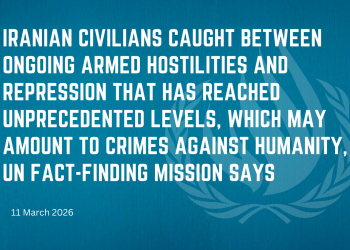
The Independent International Fact-Finding Mission on Iran has documented widespread and systematic human rights violations by Iranian authorities during the repression of the 2025–2026 protests, concluding that many of these violations may amount to crimes against humanity.
In its latest report to the UN Human Rights Council, published on September 17, the Mission found reasonable grounds to believe that Iranian security forces committed grave violations including killings, arbitrary detention, torture, and other inhumane acts against civilians.
Mass killings and lethal repression
The Mission found that killings by Iranian State security forces occurred on a large scale across all 31 provinces. The highest numbers of reported deaths were recorded in Tehran, Karaj, Mashhad, Isfahan, and Rasht.
According to the findings, security forces positioned themselves on rooftops and other elevated locations and fired assault rifles at protesters. In Karaj, security forces reportedly used tear gas to trap demonstrators in narrow streets before opening fire.
Protesters also suffered severe injuries, including wounds to the head, chest, and eyes caused by metal shotgun pellets. Some victims reportedly suffered permanent blindness.
The Mission documented the killing of at least 221 children, including children as young as two years old.
These findings underscore the scale of the State’s use of lethal force against civilians and peaceful protesters.
Attacks on medical care
The repression also extended to medical facilities and healthcare workers.
According to the Mission, security forces attacked healthcare facilities, beat and arrested wounded protesters, and detained some healthcare workers. Such actions deterred injured victims from seeking medical treatment and further endangered lives.
The findings raise serious concerns regarding the protection of the right to life and access to essential medical care during periods of mass repression.
Arbitrary arrests, torture and enforced disappearances
The Mission documented tens of thousands of arbitrary arrests and detentions during the crackdown.
Detainees were reportedly subjected to torture, solitary confinement, and denial of access to legal counsel. In numerous cases, families were not informed of the whereabouts of detained relatives, raising concerns over enforced disappearance.
These practices represent serious violations of fundamental rights, including the prohibition of torture, the right to liberty and security, and the right to a fair trial.
Families denied justice and mourning
Iranian authorities also compounded the suffering of families whose relatives were killed.
The Mission documented cases in which authorities delayed or refused to release victims’ bodies. In some cases, families were reportedly required to make payments or sign statements falsely claiming that the victims had been State agents.
Authorities also restricted or threatened mourning ceremonies and memorial gatherings.
Such measures not only obstruct families’ right to mourn but also contribute to a broader pattern of intimidation and suppression of victims’ families.
Internet blackout and suppression of information
On January 8, 2026, Iranian authorities imposed a nationwide internet and communications blackout during the height of the crackdown.
The shutdown reportedly continued for more than five months, preventing people from communicating, sharing information, and coordinating emergency assistance.
The restriction also made independent documentation of abuses more difficult at a critical time.
Executions of protesters
Following the mass arrests, Iranian authorities increasingly resorted to the death penalty against protesters.
Between March and August 2026, at least 29 men were executed following expedited trials in connection with the protests. Five of these executions were carried out publicly.
The Fact-Finding Mission also reported that more than 70 people, including five women and three boys, remained at imminent risk of execution.
The use of expedited proceedings and the reported denial of fair-trial guarantees raise serious concerns regarding arbitrary deprivation of life and the use of the death penalty following protest-related prosecutions.
UN mechanisms have separately raised concerns regarding Iranian cases involving alleged torture, arbitrary detention, enforced disappearance, and violations of fair-trial guarantees in proceedings leading to death sentences.
Crimes against humanity
The Fact-Finding Mission concluded that many of the violations documented in its investigation amount to crimes against humanity, including murder, imprisonment, torture, and other inhumane acts committed as part of a widespread and systematic attack against civilians.
The findings provide further international documentation of the serious and systematic nature of human rights violations committed by Iranian State authorities.
The evidence also demonstrates that the repression cannot be viewed solely through individual cases. Killings, mass arrests, torture, enforced disappearances, suppression of medical assistance, restrictions on mourning, communications blackouts, and protest-related executions formed interconnected elements of a broader campaign of repression.
Accountability is urgently needed
The findings of the Independent International Fact-Finding Mission reinforce the need for credible international mechanisms to preserve evidence, protect victims and witnesses, and pursue accountability for those responsible.
Iranian authorities should immediately halt executions linked to peaceful protest activity, release those arbitrarily detained, disclose the fate and whereabouts of disappeared detainees, end torture and ill-treatment, and guarantee fair trials.
The international community should support independent investigations and accountability efforts and ensure that victims and their families have access to truth, justice, and effective remedies.
The UN Fact-Finding Mission’s findings provide further evidence that decades of impunity have allowed grave violations in Iran to continue. Accountability is essential to prevent further abuses and to uphold the rights of victims and their families.