Executive Summary

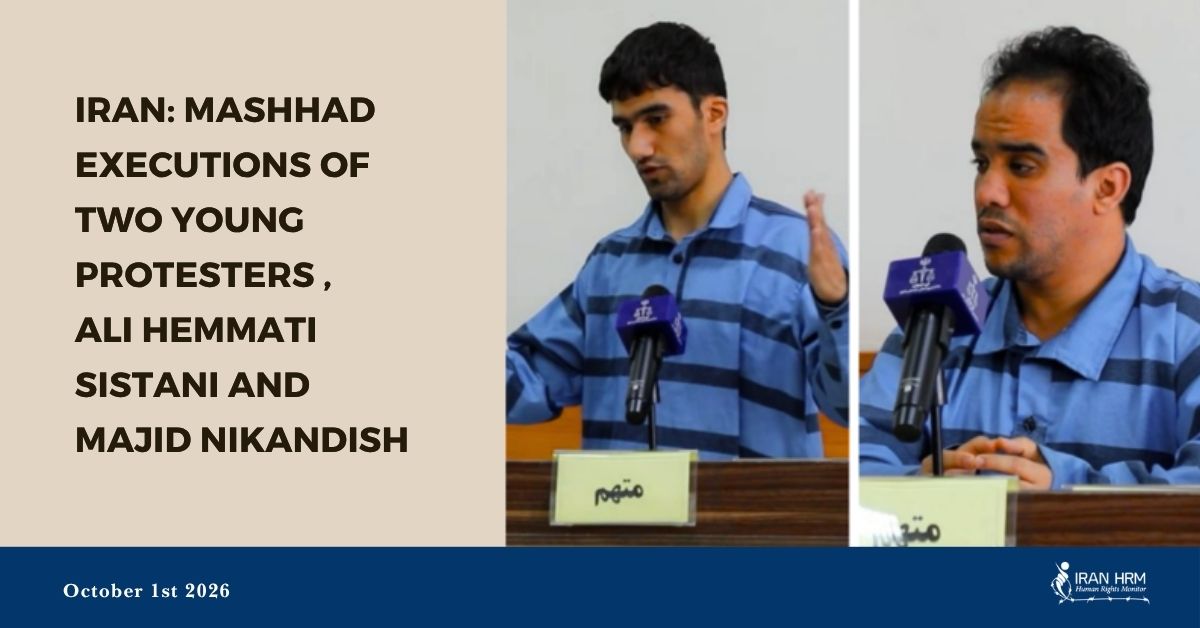
This legal and human rights report examines the dimensions of the hasty execution of two protesters arrested during the January 2026 protests, Ali Hemmati Sistani and Majid Nikandish, at Mashhad Central (Vakilabad) Prison. Relying on credible information, this document details severe and systematic physical torture (such as hanging by hands and bone fractures) used to extract forced confessions from the defendants, highlighting glaring contradictions between televised confessions broadcast by state television and the documentation of judicial authorities. Furthermore, focusing on the judicial record of Gholamreza Akbari-Moghaddam, Head of Branch 1 of the Mashhad Revolutionary Court, the report reviews severe sentences issued against other protesters—including executed individuals Ebrahim Dolatabadi-Nejad, Mehdi Rasouli, and Mohammadreza Miri, as well as imprisoned protesters Hossein Nazari and Mahboubeh Shabani—as well as lawyers, civil activists, and university professors, highlighting a flagrant violation of fair trial standards and international laws.
Introduction
Continuing the policy of repression and the issuance of heavy judicial sentences against citizens and protesters, state media reported the execution of two other detainees from the January 2026 protests in Mashhad. This report examines the legal dimensions of the executions of Ali Hemmati Sistani and Majid Nikandish, the torture methods applied to extract forced confessions, blatant contradictions in security agency documentation, and the criminal record of Judge Gholamreza Akbari-Moghaddam, Head of Branch 1 of the Mashhad Revolutionary Court.
Execution of Ali Hemmati Sistani and Majid Nikandish; blatant Torture and Hasty Execution
According to a report by Mizan News Agency (affiliated with the judiciary), Ali Hemmati Sistani (33, from Mashhad) and Majid Nikandish (23, from Quchan, Kurdish), who were arrested in connection with the January 18 and 19, 2026 protests in the Tabarsi district of Mashhad, were executed on September 30, 2026. Given that these prisoners were held in Mashhad Central (Vakilabad) Prison, the execution is believed to have been carried out there.
According to informed sources, Majid Nikandish was subjected to the most severe torture during interrogation. He was held in solitary confinement for about three months and, during interrogations, after being hung by his hands, suffered a broken jaw and a dislocated shoulder. Following these tortures, Majid was held in special cells for security prisoners, security wards, and for a period in Ward 4. In court, Majid denied the charge of leading the protests, emphasizing that he was merely present among the people and had killed no one.
Branch 1 of the Mashhad Revolutionary Court, presided over by Judge Gholamreza Akbari-Moghaddam, sentenced these two protesters to death on charges of “Moharebeh” (enmity against God) in May 2026, and the sentences were upheld by the Supreme Court in July of that same year.
Forced Confessions, Propaganda Video, and clear Contradictions in State Narrative
Shortly after the execution, the Islamic Republic of Iran Broadcasting (IRIB) broadcast a propaganda video of the prisoners’ forced confessions. The video claims that four security personnel were killed during the protests and mentions the names of other executed individuals such as Ebrahim Dolatabadi-Nejad, Mehdi Rasouli, and Mohammadreza Miri.
In the crime scene reconstruction section of the video, deep contradictions exist with Mizan News Agency’s written account:
- State Video Narrative: Ali Hemmati claims he stabbed a security officer three times in the flank and says that Majid Nikandish struck another officer four or five times in the flank and back.
- Mizan News Agency Narrative: Each defendant struck a Basij officer only twice in the flank.
- Key Contradiction: Ali Hemmati admitted in his video confession that both officers in question were alive when the ambulance arrived. This confession, alongside the lack of independent evidence, obscure aspects of the case, and the link between the defendants’ alleged actions and the deaths of security personnel, highlights the need for independent investigation
The state video narrator concludes by stating that the Tabarsi case “remains open until all perpetrators of the crime are identified and punished,” signaling ongoing threats and the likelihood of harsher sentences for other protesters.
The Criminal Record of Judge Gholamreza Akbari-Moghaddam
Gholamreza Akbari-Moghaddam, Head of Branch 1 of the Mashhad Revolutionary Court (and former Prosecutor General of Neyshabur since November 2012), has a long record of issuing death sentences, long-term imprisonment, exile, asset confiscation, and social deprivation. The following cases represent a fraction of the performance of this branch under his leadership:
- A) Hasty Executions and Death Sentences
- Ebrahim Dolatabadi-Nejad: Sentenced to death on charges of Moharebeh and leading protests on May 7, 2026, in Branch 1 of the Mashhad Revolutionary Court. Just six days after the sentence was communicated, he was executed on May 13, 2026, alongside Mehdi Rasouli and Mohammadreza Miri in Vakilabad Prison, and his assets were confiscated. Reports of torture and forced confessions have also emerged regarding Mehdi Rasouli.
- Hossein Nazari: Detainee of the January 2026 protests, sentenced to death in July 2026 on charges of communication with hostile states or groups, assembly, collusion, and Efsad-fil-arz (corruption on Earth).
- Mahboubeh Shabani (33): Sentenced to death on September 25, 2026, by the court presided over by Akbari-Moghaddam on charges of “operational action to strengthen Israel, the US, and affiliated opposition agents.”
- B) Heavy Sentences Against Defense Lawyers, Academics, and Civil Activists
- Javad Alikordi (Defense Lawyer): Sentenced to 18 years in prison, permanent disbarment from law practice, two years of travel ban, and two years of internal exile to Saravan. Security charges formed a significant portion of his punishment.
- Hassan Bagheri-Nia (University Professor and Civil Activist): Sentenced in March 2025 to a total of 10 years and 9 months in prison (5 years enforceable), 2 years ban on teaching, and a travel ban.
- Tayebeh Nazari Makiabadi: Sentenced on June 13, 2025, to 5 years in prison (4 years enforceable) on charges of assembly, collusion, and propaganda against the regime.
- Late Khosro Alikordi (Defense Lawyer): Sentenced to 1 year in prison, 2 years disbarment, and a travel ban on charges of propaganda against the state in favor of opposition groups.
- Amirreza Pedram: January 2026 protest detainee sentenced to 6 years and 3 months of enforceable prison, accompanied by reports of torture and flogging to extract confession.
- Ali Adinezadeh: Detention order upheld by Akbari-Moghaddam, with allegations of pressure and threats against the family during the proceedings. (He is the father of Abolfazl Adinezadeh, a 16-year-old boy killed by direct security forces fire on October 8, 2022. He faces detention and pressure due to seeking justice).
Systematic Violation of Human Rights and Fair Trial Standards
Examination of these rulings reveals flagrant violations of international law standards and domestic laws:
- Violation of the Prohibition of Torture: Widespread use of severe physical torture (such as suspension, jaw fractures, flogging) to extract forced confessions is a direct violation of Article 7 of the International Covenant on Civil and Political Rights (ICCPR).
- Restriction on Access to Chosen Counsel: Enforcement of the Note to Article 48 of the Islamic Penal Code of Criminal Procedure deprives security defendants of free access to independent lawyers, forcing them to select lawyers approved by the Head of the Judiciary. Furthermore, defense lawyers in these cases (such as Javad Alikordi and the late Khosro Alikordi) have themselves been targeted by repression, imprisonment, and professional bans.
- Violation of the Right to Counsel: Depriving detainees of free and confidential communication with chosen counsel or forcing them to accept “appointed defense counsel approved by security agencies” is a blatant violation of Article 14 of the ICCPR and Articles 17 and 18 of the UN Basic Principles on the Role of Lawyers. These restrictions, often aimed at extracting confessions, exerting pressure, or preventing effective defense, lack legitimate justification and are incompatible with fair trial standards under international law.
- Unconventional Speed in Carrying out Sentences: The short interval between the notification and execution of death sentences (such as Ebrahim Dolatabadi-Nejad within 6 days) destroys the possibility of effective appeal and fair trial.
Conclusion
The hasty execution of January 2026 protesters, including Ali Hemmati Sistani and Majid Nikandish, and the issuance of heavy death sentences and long-term imprisonment for other citizens, lawyers, and civil activists in Branch 1 of the Mashhad Revolutionary Court presided over by Gholamreza Akbari-Moghaddam, demonstrates the continuation of systematic repression and public intimidation. The widespread use of severe physical torture for forced confessions, glaring contradictions in security agency narratives, and the denial of defendants’ free access to chosen counsel constitute flagrant violations of fundamental fair trial principles and the Iranian government’s international obligations under the ICCPR.