Executive Summary at a Glance
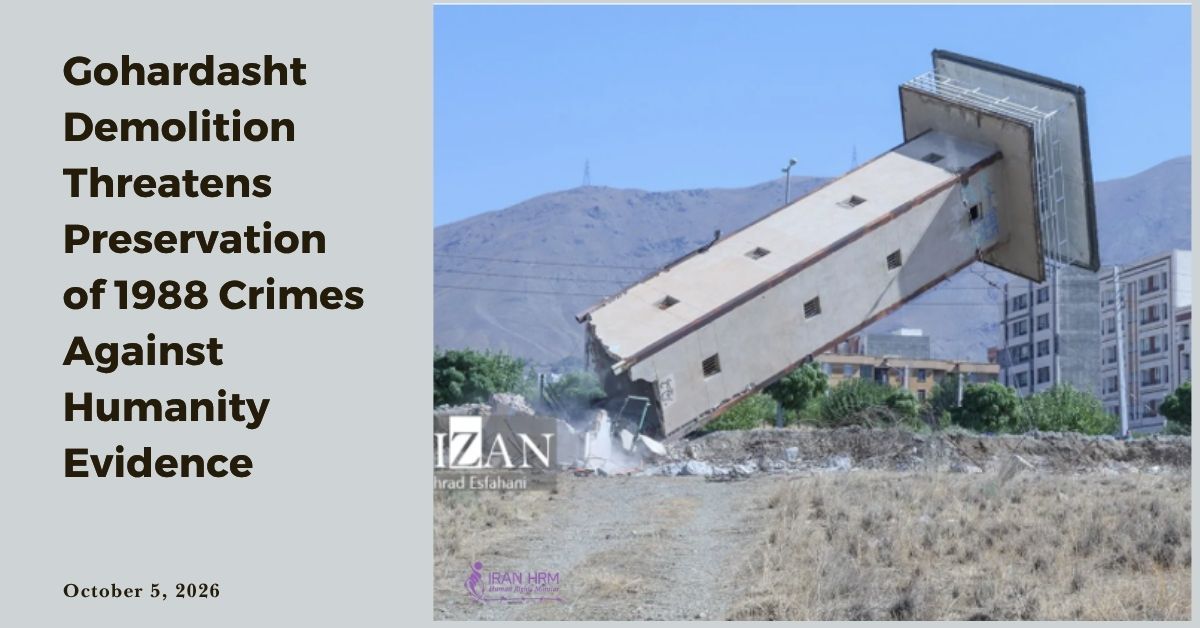
- Complete Demolition and Media Coverage of the Crime Scene: The Mizan News Agency announced on October 4, 2026 [12 Mehr 1405] the completion of the total demolition of outer perimeter walls, certain sections, and watchtowers at Gohardasht (Rajai Shahr) Prison in Karaj, following a guided judiciary media tour. This process is ongoing until the prison is completely leveled.
- Destruction of Physical Evidence of Crimes Against Humanity: Erasure of the physical layout, cellblocks, and death corridors of Gohardasht Prison—the primary site of the 1988 summer massacre—without independent documentation or 3D forensic mapping by fact-finding bodies.
- Citing Javaid Rehman’s Report and Hamid Noury’s Trial: Gohardasht’s role as the main operational site for the Tehran “Death Commission” (Nayyereh, Eshraqi, Raisi, Pourmohammadi) and the primary evidentiary basis for Hamid Noury’s life sentence by the Swedish judiciary (August 10, 2021 – July 14, 2022).
- Decades of Severe Abuse and Torture: A documented history of repression, including guard attacks on political prisoners in Hall 12 (August 2017) and severe assaults on Sunni detainees (2018).
- Violation of Domestic and International Standards: The destruction of the crime scene violates Article 554 of the Islamic Penal Code as well as Articles 3, 5, 9, 10, and 11 of the Universal Declaration of Human Rights regarding evidence preservation and fair trial guarantees.
Introduction
The complete demolition of the physical structure and perimeter walls of Gohardasht (Rajai Shahr) Prison in Karaj by the Judiciary of the Islamic Republic represents a high-risk attempt to erase historical memory and destroy physical evidence of one of the most egregious organized crimes in modern Iranian history. A facility that served as the principal crime scene for the mass execution of political prisoners in the summer of 1988, and a focal point of international human rights documentation, is now being flattened without independent international documentation.

Erasing a Key Site of Memory and Evidence of the 1988 Massacre According to Mizan News Agency
According to Mizan News Agency on October 4, 2026 [12 Mehr 1405], the 19th media tour organized by the Judiciary Media Center took place at the site of the former Rajai Shahr Prison in Karaj, attended by 35 journalists and photographers from 20 domestic media outlets, to document the conclusion of the complete demolition of perimeter walls and structural components.
As reported by Mizan, the closure process dates back to Chief Justice Gholamhossein Mohseni-Ejei’s provincial visit on April 6, 2023 [17 Farvardin 1402], during which the transfer of inmates was approved and completed by August 5, 2023 [14 Mordad 1402]. Following Ejei’s directive on February 25, 2026 [6 Esfand 1404] to accelerate demolition and land repurposing, wall and tower demolition resumed in September 2026 and concluded in October 2026.
Erasing the Physical Memory and Architectural Evidence of the 1988 Massacre
The gradual destruction of architectural and spatial components of a prison that played a central role in the mass execution of political prisoners in the summer of 1988—intensifying on September 13, 2026 [22 Shahrivar 1405] in the presence of Heidar Asiabi, head of the State Prisons Organization—has proceeded without independent investigation or technical structural recording.
In cases involving mass killings and enforced disappearances, cell dimensions, corridor layouts, interrogation rooms, the location of the “Death Commissions,” and the physical paths leading to execution sites constitute critical forensic evidence. Demolishing this topography permanently destroys the possibility of crime scene reconstruction and forensic corroboration of survivor testimony for future accountability.
Gohardasht in Javaid Rehman’s Report and Hamid Noury’s Trial
The legal and international significance of Gohardasht Prison is established in two major human rights legal frameworks:
- Javaid Rehman’s Report (17 July 2024)
In his detailed report titled “Atrocity Crimes” and grave violations of human rights committed by the Islamic Republic of Iran (1981–1982 and 1988), UN Special Rapporteur Javaid Rehman cited prisoner testimony indicating that the evacuation of Ghezelhesar Prison and the transfer of political prisoners to Gohardasht in October 1987 marked the beginning of the execution project.
The report highlights Gohardasht’s role as one of the primary execution hubs during the summer of 1988 and documents the activities of the Tehran “Death Commission”—comprising Hossein Ali Nayyeri, Morteza Eshraqi, Mostafa Pourmohammadi, and Ebrahim Raisi—which issued thousands of death sentences based on Khomeini’s fatwa.
Quoting the written testimony of Witness No. 16 from Javaid Rehman’s report:
“To convey what transpired, and to address the 1988 massacre briefly through my personal experiences, I must return to October 1987. At that time, Ghezel Hesar prison was evacuated of political prisoners, all of whom were transferred to Gohardasht prison. In my belief, this marked the beginning of the massacre.”
“Following our arrival at Gohardasht, it was evident that the situation had fundamentally changed, indicating a shift in Government policy. Restrictions grew harsher by the day: the quality and quantity of food declined, collective sports were banned, medical care was withheld, and similar measures were implemented.”
“Periodically, we were summoned from the wards for interrogation or provided with forms that were ostensibly distributed to gather information. A new phase commenced in early April 1988. The prison authorities began segregating religious and non-religious prisoners in certain wards, while a number of prisoners were relocated between Gohardasht and Evin prisons.”
- Judicial Conviction in Hamid Noury’s Trial
The trial conducted by the Stockholm District Court in Sweden (August 10, 2021 – July 14, 2022), which concluded with a confirmed life sentence for Hamid Noury for his involvement in the mass murder of political prisoners at Gohardasht, relied directly on testimony concerning the events, physical structures, and executions carried out at Gohardasht Prison during the summer of 1988.
The Right to Truth and the Rights of Families
The demolition of Gohardasht Prison is not merely about a physical building. This prison forms part of the collective memory of thousands of families who remain deprived of precise information regarding the fate, burial sites, and execution details of their loved ones. Demolishing this site without independent documentation directly conflicts with the Right to Truth, as recognized in UN frameworks and international human rights law. The destruction of this site constitutes the deliberate erasure of evidence, memory, and physical context connected to one of the largest mass executions of political prisoners in modern Iranian history.
Decades of Systematic Repression, Torture, and Abuse
Gohardasht’s history extends beyond the 1988 massacre. Over subsequent decades, the facility remained a focal point for severe torture and systemic abuse. Two documented examples include:
- Attack on Hall 12 (August 2017): Prison guards raided the political prisoners’ ward, destroyed personal belongings, and forcibly transferred inmates to high-security Hall 10, triggering a widespread hunger strike.
- Assault on Sunni Detainees (2018): Over 80 prison guards and intelligence agents raided the ward housing Sunni prisoners of conscience, subjected them to beatings and verbal abuse, and held them in open courtyards until late at night.
Legal Assessment: Violations of Domestic and International Law
The demolition of Gohardasht Prison violates a series of domestic and international legal norms, making urgent action imperative:
- Domestic Law Framework:
- Article 554 of the Islamic Penal Code: Criminalizes the destruction, concealment, or alteration of evidence of a crime intended to assist perpetrators in evading prosecution.
The rushed demolition of Gohardasht prior to independent documentation, international forensic inspection, or 3D mapping constitutes the deliberate destruction of material evidence linked to major crimes against humanity.
- International Commitments and Treaties:
- Articles 3, 5, 9, 10, and 11 of the Universal Declaration of Human Rights (UDHR): Violations of the right to life, prohibition of torture, prohibition of arbitrary detention, right to a fair trial, and fundamental rights of accused persons—rights that are simultaneously breached in cases of enforced disappearances.
- International Covenant on Civil and Political Rights (ICCPR):
- Article 6 (Right to Life)
- Article 7 (Prohibition of Torture)
- Article 9 (Prohibition of Arbitrary Detention)
- Article 14 (Right to Fair Trial)
- Articles 1, 2, and 24 of the International Convention for the Protection of All Persons from Enforced Disappearance: Particularly regarding the rights of families to know the truth about the fate and burial locations of victims.
- International Investigative Standards (The Minnesota Protocol): Under the Minnesota Protocol on the Investigation of Potentially Unlawful Death, preserving crime scenes, administrative archives, and physical evidence connected to mass killings is mandatory for truth-seeking and accountability.