Special Report for the World Day Against the Death Penalty — 10 October 2026
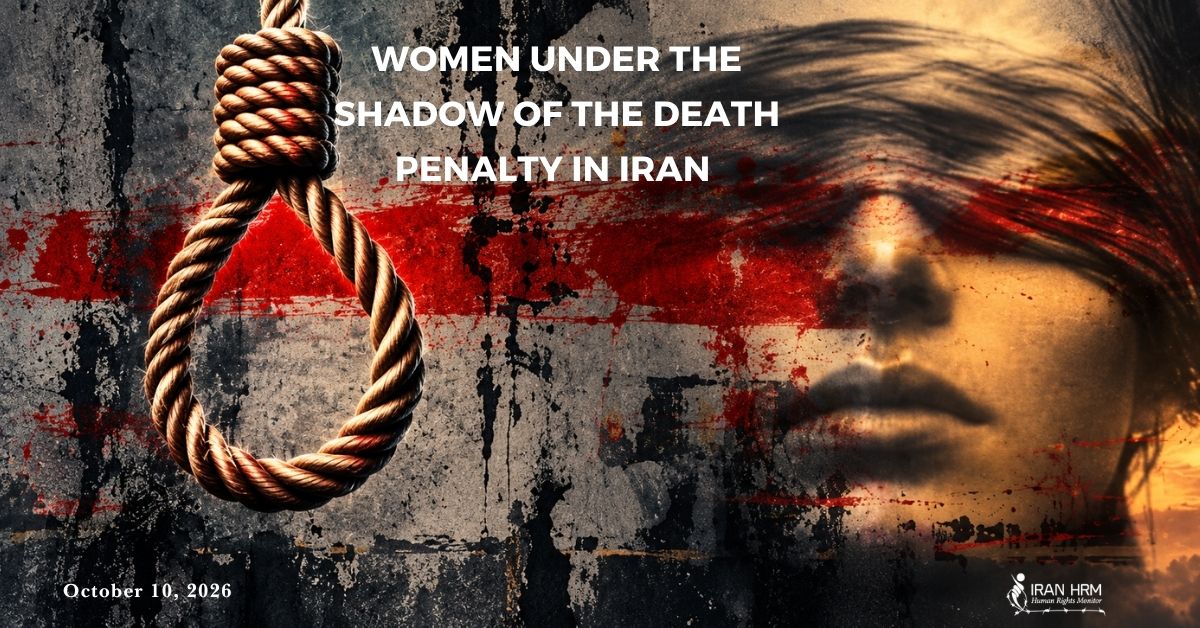
On the eve of the World Day Against the Death Penalty, the fate of women sentenced to death in Iran once again raises fundamental questions about the right to life, gender discrimination and the State’s responsibility to protect women. In a country where forced and early marriage, domestic violence and economic deprivation continue to affect the lives of some women, the judiciary has a duty, in cases leading to qisas (retribution in kind) or execution, to examine carefully any history of violence, claims of self-defence, coercion and the defendant’s individual circumstances.

Documented cases indicate that some women who were executed had themselves endured abuse and a lack of effective protection before facing the death penalty. This heightens concerns about discriminatory laws and government practices affecting women.
According to information documented up to 8 October 2026, at least 29 women have been executed in Iran since the beginning of the 2026 calendar year. Over the 12-month period from October 2025 to October 2026, at least 54 women were executed. These figures cover different reporting periods and must not be added together. Communications blackouts, restrictions on reporting and the failure to announce many executions have also prevented a complete picture from emerging.
Behind these figures are the experiences of women who faced forced marriage, sexual violence, poverty or responsibilities for caring for children. Any failure by the judiciary to consider such circumstances before imposing an irreversible sentence has profound human and legal implications.
From Forced Marriage to a Sentence of Qisas
According to the account of her case, Marzieh Nayeri was pressured by her family into an unwanted marriage at the age of 17. She had described persistent drug and alcohol use in the household, as well as harassment and assaults by people associated with her husband.
At 18, during an incident that resulted in her husband’s death, she stated that she had used a kitchen knife to defend herself and prevent a sexual assault. The court rejected her claim of self-defence, and her death sentence was carried out.
The legal issues in Marzieh Nayeri’s case extend beyond the charge of intentional homicide. It is necessary to establish how the court examined evidence of threats of sexual violence, previous abuse and the circumstances of the incident, and whether she had an effective opportunity to present a defence, witnesses and evidence.
The documented account does not, by itself, replace the full judgment and case file, but it demonstrates the need for independent examination.
According to information published about her case, Hanifeh Avandi was also subjected to forced marriage at 17 and lived for years with its psychological consequences.
Arezoo Rostad, a 23-year-old woman who was executed, had been forced as an adolescent to marry a man considerably older than herself and, according to informed sources, had experienced severe domestic violence.
In qisas cases, evidence of prior abuse or forced marriage does not automatically negate criminal responsibility. Nevertheless, courts must genuinely and impartially examine claims of self-defence, coercion, threats and other circumstances relevant to culpability and sentencing.
Where a defendant faces execution, shortcomings in such an examination can have irreversible consequences.
Poverty, Coercion and Drug-Related Cases
Drug-related offences also feature among the cases of women who have been executed. Soheila Azizi, Kimia Khani, Mina Nasirpour, Setayesh Mohammadpour and Rezvan Asgharzadeh are among the women identified in the documented cases in this category.
The circumstances and alleged role of each woman must be examined separately; a shared category of charges does not establish identical circumstances or culpability.
The case of Afsaneh Zandabadi, aged 22, raises particularly serious questions about coercion and vulnerability.
According to the published account, she had been subjected to abuse and threats by her stepfather since childhood, was deprived of the opportunity to continue her education and had repeatedly described sexual abuse. The same account states that her stepfather forced her to participate in drug-related activities. Afsaneh was subsequently executed.
This account raises specific judicial questions: Was her allegation of coercion investigated? Was the role of the person accused of abusing and compelling her examined? Did the court consider her history of abuse, her young age and her access to legal assistance?
Without access to the court file, no definitive conclusions can be reached on these questions. Nor, however, can they be excluded from a human rights assessment.
Article 6 of the International Covenant on Civil and Political Rights limits the application of the death penalty, in States that have not abolished it, to the “most serious crimes”. In its General Comment No. 36, the United Nations Human Rights Committee has made clear that drug offences fall outside that threshold.
Concerns about the execution of women for drug-related offences therefore arise independently of whether coercion can be established in an individual case.
Mothers Who Were Executed: Consequences for Children
At least eight mothers were identified among the women executed in the cases examined.
The recorded names are Tayebeh Hekmat, Asma Zarei, Setayesh Mohammadpour, Azam Gerami, Mahtab Shirmohammadi, Zahra Azizpour and Rezvan Asgharzadeh. The underlying account names seven women; the identity of the eighth mother is not specified.
Asma Zarei, a 28-year-old mother, gave birth to her child while imprisoned. The child was just two years old when she was executed.
Setayesh Mohammadpour had two children, aged eight and eleven.
According to information about her case, Rezvan Asgharzadeh, a 45-year-old mother of six, had previously been included on a list of prisoners eligible for clemency. Her name was subsequently removed from that list, and her death sentence was carried out. The reasons for, and procedure governing, that change require examination of the relevant records.
The execution of a mother does not merely sever one person’s ties with her family. For children, it may result in permanent separation, loss of care, psychological harm and economic insecurity.
These effects must be assessed in light of the actual circumstances of each child, rather than presumed to apply identically to every family.
The right to life of women without children is equally fundamental and must not be overshadowed by this attention to mothers.
Lack of Judicial Protection and International Obligations
A common feature of the cases discussed is the reported existence of vulnerabilities predating the alleged offences: forced marriage, domestic violence, sexual assault, poverty, exclusion from education or coercion into unlawful activity.
These factors have not been reported with the same severity or in the same circumstances in every case. An independent investigation must establish the specific role of each factor in the alleged offence and how it was examined by the court.
Article 14 of the International Covenant on Civil and Political Rights guarantees the right to a fair trial. In capital cases, effective access to legal counsel, the opportunity to present a defence and evidence, investigation of allegations of torture or coercion, and the right to appeal are of particular importance.
Where a death sentence follows proceedings that violate these fundamental safeguards, its execution may raise the issue of arbitrary deprivation of life.
Officially published information on the number of women executed, the charges against them, the number of mothers, histories of violence and the circumstances of their trials remains incomplete.
This lack of transparency restricts public scrutiny of criminal justice and makes accountability more difficult in cases that have ended in the death of a convicted person.
Conclusion and Urgent Calls for Action
These cases place a fundamental question before Iran’s judiciary: when a woman has endured years of violence, forced marriage or economic coercion before an alleged offence, has the justice system protected her and subsequently examined, with the necessary care, all circumstances relevant to her responsibility?
Once a death sentence has been carried out, there is no possibility of remedying a miscarriage of justice or meaningfully reconsidering the consequences of a flawed trial.
On the World Day Against the Death Penalty, executions must be halted immediately and a formal moratorium on the death penalty established. The cases of women who have alleged violence, self-defence, coercion or violations of fair-trial rights must be independently reviewed; comprehensive, disaggregated statistics on the execution of women must be published; and effective legal and social support must be made available to women subjected to violence and to the children of those sentenced to death.
The fates of Marzieh Nayeri, Afsaneh Zandabadi, Asma Zarei and the other women named here are not merely accounts of lives ended by execution. These cases test the criminal justice system’s accountability for violence previously inflicted on women, the right to a defence and the right to life. No justice system should compound its failure to protect victims of violence with an irreversible punishment.
Legal Instruments
- United Nations Human Rights Committee: General Comment No. 36 on the right to life, document CCPR/C/GC/36.
- International Covenant on Civil and Political Rights: Articles 6 and 14.