This report constitutes the second part of a five-section analytical series examining the structure of corruption in Iran. The first section outlined the overall architecture of this system; the present section focuses on its central pillar: economic corruption.
In the ruling regime in Iran, corruption is not the consequence of isolated misconduct but rather a governing method in which extra-legal institutions, semi-state conglomerates, bodies under the Supreme Leader, the IRGC, ministries, banks, and intermediary networks form a closed loop designed to transfer public wealth to the centers of power.

 1. Mega-Conglomerates and Institutionalized Monopolies
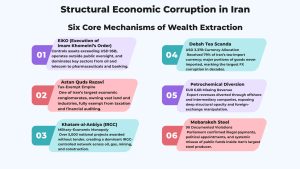
1.1. Execution of Imam Khomeini’s Order (EIKO) — Assets Exceeding USD 95 Billion
- Hamshahri – 14 January 2021:
“EIKO, with assets amounting to tens of billions of dollars, is one of the largest economic conglomerates in the country and lacks any transparent financial structure.”
EIKO operates outside all formal supervision. Its activities span pharmaceuticals, telecommunications, banking, oil, construction, and more. Independent assessments estimate its asset value at over USD 95 billion.
The concentration of such vast resources in an institution with no public accountability has pushed the national economy toward opaque accumulation of power and wealth and has severely weakened the real private sector.
1.2. Astan Quds Razavi — A Tax-Exempt Economic Empire
- Shargh – 10 October 2019:
“Astan Quds remains one of the country’s largest economic entities and has not paid taxes even in its most profitable years.”
Astan Quds owns a significant share of land, factories, urban assets, and economic enterprises in Mashhad and beyond. It is entirely exempt from taxation and formal auditing.
This exemption exemplifies an economy in which vast public assets lie beyond governmental oversight and serve primarily as engines of concentrated wealth rather than public welfare.
1.3. Khatam-al-Anbiya Headquarters — 5,000 Major Projects without Tender
- Official Parliamentary Report – 17 August 2020:
“Khatam-al-Anbiya Headquarters has received more than five thousand national projects without competitive bidding.”
As the primary economic arm of the IRGC, Khatam-al-Anbiya dominates major projects in oil, gas, petrochemicals, mining, infrastructure, and telecommunications.
Its vast reach has eliminated competitive markets and pushed the economy toward militarization and monopoly, restricting opportunities for private-sector growth and transparency.
2. Major Corruption Cases
2.1. Debsh Tea Company — USD 3.4 Billion in Allocated Currency
- Shargh – 14 July 2023:
“The Debsh Tea case is the largest foreign-currency corruption of the past three decades.” - Hamshahri – 27 July 2023:
“Seventy-nine percent of all foreign currency allocated for tea imports was granted to a single company.”
Between 2019 and 2022, the company received USD 3.37 billion in subsidized foreign currency, while a significant portion of the goods was never imported or was sold at free-market rates.
This unprecedented concentration of currency allocation reflects a system where resource distribution is driven by political access and insider networks, not public need. The case illustrates a broken oversight structure in which public resources become instruments for private enrichment.
2.2. Petrochemical Sector — More Than EUR 6.6 Billion in Financial Diversion
- ISNA – 31 May 2019:
“EUR 6.6 billion from petrochemical export revenues did not return to the country’s economic cycle.” - IRNA – 3 September 2019:
“A significant portion of these financial deviations occurred through intermediary companies outside regulatory oversight.”
This case exposed the structural opacity of Iran’s export sector. Shell companies, offshore accounts, and the absence of mandatory currency-return mechanisms enabled one of the largest financial diversions in the country’s history.
The case demonstrates how interlinked economic and political networks exploit the lack of transparency in foreign trade to extract enormous profits.
2.3. Mobarakeh Steel — 90 Officially Recorded Violations
- Parliamentary Fact-Finding Report – August 2022:
“Ninety cases of financial misconduct, ranging from unlawful payments to political appointments, have been documented in Mobarakeh Steel.”
Mobarakeh Steel, one of Iran’s most strategic industrial companies, has become a central example of how major national industries serve as channels for resource diversion under politically driven management structures.
The case reveals the dominance of political–economic networks over industrial governance.
3. Foreign-Exchange Rents: The Largest Mechanism of Extraction
3.1. Preferential 42,000-Rial Exchange Rate — USD 65 Billion Allocated
- Plan and Budget Organization – 2021 Report:
“USD 65 billion in preferential currency was allocated, yet its impact is not reflected in market prices.” - Ettela’at – 10 March 2021:
“A large share of registered goods was never imported.”
The allocation of USD 65 billion was meant to support essential imports, but it instead became a massive transfer of wealth to a limited group of favored importers.
The policy revealed how economic programs ostensibly designed to support public welfare can, without oversight, become tools for large-scale extraction of national resources.
3.2. NIMA–Open Market Gap — Rents Reaching 60%
At several points, the gap between the government-regulated NIMA exchange rate and the open market reached up to 60 percent, enabling insiders to generate unprecedented profits.
This gap fostered speculative behavior, weakened production, and fueled inflation, while facilitating profit cycles for connected exporters and intermediaries.
4. Rent-Seeking Privatization: The Transfer of Public Assets
- Supreme Audit Court – 2021 Report:
“A significant portion of privatizations resulted in the transfer of public assets to entities with no real private-sector qualifications.” - Parliament’s Article 90 Committee – November 2020:
“Sixty percent of privatized companies were transferred to buyers lacking required competence.”
Privatization in Iran has largely functioned as a mechanism for transferring public wealth to affiliated power centers.
The results included factory closures, worker dismissals, and severe degradation of national productive capacities. Instead of creating competitive markets, privatization deepened institutional monopolies.
5. The Banking System: The Core Engine of Financial Rent
- Parliamentary Research Center – May 2023:
“Ninety percent of major banking facilities have been granted to only one percent of clients.” - Central Bank of Iran – July 2022:
“A substantial portion of large loans was issued without collateral and mainly to affiliated individuals.”
The banking sector, instead of serving developmental functions, has become one of the primary drivers of rent creation, liquidity expansion, and structural inequality.
Bank-owned conglomerates, uncontrolled money creation, and preferential lending have contributed to chronic inflation, capital flight, and severe social disparities.
6. Socioeconomic and Human Rights Consequences
Structural economic corruption violates fundamental rights: the right to work, the right to adequate living standards, the right to health, the right to housing, and equal access to economic opportunity.
Escalating inflation, shrinking purchasing power, the collapse of the middle class, and the expanding poverty gap are direct consequences of this system.
Current assessments indicate that faces long-term or chronic poverty.
Conclusion
Official data from state-controlled media, parliamentary investigations, and supervisory bodies reveal a closed, systemic cycle of corruption: a cycle in which rent-seeking, monopolies, opaque financial networks, and political patronage replace accountability and transparency.
Analyses published by the Economic Committee of the National Council of Resistance of Iran (NCRI) also emphasize that Iran’s economy has, for decades, operated as a structure designed to continuously transfer national wealth into the hands of the ruling elite.
In the next section of this series, Report No. 3 will examine judicial corruption, a sector that plays a decisive role in preserving and enforcing this economic system.