The Islamic Republic’s Loophole for Gross and Widespread Human Rights Violations
Recent statements by Abbas Araghchi, the Foreign Minister of the Islamic Republic, justifying internet shutdowns under the guise of “security reasons and protecting the people during wartime,” unveil a systematic strategy to mask widespread domestic repression. Field analysis and credible reports indicate that what the regime’s diplomatic machine labels as “wartime protective measures” is, in reality, a coordinated campaign of arbitrary detentions, preventive crackdowns on protesters, the fabrication of security cases, and the deliberate endangerment of prisoners’ lives. Citing documented events from March 2026 (Esfand 1404), this report demonstrates how the Islamic Republic exploits the state of armed conflict as a “legal and oversight vacuum” to violate its fundamental international obligations, including the International Covenant on Civil and Political Rights (ICCPR).

Section I: Criminalization of Freedom of Expression and Arbitrary Preventive Detentions
Legal Mapping:
- Violation of Article 9 (ICCPR): Prohibition of arbitrary arrest and detention.
- Violation of Article 14 (ICCPR): Right to a fair trial and access to legal counsel.
- Violation of Article 19 (ICCPR): Right to freedom of expression.
In an interview with Face the Nation, when confronted with the question of why he has internet access while the people do not, Araghchi responded: “For security reasons.”
Araghchi’s Interview with Face the Nation:
- Question: “I just do want to point out you are speaking to us via Zoom. The Iranian people don’t have open internet access, but you do. Why?”
- Abbas Araghchi: “Well, I am a voice. Because I am the voice of Iranians and I have to defend their rights. So is why I have access to internet, to just you know, have our voice being heard by the international community. But internet is closed because of the security reasons. Because we are under attack. We are under aggression. And we have to do everything to protect our people. In any country, there are, you know, urgent measures taken for the sake of war.”
Let us examine what these “security reasons” entail. A review of several cases:
- Ahmadreza Radan, the commander of FARAJA (Police Force), confessed on Sunday to a massive wave of arrests. Under the cover of the internet blackout, various detentions are occurring and security files are being fabricated to prevent any uprising amidst the war. According to his admission, at least 500 individuals have been arrested under the security agencies’ standard scenarios, namely charges of “espionage” and “sending information to the enemy and anti-Iranian media.”
- This security project to purge society of protesters is not limited to the capital. The Prosecutor of West Azerbaijan announced on Sunday that 20 people were arrested on charges of espionage. In Lorestan province, the IRGC reported the arrest of three citizens. The charges, as usual, employ the Islamic Republic’s keywords to mask blatant human rights violations in arbitrary arrests: “disturbing public opinion, spreading rumors, burning mourning symbols, and sending images to enemy media.”
- Mojgan Ilanlou, a documentary filmmaker, was arrested by plainclothes forces in Tehran on the morning of March 15, 2026. This arrest involved physical confrontation and violence, and no judicial warrant was presented. Her lawyer and family have no access to her, which constitutes a clear case of arbitrary detention and a violation of fair trial principles.

- On Sunday, March 15, 2026, Ameneh Qasemzadeh and her 15-year-old son, Ario Mosharrafi, were arrested by security agents in the city of Nazarabad; their whereabouts remain unknown. The reason for their arrest was cited as “celebrating the death of Khamenei.”

- On Saturday, March 14, Hossein Afrasiab, a protest rapper, was arrested in Shahinshahr, Isfahan province, by plainclothes security forces accompanied by beatings. He was transferred to the “Aleph-Ta” detention center, affiliated with IRGC Intelligence, in Isfahan’s Dastgerd Prison. Possible charges against him remain unknown.

- The IRGC Intelligence Organization reported the arrest of 33 citizens in Tehran and Hamadan (25 in Tehran, 8 in Hamadan). No details regarding the identities, exact time of arrest, location of detention, or access to legal counsel have been released.
- According to reports received by Iran Human Rights Monitor (Iran HRM), the wave of citizen arrests continues across the provinces of East and West Azerbaijan, Alborz, Isfahan, Tehran, Khuzestan, Kurdistan, Kerman, Kohgiluyeh and Boyer-Ahmad, Gilan, Lorestan, and Yazd. Charges include “disturbing public opinion,” “activity in cyberspace,” “disrupting public security,” “collaboration with the enemy,” “collecting information for foreign countries,” and “espionage.”
Section II: Repression of Religious
Legal Mapping:
Violation of Article 18 (ICCPR): Right to freedom of thought, conscience, and religion (pressuring religious minorities for political stances).
- Arshad Afshar, Bahareh Afshar, and Arshia Afshar, three members of a Baha’i family residing in Shahinshahr, Isfahan, have been detained by security forces for over two months. Currently, Arshad and Arshia Afshar are held in Dastgerd Prison, while Bahareh Afshar is in Dowlatabad Prison. No information has been provided regarding the reasons for their arrest or the charges against them.
- Yarsan Community: According to a statement from the Yarsan community, security agencies, including the IRGC “Nabi Akram” Corps and the Intelligence Department of Kermanshah, have pressured Seyyed Nasrollah Heydari, a prominent religious figure, to issue a message of condolence for the death of Ali Khamenei and to congratulate the selection of Mojtaba Khamenei as the new leader. Following his refusal, security officials threatened to arrest his eldest son and increase pressure on members of the Yarsan community.

Section III: Freedom and Weaponization of the Judiciary
Legal Mapping:
Violation of Judicial Independence: Conducting trials in closed military/security environments (prisons) violates the UN Basic Principles on the Independence of the Judiciary.
Just one instance:
- Mahmoud Sadati, head of the Revolutionary Court in Shiraz, has stationed himself inside Adel-Abad Prison instead of the court building. It is reported that he is avoiding the court due to fear of public reaction to the heavy sentences he has issued. Consequently, trial sessions for those arrested during the January uprising are being held inside Adel-Abad Prison. This indicates that the regime will not cease its repression under any circumstances. Mahmoud Sadati was responsible for the case of the Afkari brothers and sentenced political prisoner Navid Afkari to death on charges of “Moharebeh” (enmity against God).
Section VI: Prison Siege, Deprivation of Basic Needs, and Violation of the Right to Life in War
Legal Mapping:
- Violation of Article 6 (ICCPR): Inherent right to life (welding doors and preventing escape during bombardment is a flagrant example of arbitrary deprivation of life).
- Violation of Article 10 (ICCPR): Humane treatment of persons deprived of their liberty (cutting off water, food, and sanitation).
- Violation of the Fourth Geneva Convention: The state’s obligation to protect the lives of civilians and detainees from military attacks during armed conflict.
We draw the urgent attention of all human rights organizations and the international community to the situation of prisoners:
- Fashafuyeh Prison (The Greater Tehran Prison) Report: A political prisoner reports: On the day the prison’s surroundings were hit, prisoners attempted to exit, but NOPO (Special Forces) dispersed them using direct pellet fire, tear gas, and eventually live ammunition. Since then, there has been no proper food or water, even for drinking or bathing. Gas is completely cut off, and electricity is frequently interrupted. Basic necessities—food, hygiene, medical supplies—are non-existent. Phones are nearly out of credit, and communication devices are cut. In these conditions, the regime’s agents are welding the doors shut, ensuring that even in the event of a missile strike, prisoners cannot save themselves.
- Ahar Prison Report: Following the bombardment of Sarab Prison, all prisoners and staff were transferred to Ahar. Overcrowding has reached a critical level, with no space even for sleeping; many are forced to sleep on the floor. Food supplies are extremely limited, and many prisoners are suffering from hunger. The lack of sanitary facilities and basic needs have made conditions unbearable.
- Gonbad-e Kavous Prison Report: Prisoners are facing severe food shortages, with some suffering from starvation. The prison shop is closed, increasing the pressure. Several administrative officials and staff have abandoned their posts, leaving no one to address the prisoners’ crises. Following the January uprising, the number of detainees has surged, leading to critical overcrowding; reports indicate that certain wards are holding several times their official capacity.
Legal Conclusion: Imperative for Immediate Intervention and International Commitment to Halt Organized Crimes
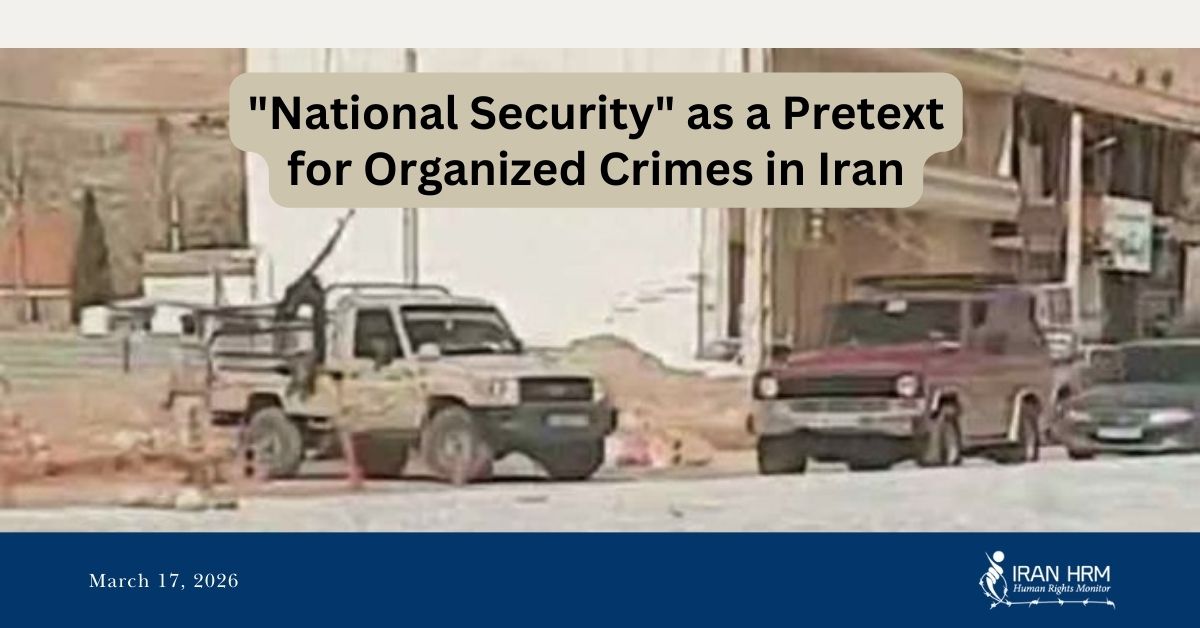
The daily reports of citizen arrests under heavy charges such as “espionage,” “collaboration with hostile states,” and “acting against national security,” alongside the internet blackout and the militarization of streets, demonstrate a deliberate state policy. The Islamic Republic is exploiting the state of conflict to grant itself a free hand to suppress its people and violate their fundamental rights under the shroud of fabricated security allegations.
The deplorable condition of detainees is one of the darkest dimensions of this crisis. Prisoners—who, even under the Islamic Republic’s own domestic laws (including Article 211 of the Prison Organization Regulations), must have their security and lives guaranteed during wartime—are being abandoned behind welded doors in high-risk zones. This action, combined with the systematic deprivation of food and medicine and the violent suppression of prisoners’ attempts to save their lives during bombardments, constitutes a flagrant crime and a direct violation of the right to life (Article 6 of the ICCPR).
Therefore, monitoring the Islamic Republic’s actions behind the dark curtain of the internet blackout and taking immediate, practical measures to prevent these gross violations is an undeniable responsibility of the international community and human rights bodies. The people of Iran are currently trapped under an unprecedented blade of repression without any shield. It is essential that international mechanisms, focusing on the recent warning from the UN Fact-Finding Mission in March—which correctly stated that “the people of Iran are now caught between two serious dangers: external attacks and intense, unprecedented domestic repression”—utilize binding legal instruments to hold the perpetrators and commanders of these crimes accountable and prevent further crimes being committed by the Islamic Republic.