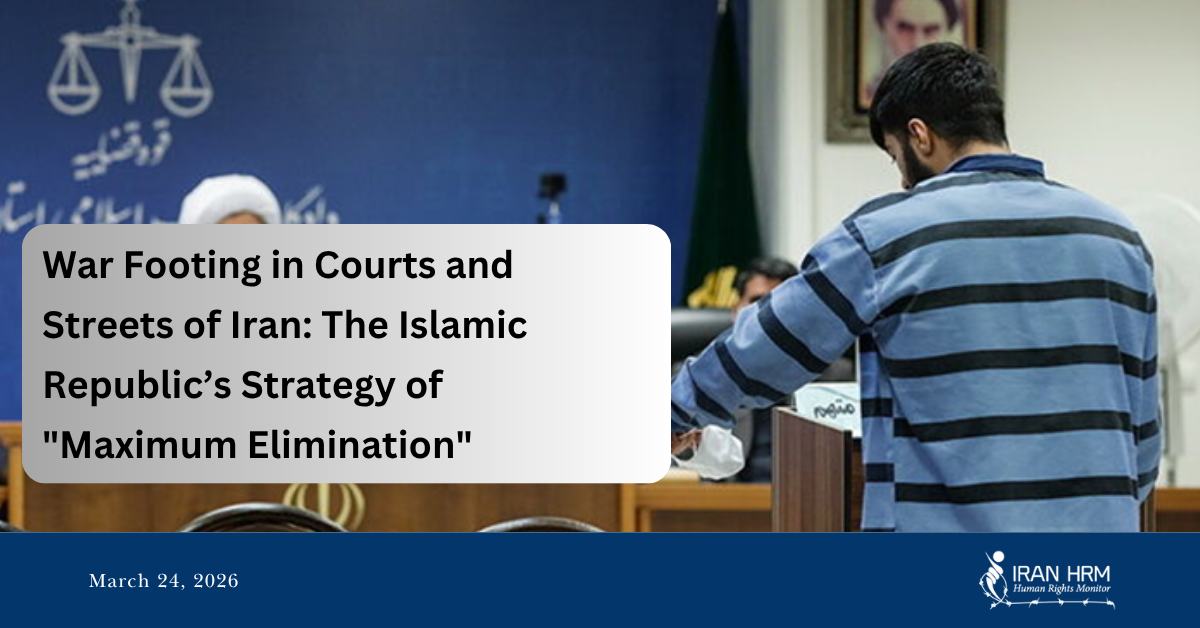
While Iran endures its 24th day of a total nationwide internet blackout, recent statements by senior judicial and military officials signal the consolidation and intensification of a strategy of “Official State Terrorism and Arbitrary Deprivation of Life.” This strategy has been pursued by the Islamic Republic since the onset of the January 2026 (Dey 1404) uprising. An analysis of the positions taken by Gholam-Hossein Mohseni-Eje’i and FARAJA (Law Enforcement Force) commanders on the eve of the new Iranian year 1405 (starting on March 20, 2026) reveals an organized exploitation of a “war-state” status to formalize a killing machine whose objective is not “unrest control,” but the physical elimination of and vengeance against civil society.

Judicial Ultimatums: Legitimizing Field Executions
On March 20, 2026, Chief Justice Mohseni-Eje’i stated in his New [Iranian] Year message: “In the year 1405, we deliver an ultimatum to all destabilizing elements… Let them not test our decisive will, derived from the law, for firm and severe action.” This high-level stance served as a strategic endorsement of the directive issued earlier by the Attorney General (Movahedi) on March 16, 2026. That directive had ordered military prosecutors to activate “round-the-clock, non-stop judicial emergency units” to confront “antagonists” (Source: Rokna). This judicial emergency structure is effectively a mechanism for the systematic removal of due process requirements and the acceleration of extrajudicial death sentences.
Economic Terrorism: Confiscation of Property as a Weapon
The Islamic Republic’s strategy for 1405 supplements the deprivation of life with “Economic Terrorism,” targeting Iranians both inside and outside the country. In a meeting of the Supreme Council of the Judiciary (Rokna, March 15, 2026), Eje’i issued an explicit order: “Iranians abroad who cooperate with the enemy in various ways shall face the confiscation of their property.” Parallel to this extraterritorial repression, the Islamic Republic’s judicial machinery has extended this financial terror domestically. On March 22, 2026, Mehr News Agency reported the commencement of judicial actions against “celebrities, public figures, and media activists.” These measures, including asset seizures, the blocking of news agencies, and arrests—demonstrate that the Islamic Republic, using a broad and ambiguous definition of “cooperation with the enemy,” intends to transform citizens’ assets into tools for political hostage-taking and the silencing of any critical voice, both domestically and internationally.
Militarization of Cities and the Return of “Police-Helpers”
In the field, FARAJA has acted with purely military rhetoric. Sardar “Mosaddegh,” Commander of the FARAJA Special Units, labeling the current situation as the “Ramadan War,” announced the nationwide deployment of his units and the “continuation of covert and overt urban patrols and checkpoints” (Mehr News, March 23, 2026). Simultaneously, Sardar Ali Moayedi, head of the FARAJA Prevention Police, announced the activation of 24-hour patrol teams and the utilization of “Police-Helpers” (local informants/spies in neighborhoods) to cover high-risk areas (Mehr News, March 21, 2026).
Prison Killings: The Direct Output of the “War-State” Doctrine
When Mohseni-Eje’i and Movahedi-Azad (Attorney General) emphasize the “war conditions governing the country” and order “firm action without any tolerance or leniency” (Rokna, March 16, 2026), they are also effectively green-lighting the total disregard for prisoners’ fundamental rights. The operational outcome of this approach was the Chabahar Prison tragedy on March 17, 2026, where inmates’ protests over the cutting of food rations (a violation of Article 211 of the Prisons Regulations) were met with direct fire from military-grade weapons. Under the prevailing judicial logic, the “war-state” has become a pretext to bypass prisoner protection requirements and transform detention centers into military combat zones.
International Deflection and the Denial of Human Rights Oversight
As the killing machine accelerates internally, the Islamic Republic’s “High Council for Human Rights” rejected the draft report of the UN Special Rapporteur, calling it “full of false claims, biased, and lacking legal validity” (Rokna, March 15, 2026). This explicit reaction and the accusation of “interference in internal affairs” against international observers is a calculated attempt to deny the jurisdiction of international bodies and create a safe haven for the continuation of atrocities under the guise of “war conditions.” Through this deflection, the Islamic Republic has effectively declared all avenues for accountability regarding the January executions and prison killings closed.
Legal Analysis and International Appeal
The alignment of these judicial directives with field events demonstrates that the Islamic Republic has not only violated international law but has also completely disregarded its own enacted statutes, transforming the judicial system into a “War Room against its own people and a machinery for issuing state-sponsored murder decrees.” This situation, far beyond a simple violation, signifies the establishment of organized state terrorism where “adjudication” has been replaced by “absolute repression.” The instrumental use of “espionage” charges to execute a Swedish national (dawn of March 17) and the label of “Moharebeh” (enmity against God) to execute three protesters from the January 2026 uprising in public in Qom, serve only as a veneer of legitimacy for the unlawful deprivation of life and the orchestration of public terror.
Responsibility of the International Community: Moving Beyond Ceremonial Statements
In the face of this systematic assault on the lives and property of citizens, the silence of international forums constitutes complicity in these crimes. The UN Human Rights Council and the International Criminal Court (ICC) are duty-bound to intervene urgently based on Article 6 (Inherent Right to Life), Article 7 (Absolute Prohibition of Torture), and Article 14 (Guarantee of Fair Trial) of the International Covenant on Civil and Political Rights (ICCPR). Furthermore, according to Article 7(1) of the Rome Statute, arbitrary deprivation of life, torture, and widespread property confiscation constitute clear instances of Crimes Against Humanity.
We call upon human rights organizations and democratic governments to activate the mechanism of Universal Jurisdiction and elevate the criminal prosecution of the perpetrators of these crimes—specifically Gholam-Hossein Mohseni-Eje’i and Ahmad-Reza Radan—from symbolic condemnations to the issuance of international arrest warrants. Any appeasement regarding the Islamic Republic regime that guns down starving prisoners and hangs protesting youths in public is a green light to transform the entire geography of Iran into a silent slaughterhouse under the shroud of an internet blackout.