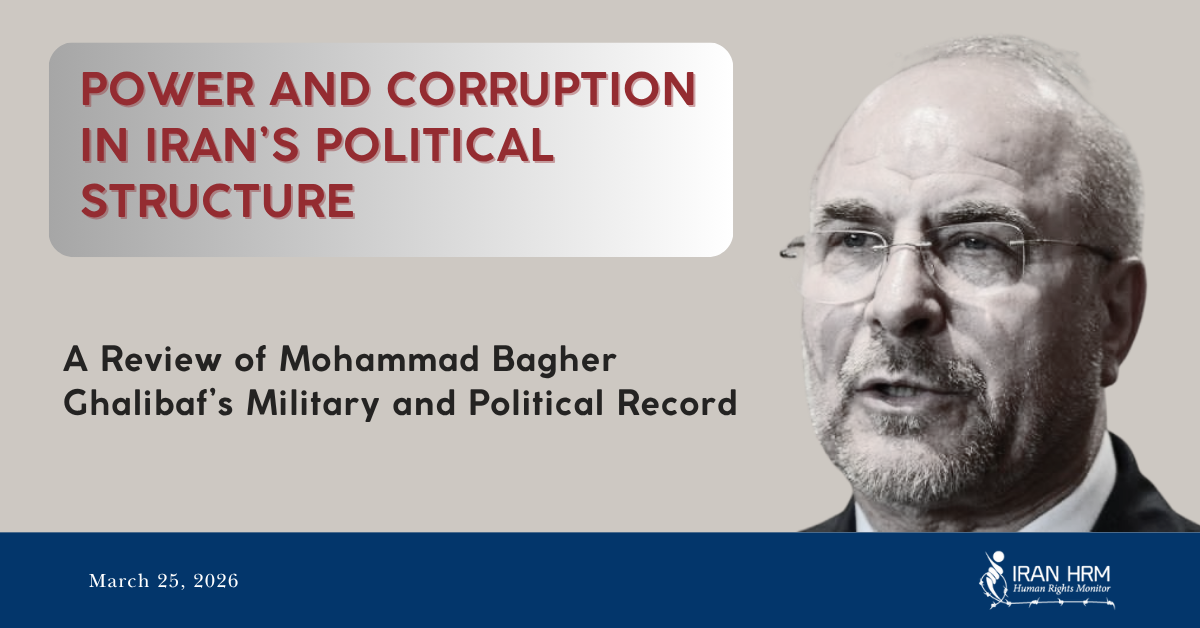
Power and Corruption in Iran’s Political Structure
This report provides a comprehensive and multi-dimensional examination of the political, military, and economic career of Mohammad Bagher Ghalibaf, one of the most influential and controversial figures within the ruling regime in Iran. Drawing on documented evidence, investigative reports, and historical records, it analyzes the process through which a Revolutionary Guards operational commander evolved into a key actor in Iran’s political and economic power structure, ultimately becoming Speaker of Parliament.

The report focuses in particular on the evident gap between official narratives of “jihadi management” and the documented realities of structural corruption, human rights violations, and the emergence of an elite political class—patterns that have become defining features of his public record over the past decades.
Biographical Background and Formation within a Military-Security Context
Mohammad Bagher Ghalibaf, born on August 23, 1961, in Torghabeh, Mashhad, is a product of the post-1979 militarization process in Iran. He began his political and military activities during his teenage years and, at the age of 18, joined the Basij forces and was deployed to conflict areas in Kurdistan. These early experiences within security environments shaped his long-term approach to social and political issues; an approach that remained consistent throughout his career.
During the Iran–Iraq war in the 1980s, Ghalibaf rose rapidly through the ranks of the Islamic Revolutionary Guard Corps (IRGC), becoming commander of the 5th Nasr Division. This period not only consolidated his military standing but also facilitated the formation of a network of loyal associates—often referred to as the “Khorasan circle”—who later played key roles within his administrative and political structures.
Following the war, between 1994 and 1997, he was appointed commander of the Khatam al-Anbiya Construction Headquarters, the IRGC’s economic arm responsible for large-scale infrastructure and development projects. This position marked his entry into the management of major economic resources and state-linked projects.
In 1997, Ghalibaf was appointed commander of the IRGC Air Force, a position he held until 2000. Subsequently, from 2000 to 2005, he served as Chief of Iran’s Law Enforcement Forces, a period marked by the strengthening of security-oriented approaches to urban protest management.
From 2005 to 2017, he served as Mayor of Tehran for three consecutive terms. In 2020, he was elected as a Member of Parliament representing Tehran and has served as Speaker of the Parliament since then.
Positions within the Power Structure (Overview)
1982: Commander of Imam Reza Brigade
1983: Commander of the 5th Nasr Division (Khorasan)
1986–1987: Command roles in western operational headquarters
1989–1990: Senior positions within IRGC ground forces command structures
1994: Deputy roles in Khatam al-Anbiya Headquarters and Basij structures
1997–2000: Commander of IRGC Air Force
2000–2005: Chief of Law Enforcement Forces
2005–2017: Mayor of Tehran (three consecutive terms)
2020–present: Speaker of Parliament
Functional Analysis of Each Phase within the Power Structure
A review of this trajectory shows that Ghalibaf’s rise within the power structure has consistently been associated with roles in military operations, internal security, and mechanisms of social control.
During the 1980s, he served as a field commander in IRGC units during the Iran–Iraq war. Some reports indicate the deployment of inexperienced personnel in high-risk operations, including minefields, an issue that raises concerns from a human rights perspective.
As he moved into higher command positions within the IRGC and Khatam al-Anbiya Headquarters, he gained access to decision-making networks and economic resources. During this period, Basij structures and their intelligence units were expanded, later playing a significant role in monitoring, identifying, and suppressing dissent and civil activities.
During his tenure as commander of the IRGC Air Force, efforts focused on expanding military capacity, including missile capabilities.
With his appointment as Chief of Law Enforcement Forces, his role in internal security and the suppression of urban protests became more pronounced. This period saw the expansion of special units, the strengthening of rapid-response structures, and the allocation of significant financial resources toward control and enforcement equipment. From a human rights perspective, this period is associated with increased use of force in response to public gatherings and protests.
During his tenure as Mayor of Tehran, this pattern of power extended into the economic sphere. In addition to widespread reports of financial corruption, policies such as crackdowns on street vendors and the enforcement of restrictive social measures were implemented, which can be analyzed in terms of pressure on vulnerable populations and limitations on civil rights.
Finally, as Speaker of Parliament, this trajectory culminated in direct influence over legislation. In this role, Ghalibaf has been involved in advancing policies that reinforce social control, restrict internet access, and support the funding of security and enforcement institutions.
Doctrine of Repression: From Street-Level Violence to Strategic Decision-Making
One of the defining aspects of Mohammad Bagher Ghalibaf’s record is his direct and multi-layered role in the management and execution of protest suppression. Available evidence and his own public statements indicate that his involvement has extended beyond administrative oversight to, at times, direct participation on the ground.
During the July 1999 student protests, Ghalibaf was among the signatories of a letter issued by IRGC commanders to the then-government, warning of direct military intervention if the protests were not contained. In a later audio recording, he described his role in those events as follows:
“The events of 1999… I wrote that letter…
There is a photo of me on a 1000cc motorcycle with a stick… I stood in the street…
Wherever it was necessary to come into the streets and use force, we were among those who did so…”
These statements indicate direct participation in acts of violence against protesters and reflect an explicit acknowledgment of such actions as part of his professional conduct.
In 2003, while serving as Chief of Law Enforcement Forces, Ghalibaf took part in a meeting of the National Security Council in which he advocated for a forceful response to student protests. In the same audio recording, he states:
“In that meeting… I obtained authorization for military presence and the use of firearms…”
From a human rights perspective, such statements point to a conscious role in decision-making processes that enabled the use of coercive force against civilian demonstrators. They raise serious concerns regarding the proportionality and legality of force used against peaceful assemblies.
In subsequent years, this approach remained consistent in his political discourse. In response to nationwide protests, Ghalibaf has repeatedly framed demonstrations in security terms, characterizing them as organized threats. This framing reflects a sustained securitized approach to social and political dissent.
Systematic Corruption and Rent-Seeking During the 12-Year Mayorship of Tehran
Ghalibaf’s tenure as Mayor of Tehran (2005–2017) is widely regarded as a period marked by the consolidation of structural corruption within urban governance. During this time, the municipality evolved from a public service institution into a platform for the allocation of resources in ways that reinforced networks aligned with political and security power centers.
Financial resources, public assets, and the economic capacity of the capital were not consistently managed within a transparent or publicly accountable framework. Instead, patterns emerged suggesting that these resources were directed toward strengthening the political and financial influence of a limited circle of actors connected to the ruling structure.
The “Astronomical Properties” Case and the Treatment of Whistleblowers
The so-called “astronomical properties” case represents one of the most significant examples of non-transparent transfer of public assets during this period. Documents indicate that hundreds of valuable properties—including land, apartments, and buildings in prime areas of Tehran—were allocated with substantial discounts and outside competitive procedures to senior officials, council members, and individuals linked to power structures.
Estimates suggest that the number of such transfers may exceed 2,000 properties, with a total value of approximately 2,200 billion tomans. This case illustrates a broader pattern of leveraging administrative authority for the non-transparent distribution of public resources.
Equally significant is the response to the exposure of this case. Rather than initiating a transparent accountability process, judicial action was taken against individuals who disclosed the information. This response can be analyzed within the broader context of restrictions on freedom of expression and limitations on public access to information.
Yas Holding and Financial Networks Linked to Military Structures
The Yas Holding case is among the most prominent examples of the intersection between municipal governance and economic entities linked to military institutions. Contracts valued at approximately 12,900 billion tomans were concluded between the municipality and affiliated companies, while the total volume of financial transactions has been estimated at around 80 trillion rials (approximately 3 billion USD).
A significant portion of these resources did not return to the municipal financial system, and their final allocation remains unclear within a network of intermediary companies and arrangements.
While some mid-level officials were prosecuted and convicted in connection with this case, accountability at higher levels was not fully pursued. This situation reflects patterns of structural and institutional impunity in addressing large-scale corruption.
Charitable Structures and the Transfer of Public Assets
Another notable pattern during this period involves the use of charitable organizations as mechanisms for the transfer of public assets. In several cases, large urban land plots were allocated under non-standard financial conditions and at prices significantly below market value to entities linked to individuals close to Ghalibaf.
Such practices raise concerns regarding the use of religious or charitable frameworks to facilitate the movement of public resources into private or semi-private control. From a human rights perspective, these processes are relevant in the context of unequal access to public resources and the reinforcement of structural economic inequality.
Elite Family Privilege and the Gap with Public Narratives
While Ghalibaf has publicly emphasized values such as modest living and social justice, available reports regarding the financial status and lifestyle of his family suggest a different reality.
Documented information points to access to substantial foreign currency assets—amounting to several hundred thousand US dollars—as well as ownership of properties abroad and involvement in various economic activities. These findings stand in clear contrast to earlier public statements portraying limited family wealth.
In addition, disclosures concerning overseas travel and large-scale purchases made outside the country have been widely interpreted as indicators of a widening gap between the living standards of officials and the broader population.
The response to such disclosures has, in some cases, included legal action against those who publicized the information, reinforcing patterns of restricting information flow and exerting pressure on critics.
Parliamentary Leadership and the Institutionalization of Restrictive Policies
Since assuming the position of Speaker of Parliament in 2020, Ghalibaf has occupied a role that enables direct influence over legislative processes. During this period, the Parliament has played an active role in advancing measures that restrict online freedoms and reinforce mechanisms of social control.
In his public statements, Ghalibaf has continued to frame protests within a security-oriented narrative, interpreting them as organized threats. This continuity suggests that earlier approaches to dissent have been carried forward into the legislative domain.
Human Rights Implications and International Response
At the international level, Ghalibaf’s record has prompted responses from various governments and institutions. Countries such as Canada and the United Kingdom have imposed sanctions on him in connection with his role in serious and ongoing human rights violations, including the suppression of protests and involvement in decision-making structures that restrict civil liberties.
Within the discourse of human rights organizations, Ghalibaf is often cited as an example of “impunity,” referring to situations in which individuals implicated in violations are neither prosecuted nor held accountable, and may instead continue to advance within power structures.
In his case, this assessment is based on a combination of factors, including public statements acknowledging involvement in violent crackdowns, repeated allegations of financial misconduct, and his continued presence at the highest levels of political authority.
Final Analysis and Political Synthesis: Ghalibaf as a Pillar of a Rent-Based Power Structure
Mohammad Bagher Ghalibaf can be understood as a representative case of the transition from military command to political authority within the power structure of Iran; a trajectory shaped by the intersection of military institutions, economic networks, and political governance.
Throughout this trajectory, he has overseen large-scale urban projects and administrative initiatives, while at the same time facing sustained reports of non-transparent resource allocation and the consolidation of affiliated economic networks.
The gap between public narratives of simplicity and documented evidence regarding financial assets and lifestyle reflects a broader pattern within the governing structure, where official discourse diverges from socio-economic realities.
From a structural perspective, his continued advancement despite repeated controversies points to a system in which political loyalty and functional alignment with power structures take precedence over accountability mechanisms.
Having played roles in internal security management and responses to protests, and later in legislative processes that reinforce restrictive policies, Ghalibaf’s career reflects continuity across different domains of governance.
Overall, his record illustrates the interconnection between three key elements: the suppression of dissent, the non-transparent management of public resources, and the persistence of institutional impunity. This convergence positions him as a central figure in analyses of power dynamics and human rights challenges in Iran.