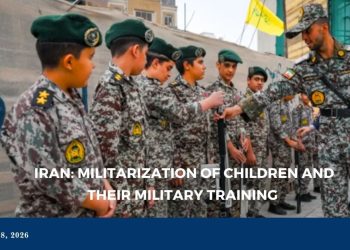
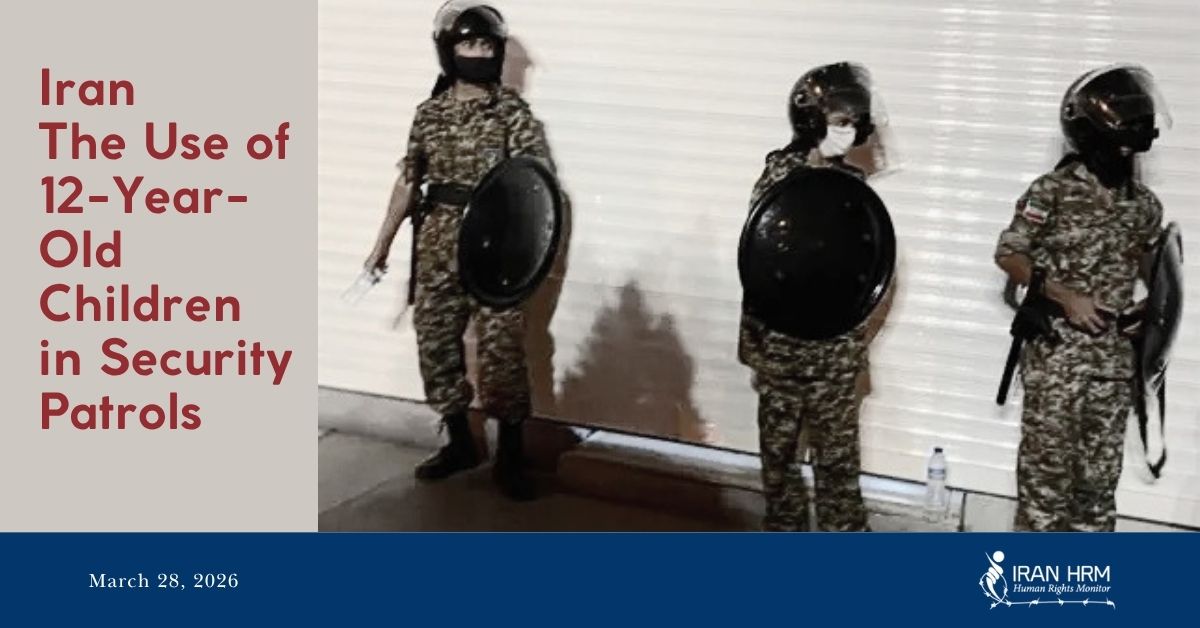
Lowering the age of participation to 12 constitutes the use of “child soldiers” and a violation of international obligations on children’s rights
The use of 12-year-old children in security patrols in Iran raises serious human rights and structural concerns. This development shows why the ruling regime in Iran has turned to using children in intelligence and operational activities, what crises have shaped this decision, and what this policy reveals about the actual condition of the country’s security and military institutions. The formal reduction of the participation age under the scheme known as “For Iran,” and the presence of adolescents at checkpoints and in urban missions, not only violates international obligations toward children’s rights, but also points to a growing pattern of instrumentalizing children within structures of internal repression.

Official admission; the participation age lowered to 12
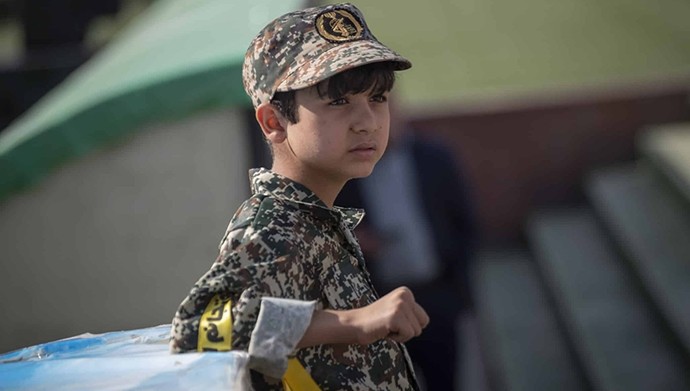
On March 26, 2026, Rahim Nadaali, the cultural deputy of the Islamic Revolutionary Guard Corps in Tehran, announced in an official televised interview that the age for participation in intelligence patrols, operational patrols, and checkpoint duties had been lowered to 12. He said:
“We launched this plan in different areas… there are intelligence and operational patrols, and our dear young people and teenagers repeatedly came forward and said they wanted to take part in these patrols… in the checkpoint patrols that you now see across the cities, we received a very large number of requests from teenagers and young people… given the ages of those who came forward and demanded to participate, we lowered the age to 12 and above. Now 12- and 13-year-old kids want to take part in this space.”
These remarks amount to an official declaration of the use of children in security structures; a matter that has moved beyond allegation and has been presented as an operational policy.
 Operational expansion; the deployment of a broad network of patrols and checkpoints
At the same time, law enforcement officials announced a major expansion of security personnel across the country. Saeed Montazerolmahdi, spokesperson for the Law Enforcement Command, stated that 1,463 special checkpoints had been deployed across Iran; checkpoints that, according to him, were organized based on “the importance of geographical location, law enforcement considerations, and urban traffic movement” in different parts of the country.
He also reported the deployment of more than 129,000 police personnel in various units, including police emergency forces, relief units, special units, and road police, on a round-the-clock basis. In addition, nearly 15,000 vehicle and motorcycle patrol units are reportedly operating continuously in cities and on roads.
According to official statements, following damage to certain law enforcement centers during recent clashes, some of these patrol units were tactically converted into mobile police stations and mobile posts. This shift points to a change in the pattern of security deployment, from fixed structures to a wide, mobile, and dispersed presence throughout urban areas.
In such a setting, the use of adolescents in intelligence patrols, checkpoints, and urban missions cannot be seen as an isolated measure. It must be understood as part of an operational mechanism that is already being put into practice.
 Historical continuity; the persistence of a pattern of using children in military structures
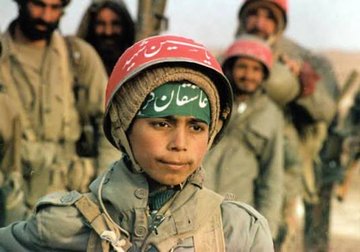
The use of children in Iran’s military and security structures has a history spanning several decades. During the Iran-Iraq war, numerous reports documented the use of adolescents in high-risk operations, including minefield clearing; practices that resulted in widespread casualties among school students.
The daily Ettela’at wrote on May 1, 1983, in describing these scenes:
“Fifteen-year-olds, fourteen-year-olds… cheerful and sweet, chanting prayers… dawn, the desert of mines… and moments later, when the dust settled, nothing remained; only pieces of flesh and bone scattered across the desert…”
Recent developments indicate that this pattern has changed form and moved from the battlefield into urban space, where it is being reproduced through security patrols and internal control mechanisms.
 Legal framework; the use of “child soldiers” and the violation of international obligations
The use of children in security and paramilitary activities is explicitly prohibited under international law and, in certain circumstances, may amount to an international crime. Iran is a state party to the Convention on the Rights of the Child (CRC) and, under Article 38 of that convention, is required to prevent the participation of persons under the age of 15 in hostilities and related conflict activities.
In addition, the Optional Protocol to the Convention on the Rights of the Child on the involvement of children in armed conflict (OPAC) establishes stricter standards and emphasizes the necessity of not involving persons under 18 in military and security activities. Under this framework, even where participation is described as “voluntary,” such consent cannot be considered legally valid because of the surrounding environmental, ideological, and structural pressures.
At the same time, the Rome Statute of the International Criminal Court defines the use of children under 15 in armed conflict as a war crime. Although the current situation in Iran is not defined as a classic armed conflict, the use of children in internal security and paramilitary structures, particularly for control, surveillance, and repression, can still be assessed within the framework of serious human rights violations and individual criminal responsibility.
Accordingly, the use of 12-year-old children in intelligence patrols, checkpoints, and operational missions not only violates the state’s international obligations toward children’s rights, but also constitutes a form of child soldier use within an internal security structure; a situation that may engage legal responsibility at different levels of command and decision-making.
 Additional quotations and evidence; confirming a continuing pattern
During the Iran-Iraq war, official figures also acknowledged large-scale student casualties. For example, Mojtaba Jafari stated that “more than 33,000 students” were killed during that period.
In later years, reports also emerged about the use of children in regional conflicts. Nikki Haley, then United States Ambassador to the United Nations, stated at a Security Council session on October 18, 2018:
“The Revolutionary Guards are using children, recruiting and training them for war in Syria and to support the brutal Assad regime.”
Alongside these cases, international bodies, including UN Special Rapporteurs, have repeatedly expressed concern about patterns of violence against children in Iran, particularly during protests; patterns that have included detention, ill-treatment, and exposing children to violent environments.
This evidence shows that the use of children in military and security structures is not a temporary measure. It is part of a continuing pattern that, in recent developments, has been reproduced domestically through security patrols and urban control structures.
Final analysis; pre-emptive control of society and the expansion of a surveillance network
The use of children in security patrols and checkpoints first points to mounting pressure on the manpower structures of the security and law enforcement apparatus. Lowering the participation age to 12, together with the extensive deployment of forces in urban areas, suggests an attempt to compensate for operational limitations by quantitatively expanding the pool of those involved in internal control.
At the same time, the function of this network is not limited to physical presence in the streets. The structure of checkpoints and urban patrols is designed to enable the collection of information, the identification of individuals, and the continuous monitoring of citizens’ behavior. In this context, the use of adolescents in intelligence and surveillance roles can be understood as part of a broader network intended to track social activity, especially among young people.
The expansion of this mechanism can also be analyzed in light of the protest movements of recent years; movements in which young people and students played a visible role in the emergence and continuation of unrest, while direct confrontation with police and Basij forces also intensified. In this context, the increased deployment of security forces in urban spaces and the multiplication of checkpoints can be understood as an effort at pre-emptive control aimed at preventing the re-emergence of large-scale protests.
At the discursive level as well, statements by some regime officials have stressed the need for regime supporters to maintain a constant presence in the streets. Ahmad Alamolhoda, Friday Prayer leader of Mashhad, said in remarks addressed to Basij members and regime supporters:
“Preserve your Hezbollah identity in the streets… hold the ground, intervene in these gatherings day and night.”
Such statements indicate that the continued presence of these forces in urban space is being pursued as a deliberate policy to preserve control and prevent retreat in the face of possible unrest.
In this framework, the use of children in security structures is not merely a tactical measure. It is a sign of the expansion of surveillance and control networks into lower layers of society; a process in which the objective is not only to manage the current situation, but also to prevent future crises through broader and more continuous monitoring of society.