Reuters: Two Prisoners Executed Over Alleged MEK Links; Six Executions in Days Raise Alarm
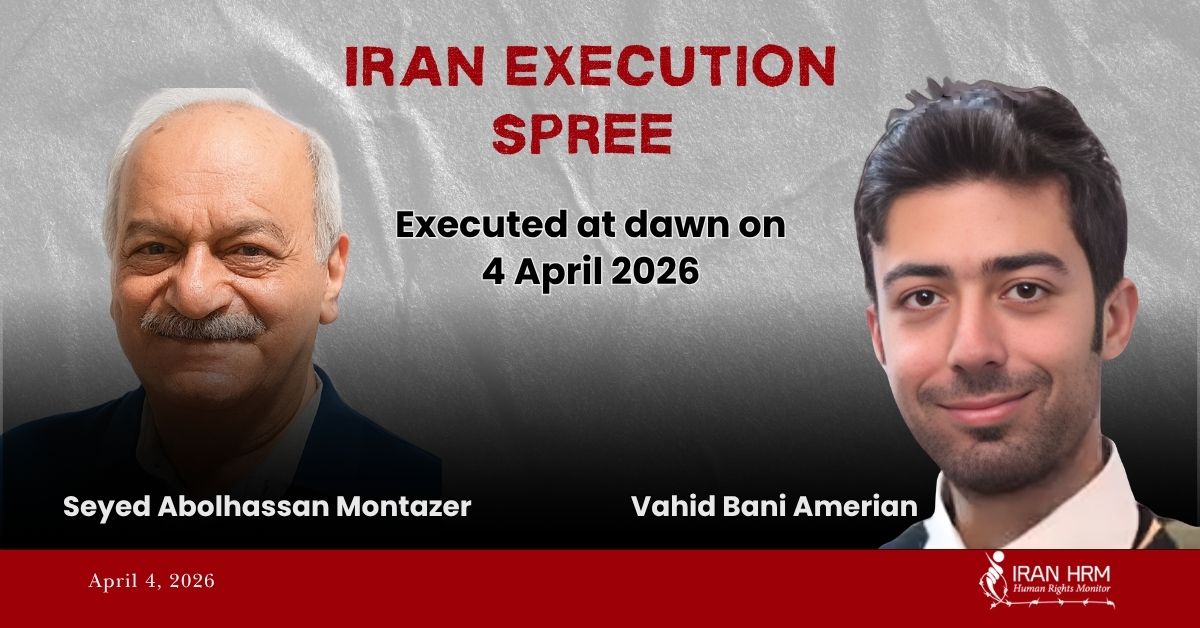
Reuters reported that the ruling regime in Iran executed two prisoners on Saturday in connection with alleged links to the People’s Mojahedin Organization of Iran (MEK) and security-related charges. This report coincides with the execution, in the early hours of Saturday, April 4, 2026, of Vahid Bani-Amerian and Abolhassan Montazer in Qezel Hesar Prison in Karaj. These executions followed the execution of four other political prisoners in the same case in the preceding days, bringing the total number of executions in a short period to six.

Factual Account
In the early hours of April 4, 2026, Vahid Bani-Amerian and Abolhassan Montazer were executed in Qezel Hesar Prison in Karaj. These executions were carried out as part of a shared case involving multiple defendants.
On April 30 and 31, 2026, four other political prisoners; Mohammad Taghavi, Akbar Daneshvar-Kar, Babak Alipour, and Pouya Ghobadi; were also executed in the same prison. The execution of six individuals within a short timeframe in connection with a single case has raised serious concerns about the existence of a systematic pattern in the implementation of executions.
Who Was Vahid Bani-Amerian?
Vahid Bani-Amerian, aged 34 and originally from Sonqor, was an academic elite in the field of physics. He was a graduate of Khajeh Nasir al-Din Toosi University of Technology and held a master’s degree in management. He was arrested on January 21, 2024, and transferred to Ward 209 of Evin Prison.
During his detention, he was subjected to interrogation and torture. Reports indicate that he was placed under severe pressure to extract confessions. The intensity of this pressure was such that upon his transfer to a general ward, he was forced to sign a statement asserting that the torture had occurred prior to his transfer.
He had previously been arrested and sentenced on security-related charges and had served prison terms and internal exile. Reports also indicate that he suffered from medical conditions and had limited access to adequate healthcare during his detention.
Who Was Abolhassan Montazer?
Abolhassan Montazer, aged 67 and originally from Tehran, was a long-time political prisoner who had been repeatedly arrested both before and after the 1979 revolution, spending many years in detention. He held a bachelor’s degree in architecture, was married, and had two children.
In recent years, he suffered from multiple serious health conditions, including heart disease, and underwent open-heart surgery. However, due to the lack of adequate post-operative medical care, his condition did not improve and he required further treatment.
Reports also indicate that he suffered from diabetes, kidney problems, and skin disorders. Despite his urgent need for specialized medical care, he was denied adequate treatment. In one instance, after being transferred to a hospital, he was shackled to a bed and ultimately forced to abandon treatment and return to prison.
Further Details; Solitary Confinement and Staged Executions
Prior to the executions, reports indicated that at least 22 political prisoners were transferred from Ward 4 of Qezel Hesar Prison to an undisclosed location. Among them were individuals sentenced to death. After a period of uncertainty, it was confirmed that some of these prisoners, including Bani-Amerian and Montazer, had been placed in solitary confinement.
Transfer to solitary confinement, often used as a precursor to execution, was followed in this case by the staged implementation of death sentences over several days.
Judicial Process
These prisoners were arrested in January 2024 and tried on charges of “baghi” (armed rebellion). Although their death sentences were initially overturned by the Supreme Court, the same sentences were subsequently reissued and enforced by Branch 26 of the Tehran Revolutionary Court, presided over by Judge Iman Afshari. This development has raised serious concerns regarding the integrity of judicial proceedings.
Reactions
Alongside international media coverage, Amnesty International has warned of a new wave of executions in Iran.
The organization stated that following the execution of four prisoners within a 24-hour period, at least seven other prisoners in Qezel Hesar Prison face an imminent risk of execution. The statement explicitly named Vahid Bani-Amerian, Abolhassan Montazer, Mohammadamin Biglari, Ali Fahim, Abolfazl Salehi Siawashani, Amirhossein Hatami, and Shahin Vahedparast Kolou.
Diana Eltahawy, Amnesty International’s Deputy Director for the Middle East and North Africa, emphasized that authorities must immediately halt any plans to carry out executions. She warned that continuing executions even amid war and bombardment demonstrates that the death penalty is being used as a tool to suppress dissent.
According to the statement, four prisoners; Akbar (Shahrokh) Daneshvar-Kar, Mohammad Taghavi Sangdehi, Babak Alipour, and Pouya Ghobadi; were executed secretly within a 24-hour period. These executions were carried out without prior notice to the prisoners, their families, or their lawyers, and without allowing final visits. In some cases, the bodies were not returned to the families.
Amnesty International described these acts as “secret and arbitrary executions” and warned of the continuation of this pattern.
At the same time, Dr. Mai Sato, the United Nations Special Rapporteur on the situation of human rights in Iran, had warned prior to the executions about the risk faced by these prisoners. She stated that, amid ongoing conflict and internet disruptions in Iran, she continues to receive reports of executions.
She emphasized that persistent internet shutdowns severely hinder independent monitoring of prisoners’ conditions and execution procedures, and warned of the risk of further executions. She also called on the authorities to immediately halt all executions and to grant families access to detained individuals.
Legal Analysis
This case demonstrates multiple violations of fair trial standards, including the enforcement of death sentences after they had been overturned by the Supreme Court, reports of torture used to obtain confessions, and denial of access to legal counsel.
The implementation of executions under conditions of internet shutdown, which severely restricts independent monitoring, further raises concerns regarding transparency and due process.
Human Impact
Families of the prisoners reported that they were not informed of their relatives’ condition prior to the executions. Their attempts to establish contact or arrange visits were unsuccessful. This lack of information has imposed severe psychological pressure on families and intensified concerns about the fate of other prisoners facing execution.
Pattern of Repression
The execution of six political prisoners within a single case over a short period reflects a pattern in which the death penalty is used as a tool of repression. The staged implementation of executions, mass transfers to solitary confinement, and the timing of these actions amid war and restricted information flow all point to an escalating and systematic approach.
Conclusion
The recent executions in Qezel Hesar Prison cannot be viewed as isolated incidents. Rather, they form part of a broader structural pattern in the treatment of political prisoners in Iran. The continuation of this trend increases the risk of further executions and underscores the urgent need for international attention and response.