Policy of Enforced Disappearance, Torture of Families of the Executed
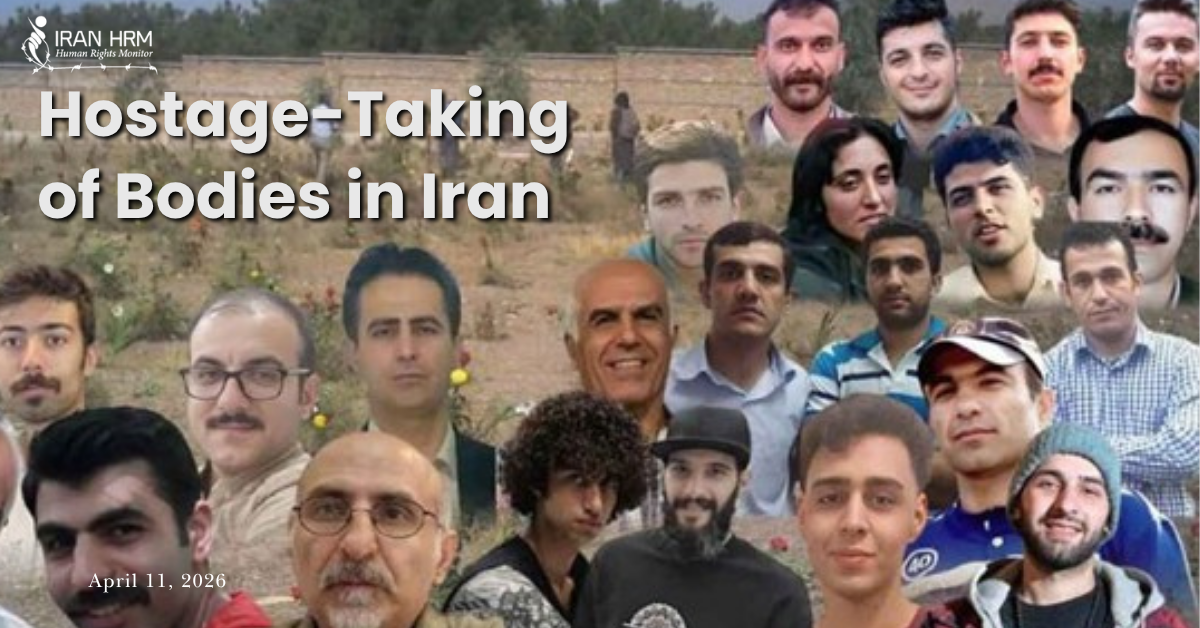
The question “Where are the bodies?” has been one of the primary and most agonizing demands of the families of executed political prisoners in Iran for decades. These families are not only deprived of the basic right of a “final visit” with their loved ones before the execution but are also denied the right to receive the body and hold mourning ceremonies afterward.

Rights Denied: Deprivation of the Final Visit and Proper Burial
The failure to return bodies and the concealment of burial sites of the executed, according to international law, is a clear instance of “enforced disappearance” and “psychological torture” of the families. By creating ambiguity and permanent suspense regarding the fate and burial place of the victims, the government imposes double, continuous, and long-term suffering on the survivors. This action deprives families of the right to hold burial rites, mourning, and ceremonies befitting their loved ones. The psychological consequences of this situation can affect the lives of survivors for years, becoming a form of ongoing torture. This practice forms part of a broader pattern of enforced denial of the right to mourn and systematic psychological pressure on families and is a blatant violation of Article 7 of the International Covenant on Civil and Political Rights (prohibition of torture and cruel treatment).
The April 2026 Execution Machine: Continued Crimes and the Hostage-Taking of the Bodies of PMOI Members and Protesters
Over the span of 8 days, from March 30 to April 6, at least 10 political prisoners have been executed, including six members of the People’s Mojahedin Organization of Iran (PMOI/MEK): Vahid Bani-Amerian, Mohammad Taghavi, Babak Alipour, Pouya Ghobadi, Abolhassan Montazer, and Akbar Daneshvarkar; and four detainees from the January 2026 uprising named Amirhossein Hatami, Mohammad-Amin Biglari, Shahin Vahedparast, and Ali Fahim. Their bodies have not yet been returned to their families.
Hamed Bani-Amerian, brother of Vahid Bani-Amerian, writes: “After the crime and the execution of political prisoners, they do not return the bodies. You Hyenas.”
Addressing Vahid he adds: “You know how much I personally loved you and how sensitive I was to your health and every aspect of your life; you were very important to me, perhaps the priority over everything else. I never thought the day would come when, with a broken heart full of sorrow and regret, I would want to set a memorial table for you and your eternal friend and companion, Pouya (Qobadi, executed on March 11). You also had an indescribable love for me, beyond that of a brother, and this became a lever of pressure in the hands of the hyena-like ones to harass you during your years of captivity and torture. But despite all the love you had for your family, you embraced all the horrific hardships and chose the path of the homeland and the path of freedom; because, as you told me, you could not see oppression and lead an ordinary life.”
Following the execution of these sentences, security and judicial apparatuses have not only failed to return the bodies of these victims to their families but have provided no transparent information regarding their burial sites. In other recent cases, such as the executions of political prisoners Mehdi Hassani and Behrouz Ehsani, this same illegal practice was repeated, which increases the intensity of concerns regarding the fate of other prisoners.
From Khavaran to Today: Four Decades of the Policy of Concealing the Graves of Political Prisoners
The failure to return the bodies of prisoners who are hanged in the “death chambers” of the Islamic Republic is not a new issue and has roots spanning four decades. This practice began in the 1980s, particularly during the massacre of political prisoners in the summer of 1988, when thousands of those executed were buried by government agents in mass graves or unmarked locations, and families were never informed of the exact location of their children’s graves. This systematic policy continued in the following decades. The real numbers? Truly unknown.
- May 2010: Execution of Farzad Kamangar, Shirin Alam-Holi, Farhad Vakili, Ali Heydarian, and Mehdi Eslami (five Kurdish political prisoners) whose bodies were never returned to their families.
- September 2018: Execution of Zaniar Moradi, Loghman Moradi, and Ramin Hossein-Panahi, whose burial sites remain shrouded in mystery.
- January 2024: Execution of Pejman Fatehi, Mohammad Faramarzi, Mohsen Mazloum, and Vafa Azarbar (four Kurdish political prisoners). The following year, the families of the executed prisoners registered their complaint with the UN Committee on Enforced Disappearances.
- Wednesday, June 11, 2025: The death sentence of Mojahed Korkour, a detained protester from Izeh and one of the detainees of the 2022 nationwide uprising, was carried out. The burial site of his body remained unknown until his 40-day memorial and still remains in ambiguity.
Why Hide the Bodies?
The concealment of bodies and the secret burial of political prisoners are carried out with a security objective: to prevent the formation of a “justice-seeking movement.” The security apparatus knows well that specific graves of victims allow for the holding of ceremonies, protest gatherings, and keeping their memory alive. Therefore, by making the burial sites unmarked, it attempts to erase the issue and prevent the formation of collective movements and protests to pursue the rights of the victims.
Guardians of the Sanctity of Words: Does the International Community Also Uphold the Sanctity of Words?
Who are these political prisoners whom the Islamic Republic regime even refuses to return their bodies to their families? In a world where words have been reduced to triviality, Vahid relied on guarding the sanctity of words: “The Mojahedin are the guardians of the sanctity of words, he quoted” This is a sentence that takes on ontological dimensions in a solitary cell. For Vahid, words like “resistance,” “freedom,” and “it can and must be done” are not letters on paper; they are gems, the price for each of which must be paid with torture, exile, and ultimately execution. He understood well that freedom is not a word for free; it is a trust for which the blood-price has been paid generation by generation for 60 years to reach his determined hands today. He saw himself not as a victim, but as a “guardian”, a guardian of the honor of words that, if he and his kind remain silent, will be crushed under the boots of tyranny. Vahid’s final sentence in this letter echoes an eternal cry: “I am Ready! Ready! Ready!” This triple repetition is the blood-signature of one who has challenged death.
Amirhossein Hatami, an 18-year-old youth and a detained protester of January 2026 uprising in Iran who was executed on April 2, stated without fear before the judiciary of the Islamic Republic: “My goal was the overthrow of the regime.” This short sentence is not merely a confession, but the expression of a philosophy—an explanation of “death” in the struggle for freedom, equality, justice, and awareness, in contrast to the struggle to maintain dominance, totalitarianism, discrimination, and exploitation. A youth who had years of life ahead of him but, to preserve the sanctity of the word “freedom” and the sanctity of “human liberty”, cries out without fear that he fights against anyone who wants to bury these values under the black earth—at the cost of his own life. For this reason, even his body, which serves as a reminder of this cry, is taken hostage.
But has the international community, with all the facilities and levers at its disposal, preserved the sanctity of the word “human rights”? While Vahid and those like him have preserved the sanctity of words at the cost of their lives, is it not appropriate for the global community and international human rights to preserve the sanctity of the word “human being” by stopping the bloodthirsty regime ruling Iran in its executions, forcing it to return the bodies of all missing executed persons to their families, and demanding accountability without exception from the perpetrators of such crimes?