Qezel Hesar, the Final Station Before the Gallows
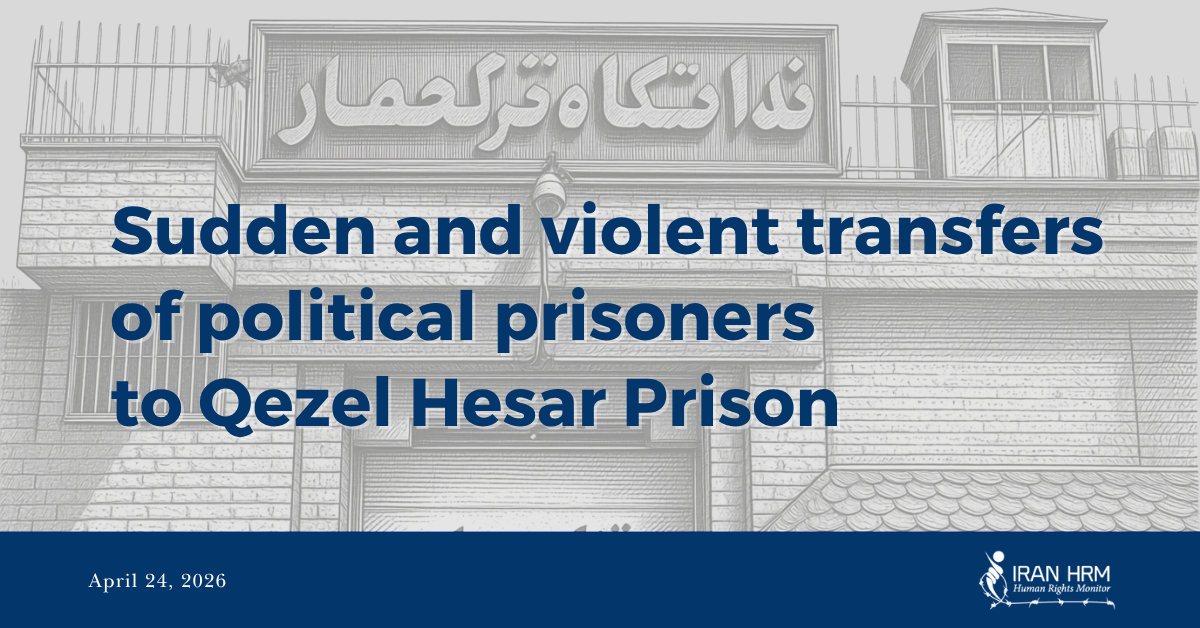
Following an unprecedented wave of political executions in Iran (17 executions in 35 days) and continuous pressure on political detainees, the forced transfer of political prisoners to Qezel Hesar—notoriously known as the “Execution Prison”—continues. These transfers signal a new strategic shift by the Islamic Republic’s judiciary to physically eliminate dissidents in an environment of extreme isolation and heightened restrictions.

Violent Transfers and the Violation of Human Dignity
In the most recent judicial action, at 7 political prisoners from Ward 7 of Evin Prison were abruptly and violently moved to solitary confinement cells in Unit 3 of Qezel Hesar. Among families of the incarcerated, Unit 3 is infamous as a place of brutal conditions, severe restrictions, and direct threats to the lives of prisoners.
- Evidence of Torture and Degrading Treatment: Prior to their transfer, these prisoners were handcuffed, shackled, and blindfolded. Their heads were forcibly shaved, and they were severely beaten with water hoses, resulting in multiple injuries. These actions constitute a flagrant violation of human dignity and international standards for the treatment of prisoners.
Identity of Prisoners Transferred to the Killing Field
During this operation, seven prisoners were moved from Evin, of which the following 6 individuals have been identified:
- Mir Yousef Younesi (71 years old)
- Mehdi Vafaei Sani (40 years old; previously arrested in June 2022 and sentenced to 6 years for “assembly and collusion” and “membership in the PMOI/MEK”)
- Shiva Esmaili (Mother of Mehdi Vafaei Sani, detained since March 2023 in the Evin Women’s Ward and sentenced to 10 years)
- Mohsen Pirayesh
- Vahid Sorkhgol
- Ali Sheidaei
Simultaneously, three other political prisoners—Abolfazl Rahbar, Omid Rahbar, and Farshid Dolatyari—were transferred from Fashafouyeh Prison to Qezel Hesar on charges of membership in the PMOI/MEK. The sudden transfer of these 10 individuals, combined with violence and a total communication blackout, has intensified grave concerns regarding their immediate safety.
A Recurring Pattern: Transfer as a Prelude to Execution
It must be noted that previously executed political prisoners (since March 30), including Akbar Daneshvarkar, Mohammad Taghavi, Pouya Ghobadi, Babak Alipour, Vahid Baniamerian, Abolhassan Montazer, Hamed Validi, and Mohammad Masoum Shahi, were all suddenly transferred to Qezel Hesar shortly before their executions were carried out.
Escalating Pressure in Evin’s Women’s Ward
Reports indicate a sharp increase in pressure on political prisoners within Evin Prison, particularly in the Women’s Ward. The Warden of Evin has distributed a directive stating that any form of protest, hunger strike, or chanting will be met with severe retaliation and transfer to solitary confinement. Furthermore, female prisoners have been strictly prohibited from participating in the “No to Execution Tuesdays” campaign, with threats of cutting off family contact and isolation for those who take part.
Legal Analysis: The Alarm of Systematic “Cleansing”
These collective actions point toward a systematic “cleansing” of political prisoners, especially those affiliated with the PMOI/MEK. The Islamic Republic is not only suppressing dissent within society under the cover of internet blackouts but is also resorting to intimidation and accelerated executions within the prison system. These measures follow the direct orders of Gholam-Hossein Mohseni-Eje’i, the Head of the Judiciary, aimed at expediting the issuance and implementation of death sentences.
Call for International Intervention
We call upon the international community and human rights organizations to intervene immediately to stop the pressure on political detainees and end these executions. It is of the utmost urgency that the UN Special Rapporteur and the International Fact-Finding Mission visit the 10 transferred prisoners in Unit 3 of Ghezel Hesar to ascertain their condition in this notorious killing field. Any delay in action will undoubtedly lead to more executions.
Without international accountability, the perpetrators of these violations of the right to life will continue their killing spree without fear.