Case No. 4 | Case ID: IRN-DP-1404-004 | Last reviewed: 12 August 2026

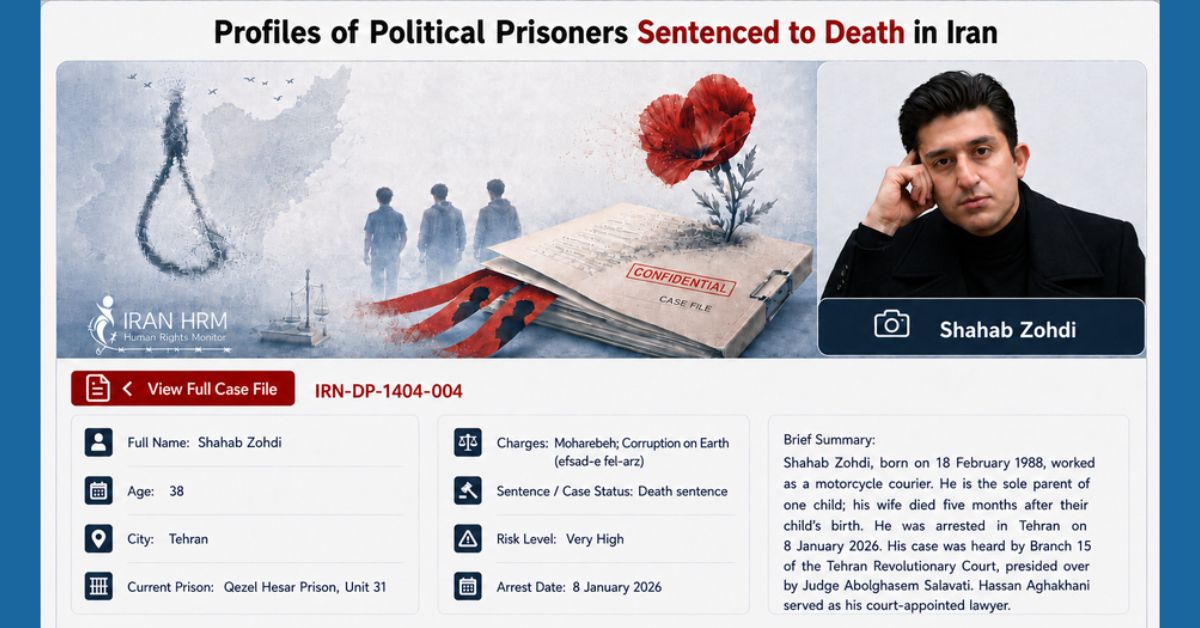
| Shahab Zohdi, a 38-year-old motorcycle courier and father of one, was arrested in Tehran on 8 January 2026. His case was heard by Branch 15 of the Tehran Revolutionary Court, presided over by Judge Abolghasem Salavati, and he was sentenced to death on charges of moharebeh (enmity against God) and efsad-e fel-arz (corruption on Earth). He is currently held in Unit 31 of Qezel Hesar Prison. The executions of Amirhossein Hatami, Ali Fahim, Mohammad-Amin Biglari, and Shahin Vahedparast Kalour—four of his co-defendants—have made the risk that Shahab Zohdi’s sentence will be carried out an urgent concern. |
Key Case Information
| Category | Information |
| Full name | Shahab Zohdi |
| Date of birth | 18 February 1988 |
| Age | 38 |
| Occupation before arrest | Motorcycle courier |
| Family status | Father of one; his wife is deceased |
| Date and place of arrest | 8 January 2026; Tehran |
| Charges | Moharebeh (enmity against God); efsad-e fel-arz (corruption on Earth) |
| Court | Branch 15, Tehran Revolutionary Court |
| Judge | Abolghasem Salavati |
| Lawyer | Hassan Aghakhani; court-appointed counsel |
| Sentence | Death |
| Current place of detention | Qezel Hesar Prison; Unit 31 |
Human and Personal Background
Shahab Zohdi was born on 18 February 1988. Before his arrest, he worked as a motorcycle courier. His wife died five months after the birth of their child, and for approximately the past fifteen years he has been responsible for raising the child. This family background underscores the human consequences of the death sentence: its execution would not only deprive Shahab Zohdi of his right to life, but would also leave his child without a father.
Arrest, Trial and Sentencing
Shahab Zohdi was arrested in Tehran on 8 January 2026. His arrest was connected to a case that judicial authorities have linked to a fire at Basij Base 185, named after Martyr Mahmoud Kaveh, on Namjou Street in Tehran. The use of this description does not establish his involvement in the incident; the available information does not clarify the evidence, the basis on which the alleged act was attributed to him, the text of the judgment, or his defence submissions.
The case was heard by Branch 15 of the Tehran Revolutionary Court, presided over by Judge Abolghasem Salavati. Hassan Aghakhani was appointed as court-appointed counsel. The court sentenced Shahab Zohdi to death on charges of moharebeh (enmity against God) and efsad-e fel-arz (corruption on Earth). The exact dates on which the judgment was issued and served, the full text of the ruling, the evidence relied upon by the court, and the current status of any appeal or request for judicial review have not been made transparently available.
Joint Case and Execution of Four Co-defendants
Shahab Zohdi was prosecuted in a joint case alongside Mohammad-Amin Biglari, Amirhossein Hatami, Ali Fahim, Abolfazl Salehi Siavashani, Shahin Vahedparast Kalour, and Yasser Rajaeifar. The charges announced in the case include moharebeh and efsad-e fel-arz in connection with the aforementioned fire.
According to supplementary information received for this report, Amirhossein Hatami, Mohammad-Amin Biglari, Ali Fahim, and Shahin Vahedparast Kalour have been executed. The execution of these four co-defendants, together with the lack of transparency regarding the precise judicial stage of Shahab Zohdi’s case, heightens the risk that his sentence may be carried out. This makes it all the more urgent that the authorities immediately disclose the status of the case, guarantee effective access to legal counsel, and halt any steps towards execution.
Government Response and Conduct
The government’s response in this case has taken the form of arrest, the filing of serious security-related charges, proceedings before a Revolutionary Court, and the imposition of a death sentence. Despite the severity and irreversible nature of the punishment, sufficient public information has not been released concerning the evidence supporting the charges, the timing and number of court sessions, Shahab Zohdi’s access to counsel of his own choosing, the time and facilities available for his defence, the text of the judgment, or the outcome of any judicial appeal.
The death sentence imposed on Shahab Zohdi must be assessed in the context of the broader wave of death sentences and executions in Iran following recent protests and unrest—a pattern that has raised grave concerns about the use of capital punishment as a tool to instil fear and suppress dissent in society. Volker Türk, the United Nations High Commissioner for Human Rights, has also warned that the death penalty in Iran is being used to ‘instil fear among the population and suppress dissent.’
Current Status and Risk of Execution
As of the last review of this report, Shahab Zohdi was being held in Unit 31 of Qezel Hesar Prison, and his death sentence remained in force. In view of the execution of four of his co-defendants, the absence of transparent information about the status of judicial review, and the lack of an official announcement concerning the timing of execution, his situation must be regarded as critical. This report does not confirm any specific date for the execution; however, the absence of an announced date must not be interpreted as an absence of risk.
Human Rights and Fair Trial Analysis
Right to life and the strict limitation of capital punishment: Article 6 of the International Covenant on Civil and Political Rights, to which Iran is a State Party, recognises the inherent right to life and, in countries that have not abolished the death penalty, restricts its application to the ‘most serious crimes.’ International bodies have interpreted this threshold as limited to crimes of exceptional gravity involving intentional killing. The mere legal characterisation of conduct as moharebeh or efsad-e fel-arz cannot substitute for clear, individualised proof of the alleged criminal act, intent, and the accused person’s individual responsibility.
Right to a fair trial: Article 14 of the Covenant guarantees the right to a fair and public hearing before a competent, independent and impartial tribunal; the presumption of innocence; detailed notification of the charge; adequate time and facilities to prepare a defence; and effective access to legal counsel. In proceedings that may result in the deprivation of life, these safeguards must be observed to the highest possible standard. The absence of transparent information concerning the evidence, the text of the judgment, the ability to choose counsel, confidential communication with counsel, and the stage of judicial appeal makes an independent assessment of the fairness of the proceedings impossible.
Court-appointed counsel and effective defence: The nominal presence of court-appointed counsel is not, by itself, sufficient to fulfil the right to a defence. Legal representation must be genuine, effective and independent, and counsel must have the necessary time and facilities. Until it is established that Shahab Zohdi was able to consult with counsel confidentially, access the case file, challenge the evidence, and present an effective defence, serious concerns will remain regarding respect for his defence rights.
Risk of irreversible execution: Capital punishment is irreversible. Where fundamental information about the proceedings has not been disclosed and four defendants in the same case have been executed, carrying out Shahab Zohdi’s sentence before an independent review of all fair-trial guarantees could result in an arbitrary deprivation of life.
Conclusion
Shahab Zohdi’s case illustrates the danger created by the combination of broadly framed security charges, opaque proceedings before a Revolutionary Court, and the irreversible punishment of death. He is the father of one child and, following his wife’s death, has borne responsibility for raising the child for years. Now, after the executions of Amirhossein Hatami, Mohammad-Amin Biglari, Ali Fahim, and Shahin Vahedparast Kalour in the same joint case, protecting his life requires urgent and coordinated international action.
Urgent Appeal
The United Nations, the Office of the United Nations High Commissioner for Human Rights, the Special Rapporteur on the situation of human rights in Iran, the Special Rapporteur on extrajudicial, summary or arbitrary executions, the Working Group on Arbitrary Detention, governments, and international human rights organisations are urged to act immediately to prevent the execution of Shahab Zohdi.
- Immediately halt any steps towards the execution of Shahab Zohdi.
- Officially and transparently disclose the current stage of the case, the status of any appeal or judicial review, and any decision related to implementation of the sentence.
- Quash the death sentence and guarantee a retrial before an independent and impartial tribunal, in accordance with international fair-trial standards and without recourse to the death penalty.
- Guarantee Shahab Zohdi immediate, effective and confidential access to legal counsel of his own choosing, and provide adequate time and facilities for the preparation of his defence.
- Guarantee regular contact and visits with his family, and provide immediate notification of any transfer or change in his conditions of detention.
- Disclose information concerning the evidence, the text of the judgment, the dates of proceedings, and the legal basis for the sentence, with due regard for the accused person’s privacy and rights.
- Disclose the dates and circumstances of the executions of Amirhossein Hatami, Mohammad-Amin Biglari, Ali Fahim, and Shahin Vahedparast Kalour, and conduct an independent review of compliance with fair-trial guarantees in their cases.