On 29 April 2026, the UN High Commissioner for Human Rights, Volker Türk, warned of escalating repression in Iran, stating: “I am appalled that, on top of the already severe impacts of the conflict, the rights of the Iranian people continue to be stripped from them by the authorities, in harsh and brutal ways.”

He emphasized that even in times of war, restrictions on human rights are permissible only when strictly necessary, proportionate, and pursued for a legitimate purpose, and that “core, non-derogable rights, such as protection against arbitrary detention and the right to a fair trial, must be respected at all times.” Türk also called for an immediate halt to executions, a moratorium on the death penalty, full fair trial guarantees, and the release of arbitrarily detained individuals.
Mai Sato, the UN Special Rapporteur on the situation of human rights in Iran, also warned that under conditions of internet shutdown, executions and other human rights violations may continue without public or international awareness. These warnings are consistent with field data from inside Iran; from 19 March to 30 April 2026, at least 19 politically motivated executions have been recorded, averaging one political execution every two days.
Top-Down Orders; Direct Responsibility for Accelerating Executions
The acceleration of executions is not merely the result of isolated court decisions. Public statements by senior judicial and security officials indicate that this trend is being directed and encouraged from the highest levels of power.
On 30 April 2026, only one day after the UN High Commissioner’s warning, Gholamhossein Mohseni Ejei, head of the judiciary, again emphasized the rapid prosecution and punishment of those described as “foot soldiers of the invading enemy.” He stated: “They say do not execute this or that foot soldier; you are wrong to say that someone whose hands are stained with the blood of the people should not have the sentence carried out.”
Ejei also added: “We will certainly show no negligence or leniency in prosecuting and legally punishing that criminal whose hands are stained with the blood of our people, and we will pay no attention to the rhetoric of arrogant powers and their propaganda outlets.”
These statements, alongside his emphasis on expedited handling of security cases, show that the judiciary of the ruling regime, under wartime conditions, has moved political and security cases outside ordinary judicial procedures and toward accelerated, extraordinary proceedings.
In the same context, Ahmad Hajji-Sadeghi, the representative of the Supreme Leader in the IRGC, stated on 3 April in a threatening tone: “The time for leniency is over.” Mohammad Movahedi Azad, the Attorney General, also announced that more than 7,000 public reports had been received against individuals described as “linked to foreign entities,” and that orders had been issued for their rapid review. This trend pushes society toward securitization, public denunciation, and the criminalization of civic and media activity.
Political Executions; From Qezel Hesar to Isfahan and Zahedan
Among those executed during this period, the cases of Vahid Bani-Amerian, Pouya Ghobadi, Babak Alipour, Akbar Daneshvarkar, Mohammad Taghavi, and Abolhassan Montazer stand out; political prisoners whose cases had previously been repeatedly raised by Amnesty International and the UN Special Rapporteur. Their executions show that, under wartime conditions, the ruling regime has carried even well-known cases through to physical elimination.
At the same time, the execution of Erfan Kiani on 25 April 2026 in Isfahan, and Amer Ramesh, a Baloch political prisoner, on 26 April 2026 in Zahedan Central Prison, shows that this wave is not limited to well-known figures. It has also extended to lesser-known prisoners whose names rarely appear in official international reports, but who face the same risks of death, torture, and unfair trial.
Hamed Validi, 45, and Mohammad (Nima) Masoum-Shahi, 38, were executed on 20 April 2026 in Karaj Prison. Reports indicate serious violations of due process, torture, forced confessions, and inconsistencies in the charges against them. Amir Ali Mirjafari was also executed on 21 April 2026 in Qezel Hesar Prison.
The latest recorded case is the execution of Sasan Azadvar, a 21-year-old political prisoner and detainee from the December 2025 protests, who was executed at dawn on Thursday, 30 April 2026, in Isfahan Central Prison. His family, lawyers, and legal sources had emphasized that no independent evidence had been presented against him and that the case was primarily based on confessions extracted under severe physical and psychological torture. The execution, carried out one day after Volker Türk’s warning calling for an immediate halt to executions, demonstrates the ruling regime’s open disregard for international concerns.
Qezel Hesar; Final Station Before the Gallows
Qezel Hesar Prison has become central to the recent wave of executions. Transfers of political prisoners to this prison continue; a facility known among families and human rights activists as one of the most dangerous sites in Iran’s prison system because of its concentration of executions.
In one recent case, seven political prisoners were suddenly and violently transferred from Ward 7 of Evin Prison to solitary cells in Unit 3 of Qezel Hesar, with their communication cut off. Reports indicate that before transfer, they were handcuffed, shackled, blindfolded, had their heads shaved, and were beaten with water hoses. Six of them have been identified as Mir Youssef Younesi, 71; Mehdi Vafaei Sani, 40; Shiva Esmaeili, mother of Mehdi Vafaei Sani; Mohsen Pirayesh; Vahid Sorkhgol; and Ali Sheidaei.
At the same time, three other political prisoners, Abolfazl Rahbar, Omid Rahbar, and Farshid Dolatiyari, accused of membership in the People’s Mojahedin Organization of Iran, were transferred from Fashafouyeh Prison to Qezel Hesar. Sudden transfer, severed communication, violence, and relocation to a prison with an extensive record of executions have heightened concerns over their lives.
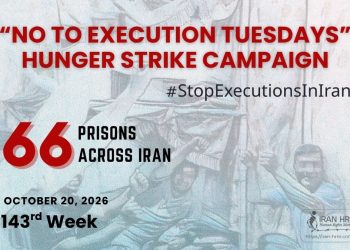
In Evin Prison, particularly in the women’s ward, pressure has also increased. Reports indicate that the head of Evin Prison issued a directive under which any protest, hunger strike, or even chanting would be met with severe punishment and transfer to solitary confinement. Under this directive, women prisoners have been banned from participating in the “No to Execution Tuesdays” campaign and threatened with loss of phone contact and solitary confinement if they take part.
Death in Custody and Enforced Disappearance
The case of Abbas Yavari, an Arab citizen from Khuzestan residing in Shiraz, is a clear example of death in custody and alleged killing under torture. He was arrested during the nationwide protests in January 2026 and, after a period of detention, was transferred in late February to Shiraz Central Prison. According to reports, on 26 March 2026 he was transferred to an unknown detention facility, and only three days later, on 29 March, his family was informed of his death. Judicial and security officials, following a recurring pattern in similar cases, claimed that the cause of death was “suicide.”
According to informed sources, Abbas Yavari had been subjected to severe physical and psychological torture from the time of his arrest to force him to confess to killing a Basij member during the Shiraz protests. The prohibition of torture is a jus cogens norm under international law; no government may suspend it under any circumstances, including war or a state of emergency. Death in custody under such conditions may amount to killing under torture.
At the same time, the pattern of enforced disappearance has intensified. In recent days, between 10 and 20 political prisoners have been transferred from Evin Prison to the quarantine section of Qezel Hesar, with all communication with their families cut off. On 13 April 2026, Reza Younesi reported on X that his father, 73-year-old Mir Youssef Younesi, had been transferred to an unknown location. On 12 April, Mohsen Pirayesh, along with several other prisoners, including Vahid Sorkhgol, Ali Sheidaei, Mehdi Vafaei Sani, and Amin Sokhanvar, was also transferred to an unknown location.
Reports from Urmia Prison also indicate the sudden and separate transfer of three death-row prisoners, Naser Bakrzadeh, Karim Yaghoubpour, and Mehrab Abdollahzadeh, to unknown locations. Informed sources have warned of the risk of their imminent execution.
List of Political Executions Recorded from 19 March to 30 April 2026
| No. | Name | Persian Date | Gregorian Date | Location of Execution |
| 1 | Mehdi Ghasemi | 28 Esfand 1404 | 19 March 2026 | Public execution, Qom |
| 2 | Saleh Mohammadi | 28 Esfand 1404 | 19 March 2026 | Public execution, Qom |
| 3 | Saeed Davoudi | 28 Esfand 1404 | 19 March 2026 | Public execution, Qom |
| 4 | Akbar Daneshvar-Kar | 10 Farvardin 1405 | 30 March 2026 | Qezel Hesar |
| 5 | Mohammad Taqavi | 10 Farvardin 1405 | 30 March 2026 | Qezel Hesar |
| 6 | Pouya Qabadi | 11 Farvardin 1405 | 31 March 2026 | Qezel Hesar |
| 7 | Babak Alipour | 11 Farvardin 1405 | 31 March 2026 | Qezel Hesar |
| 8 | Amirhossein Hatami | 14 Farvardin 1405 | 3 April 2026 | Qezel Hesar |
| 9 | Vahid Bani-Amerian | 15 Farvardin 1405 | 4 April 2026 | Qezel Hesar |
| 10 | Abolhassan Montazer | 15 Farvardin 1405 | 4 April 2026 | Qezel Hesar |
| 11 | Mohammadamin Biglari | 16 Farvardin 1405 | 5 April 2026 | Qezel Hesar |
| 12 | Shahin Vahedparasht | 16 Farvardin 1405 | 5 April 2026 | Qezel Hesar |
| 13 | Ali Fahim | 17 Farvardin 1405 | 6 April 2026 | Qezel Hesar |
| 14 | Hamed Validi | 31 Farvardin 1405 | 20 April 2026 | Karaj Prison |
| 15 | Mohammad Masoum-Shahi | 31 Farvardin 1405 | 20 April 2026 | Karaj Prison |
| 16 | Amir Ali Mirjafari | 1 Ordibehesht 1405 | 21 April 2026 | Qezel Hesar |
| 17 | Erfan Kiani | 5 Ordibehesht 1405 | 25 April 2026 | Isfahan |
| 18 | Amer Ramesh | 6 Ordibehesht 1405 | 26 April 2026 | Zahedan Central Prison |
| 19 | Sasan Azadvar | 10 Ordibehesht 1405 | 30 April 2026 | Isfahan Central Prison |
Internet Blackout; Concealing Repression in the Darkness of War
The widespread internet shutdown, occurring alongside executions, arrests, and security transfers, has restricted the transmission of news, images, testimony, and documentation from inside the country. Volker Türk warned: “This deprives people across the country of access to vital information, silences independent voices, and inflicts enormous social and economic harm.”
In these conditions, the internet is not merely a communication tool; it is a means for families to learn the fate of detainees, for prisoners to maintain contact with the outside world, and for evidence to reach media outlets and international bodies. The ruling regime arrests citizens for disseminating information while simultaneously blocking the same channels of communication.
Prisons; Hunger Strikes, Medical Deprivation, and Lethal Violence
On 28 April 2026, political prisoners in at least 56 prisons across the country launched a coordinated hunger strike in protest against the wave of executions. Reports from Evin, Qezel Hesar, Adelabad, and Urmia Central Prison describe catastrophic conditions. In Qezel Hesar, militarization of the prison environment, severe food shortages, and suspension of in-person visits have turned the prison into a closed and tense space.
Many political prisoners, including ill and elderly prisoners, death-row prisoners, Baloch, Kurdish, Arab and Baha’i detainees, and prisoners accused of links to opposition groups, are held in far harsher conditions and their names rarely appear in official or international reports.
Denying prisoners, particularly political and religious prisoners, access to medical care in Iran’s prisons is a deliberate and systematic practice aimed at breaking prisoners’ resistance through suffering and the gradual erosion of body and mind.
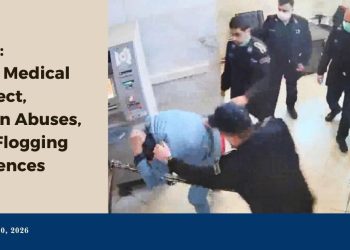
In Chabahar Prison, on 18 March 2026, prisoners protested the prolonged suspension of food distribution. Security forces responded with lethal violence; at least five prisoners were killed and 21 were injured. The incident shows that even the most basic demand for access to food can be met with deadly force.
Legal Analysis
Taken together, these cases demonstrate widespread violations of non-derogable rights: the right to life, the prohibition of torture, protection against arbitrary detention, the right to a fair trial, access to counsel, contact with family, access to medical care, and access to information. Reliance on forced confessions, expedited proceedings, unknown transfers, death in custody, repeated executions, and internet shutdowns together reveal a coherent pattern of repression.
The warning issued by the UN Independent International Fact-Finding Mission on 10 April 2026 regarding the possible commission of crimes against humanity must be understood in this context. What took place in March and April 2026 was a combination of executions, arrests, torture, enforced disappearance, medical deprivation, asset confiscation, and information blackout; a mechanism that simultaneously intensifies repression and conceals it from the public and the world.
The international community should demand an immediate halt to executions, disclosure of the status and whereabouts of transferred prisoners, access to families and lawyers, the full lifting of the internet shutdown, an independent investigation into killing under torture and lethal violence in Chabahar Prison, and scrutiny of the role of judicial, security, and prison authorities in accelerating executions and organized repression.