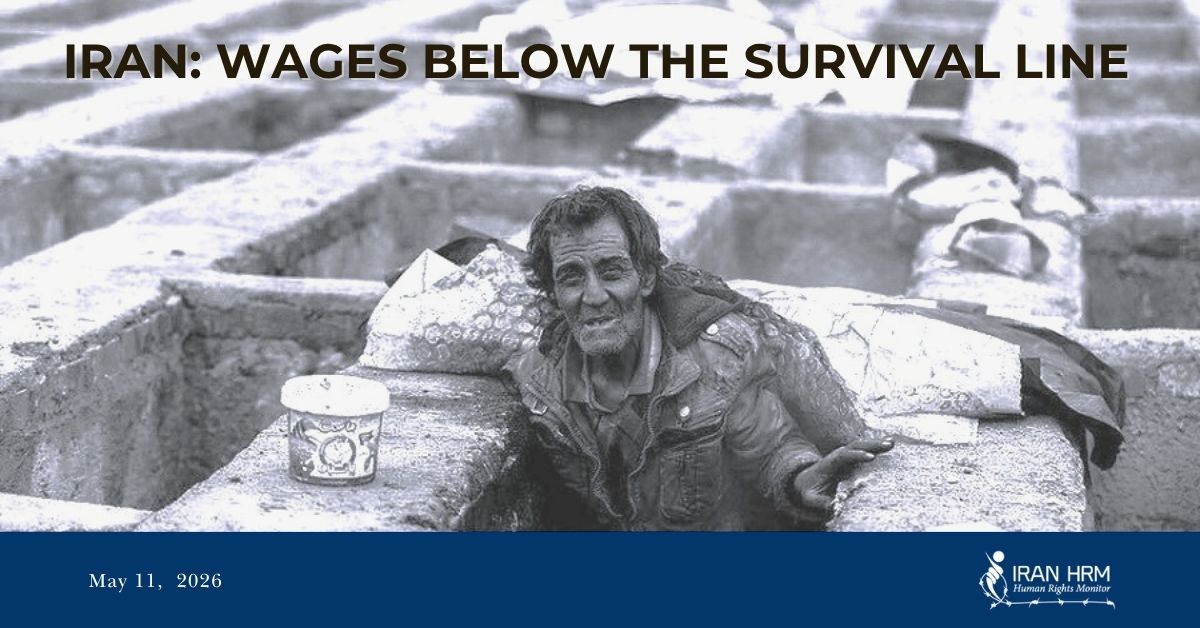
Structural Poverty and the Erosion of Human Rights
This report is not about routine economic indicators or ordinary market fluctuations. It concerns the violation of the most basic human rights of millions of people in Iran: the rights to food, housing, healthcare, work, social security, and the minimum conditions required for a dignified human life.

In recent years, rising prices of essential goods, the collapse of the rial, chronic inflation, unemployment, job insecurity, and the erosion of purchasing power have pushed large segments of Iranian society to a point where meeting basic needs has become difficult or impossible. The removal of meat, dairy products, medicine, and other essential items from household consumption is no longer exceptional. It has become part of daily life for millions of citizens.
State media and officials have repeatedly acknowledged the crisis. In May 2026, Arman Melli wrote: “The economic situation of the people is extremely troubled, and with the developments that have occurred, it has become even more complicated.” The same outlet reported that a two-month internet shutdown had led to business closures and unemployment.
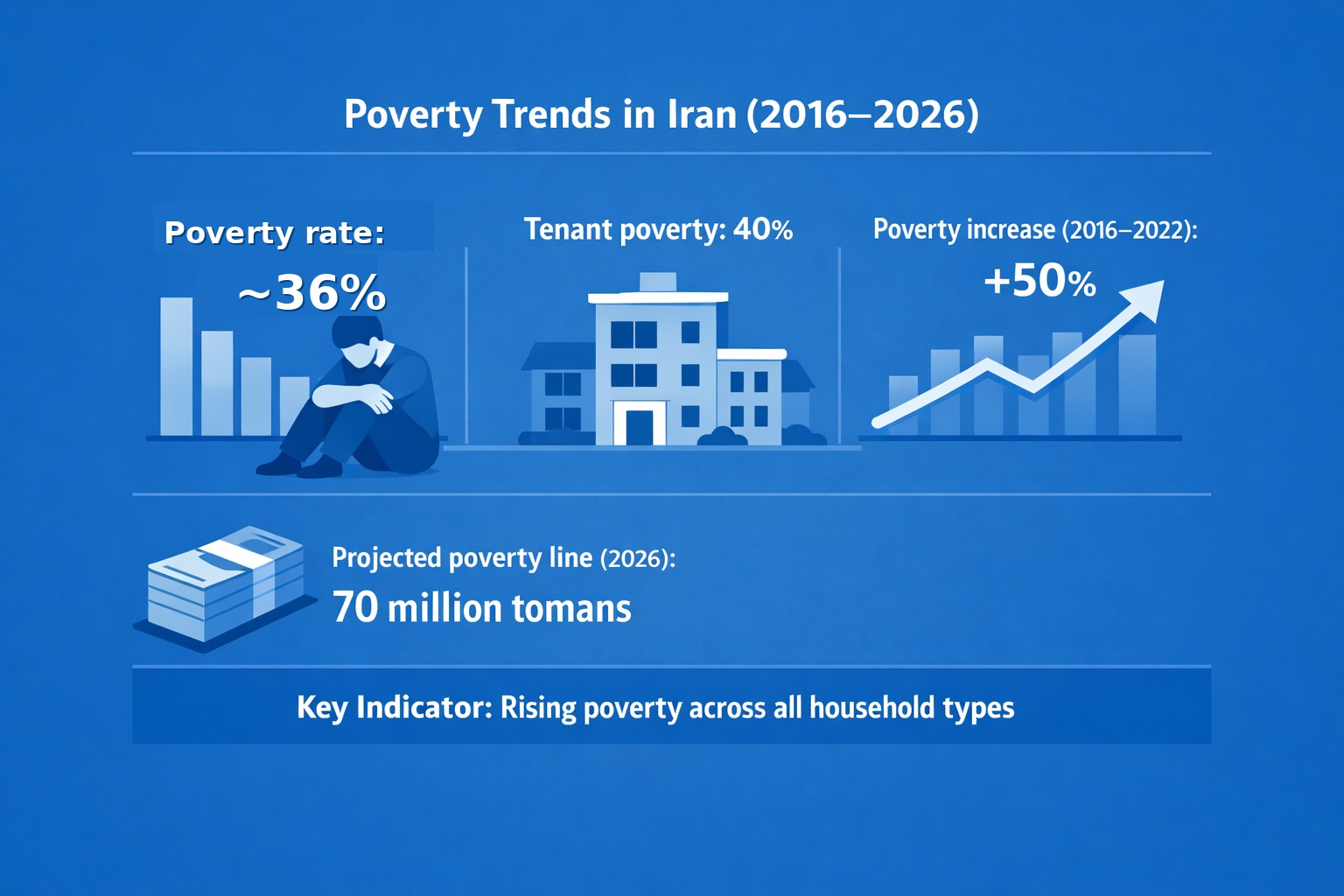
Official and semi-official reports place Iran’s poverty rate at around 36 percent, rising to 50 percent in some deprived and marginalized areas. State media have also warned of millions of “working poor”; people who are employed but still live below the poverty line.
 Inflation has sharply intensified household hardship. A report published in November 2025 said point-to-point food inflation exceeded 64 percent, while the price of bread and cereals nearly doubled within one year. Other reports have referred to livelihood inflation of 100 to 120 percent in essential items such as bread, rice, meat, dairy products, oil, and eggs.
Iran’s livelihood crisis is no longer merely economic. It is a crisis of economic and social rights. As a State Party to the International Covenant on Economic, Social and Cultural Rights, Iran is obligated to guarantee the rights to food, work, health, housing, social security, and an adequate standard of living. Yet economic policies, structural corruption, unbacked money printing, security-centered budgeting, suppression of labor demands, and internet restrictions have severely weakened these rights.
Poverty Under the Shadow of War; State Narrative and Social Reality
As the crisis has deepened, state officials and affiliated media have sought to present war, sanctions, and regional tensions as the main causes of livelihood collapse. Yet even media outlets and experts close to the state acknowledge that Iran’s economic crisis began years before recent tensions and is rooted in the ruling political and economic structure.
In May 2026, Arman Melli wrote: “Little effort has been made to resolve these problems and address the people’s demands.” It also stressed that the two-month internet shutdown had disrupted many businesses and left many citizens unemployed.
Officials have often attributed price increases to “profiteering” or wartime conditions. The First Vice President stated: “In some cases, it is observed that the price of a commodity increases by up to 100 percent in less than a week.”
Yet state-affiliated economists acknowledge that the crisis is the result of decades of corruption, a rent-based economy, money printing, failed policymaking, and prioritizing the preservation of power over public welfare. War and regional insecurity have become less a cause than a justification.
Since 2018, the collapse of the middle class and the expansion of poverty have accelerated. Official and semi-official reports show that millions of households once considered middle class have fallen into lower income deciles. The Institute of Labour and Social Security, affiliated with the Ministry of Labour, has described poverty in Iran as “an undeniable reality” affecting a large part of society.
War and external tensions may accelerate the crisis, but they are not its root. The roots lie in accumulated corruption, banking imbalances, budget deficits, rent-seeking, repression of protests, and institutional unaccountability.
Wages Below the Survival Line
The gap between income and living costs has reached a point where employment no longer guarantees escape from poverty. Millions of workers, employees, and retirees live below the poverty line despite having jobs or a work history.
State media reports indicate that the poverty line for an urban household has reached tens of millions of tomans in some estimates, while the official minimum wage remains far below it. In 2025, the minimum wage was set at around 10 million tomans, while workers’ estimates of the livelihood basket reached more than 70 million tomans. This means the official wage often covers only a small part of survival costs.
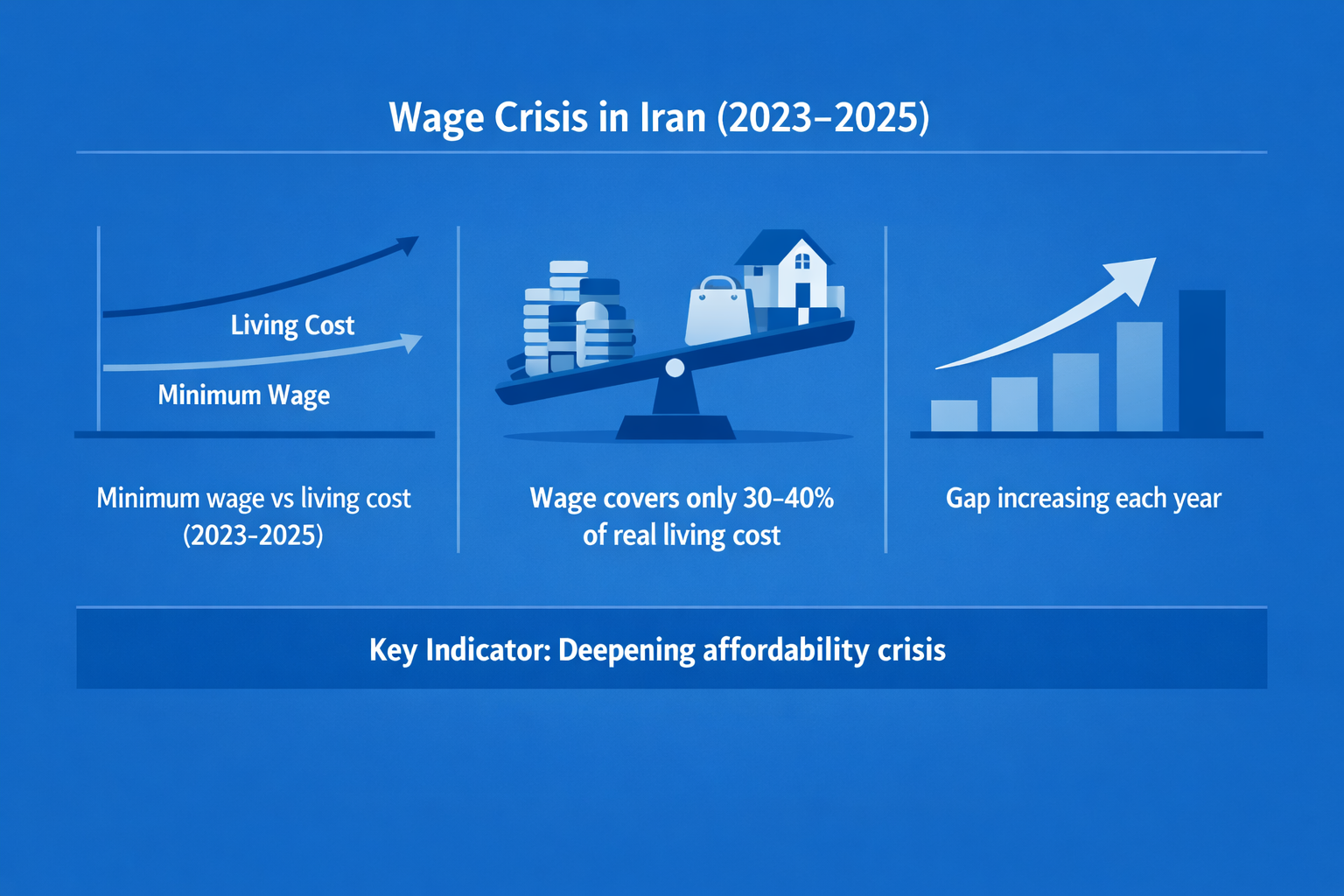 Faramarz Tofiqi, a former workers’ representative in the Supreme Labor Council, stated: “Meat has been completely removed from workers’ shopping baskets, and in the dairy sector both quantity and quality have declined.” He added that under such conditions, speaking of the livelihood basket was more like “a joke.”
Food inflation has placed further pressure on low-income families. Official reports show point-to-point food inflation at 64.3 percent, with bread and cereals nearly doubling in one year. Rising prices of fruit, vegetables, dairy products, eggs, and protein have forced many households to reduce or eliminate these items.
For much of Iranian society, the economy has moved from “providing for life” to a “survival economy.” Families are not trying to improve their lives; they are struggling to stay alive. Multiple job-holding, selling limited assets, abandoning medical treatment, forced migration for work, street vending, child labor, and the removal of essential foods have become survival strategies.
This is not only declining welfare. It is the erosion of human dignity. When a family must choose between food, rent, medicine, or children’s education, economic crisis becomes a direct human rights violation.
Housing, Rent, and Poverty
Housing is a major driver of poverty in Iran. Official reports show that many tenant households lose the ability to meet basic needs after paying rent. Some estimates place 40 percent of tenant households in poverty.
Rising rents in major cities, expanding marginal settlements, forced relocation to cheaper areas, smaller and less secure housing, and several families living in one unit all show that the housing crisis has become a human rights crisis. The right to adequate housing includes security, affordability, a healthy environment, access to services, and dignity.
Many households now spend most of their income on rent, leaving little for food, healthcare, education, or transportation. Poverty in Iran is therefore not only the result of low wages. It is the combined effect of falling income, rent shocks, food inflation, and weak social protection.
Workers, Retirees, and the Working Poor
Workers and retirees are at the front line of the crisis. Repeated protests in the oil, petrochemical, steel, mining, municipal, transportation, and public service sectors show a chronic crisis in wages, insurance, job security, and working conditions.
In many production units, workers face months of unpaid wages, temporary contracts, unpaid insurance contributions, threats of dismissal, and no independent organizing. Retirees have also protested repeatedly because pensions no longer cover living costs. These are not only labor demands; they are demands for the right to a dignified life.
Slogans such as “Our wages are in rials, our costs are in dollars” and “Where is inflation control? You are lying to the people” show that workers and retirees understand the link between state policies, currency collapse, and livelihood destruction.
Under international human rights law, the right to work includes fair wages, safe conditions, job security, the right to organize, and an adequate standard of living. When wages cannot cover food, rent, medicine, and transportation, the right to work loses its human meaning.
Youth Unemployment, Migration, and the Collapse of Hope
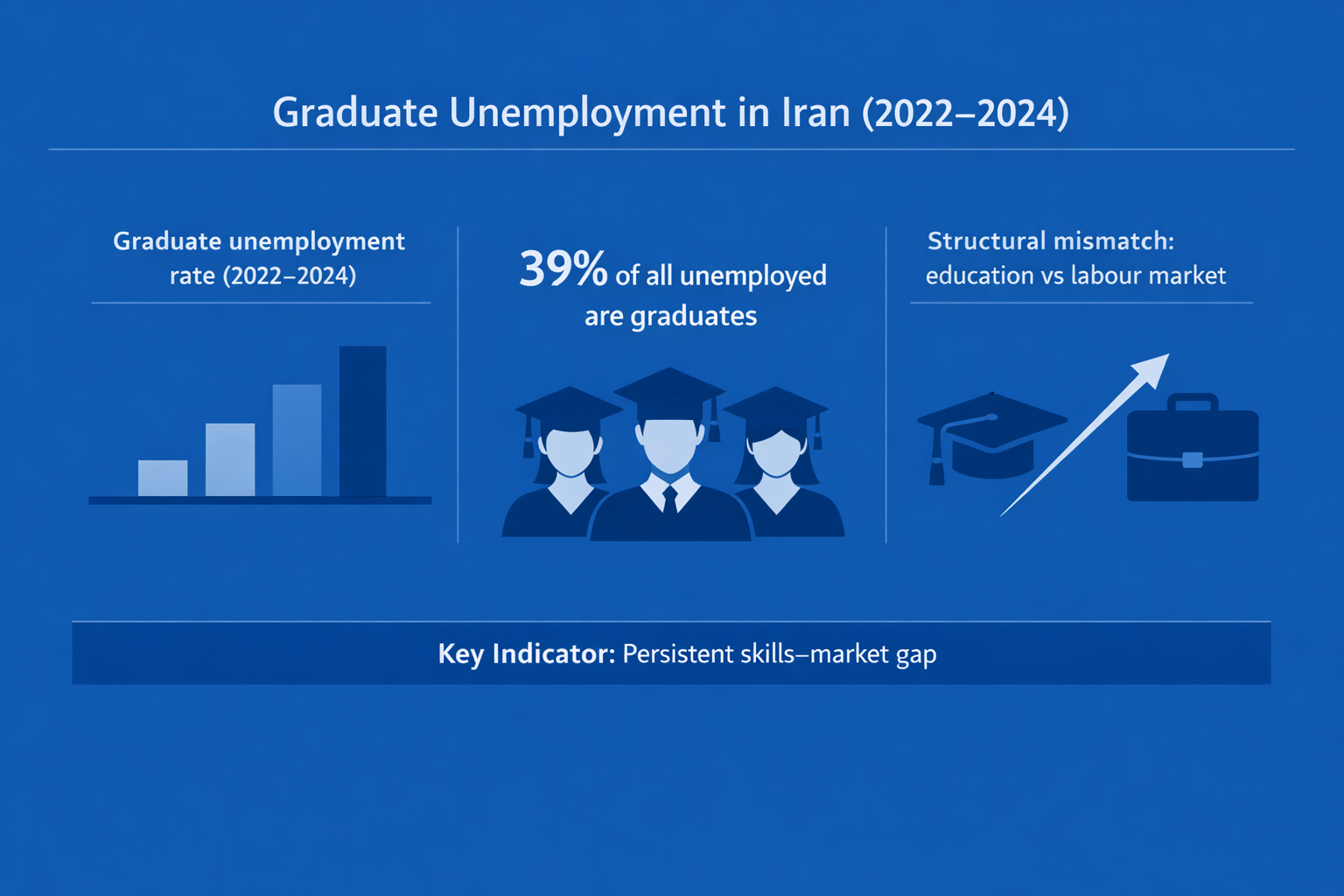
The crisis has also struck young people. They face structural unemployment, unstable jobs, low wages, and no clear future. Official figures show that around 39 percent of the unemployed are university graduates.
Youth unemployment in some age groups has exceeded 20 percent.
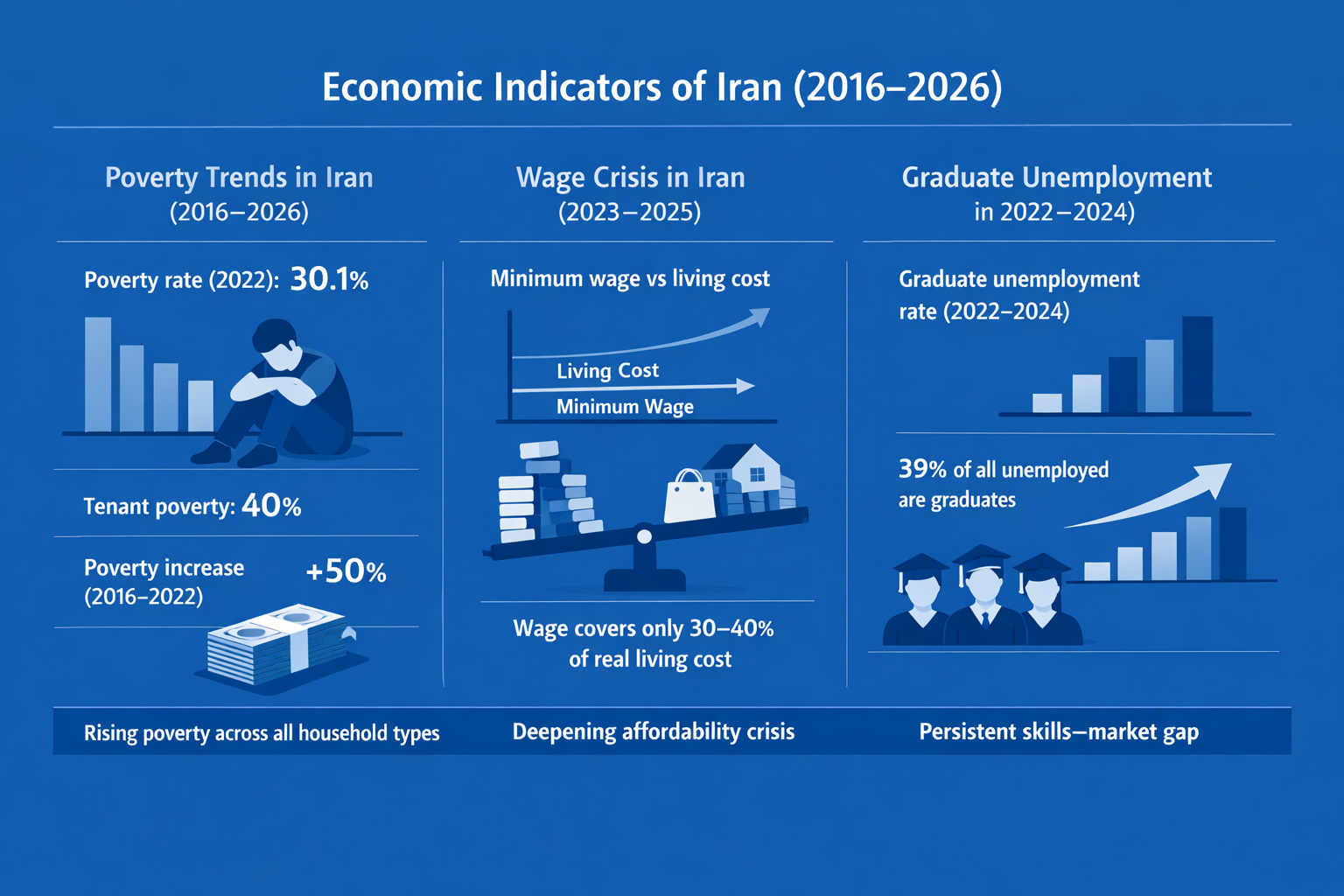 This reflects a deep gap between education and the labor market. Thousands of educated young people cannot find work related to their expertise or are forced into temporary, low-paid, uninsured jobs unrelated to their studies.
The widespread migration of skilled professionals, doctors, engineers, technology workers, and educated youth is another direct consequence. Brain drain is not merely the loss of human capital; it is a sign of collapsing trust in the future. A society whose young people see no prospect for work, security, freedom, and dignity is experiencing deep social erosion.
Social experts have described this as the “collapse of the capacity to imagine a future.” The economic crisis does not only shrink household tables; it destroys hope for stability, progress, independence, and ordinary life.
Admissions From Within the State
The scale of the crisis has been acknowledged by officials and state-affiliated experts. These admissions show deep concern inside the power structure.
Saeed Laylaz, an economist close to the state, described the country in January 2026 as “looted” and said: “Privatization in our country means plunder.” He also stated that “40 percent of all assets in Iran’s banking network are fictitious” and that the banking system operates on unbacked money.
Hossein Ragfar linked the crisis to the absence of “political will” and said: “Solving the issue of inflation in the country requires political will, and until this political will is formed, the problem will not be solved.”
State media have acknowledged contradictions and opacity in official statistics. In November 2025, Jahan-e Sanat wrote that poverty-line statistics are “contradictory and lack transparency,” preventing real planning.
Some members of parliament have warned of a “social explosion” caused by falling purchasing power and deepening poverty. The protest letter by 170 MPs regarding the 2026 budget was a clear sign of concern over public dissatisfaction.
Ali Rabiei, former Minister of Labour, described poverty as a security issue: “Poverty in Iran is the basis of many disruptive and non-disruptive unrests… In Iran, poverty is a security issue.”
These admissions show that the ruling regime in Iran is aware of the crisis. Yet its policies have not reduced poverty; they have deepened it.
Inflation, Poverty, and Human Rights Violations
Chronic inflation directly affects the rights to life, health, food, housing, and dignity. Continuous price increases have deprived millions of adequate nutrition, medical care, safe housing, and minimum living conditions.
Under the International Covenant on Economic, Social and Cultural Rights, states must guarantee an adequate standard of living, food, health, work, social security, and housing. They must use the maximum available resources to realize these rights and avoid serious regression.
Michael Fakhri, the UN Special Rapporteur on the right to food, has warned that high inflation and rising food prices can prevent states from fulfilling their obligations regarding the right to food. This is highly relevant to Iran, where food inflation and currency collapse have pushed large parts of society toward food insecurity.
Internet shutdowns, unemployment, suppression of labor protests, and the prohibition of independent labor organizations have also weakened access to work, income, and collective advocacy. The UN Special Rapporteur on Iran has noted that recent nationwide protests have been rooted in severe economic and livelihood problems.
 From Livelihood Poverty to Structural Collapse
Iran’s livelihood crisis is not merely a decline in welfare or a rise in living costs. It is a direct violation of basic human rights. When official wages cannot provide food, housing, healthcare, and minimum daily needs, millions are effectively denied the right to live with dignity.
The spread of poverty, the rise of the working poor, the removal of essential goods from household baskets, job insecurity, rent crisis, child labor, youth withdrawal from the labor market, and migration of skilled professionals all show that Iran’s economic crisis has weakened the most basic economic and social rights.
Behind this widespread poverty lies a structure that has, over decades, turned the economy into a tool for preserving political power, financing security institutions, distributing rents, and controlling society.
The second part of this dossier, “Iran: An Economy Against the People,” examines the role of systemic corruption, security budgets, unbacked money printing, banking collapse, allocation of public resources to military institutions, and the policies of the ruling regime in Iran in producing and deepening this crisis.