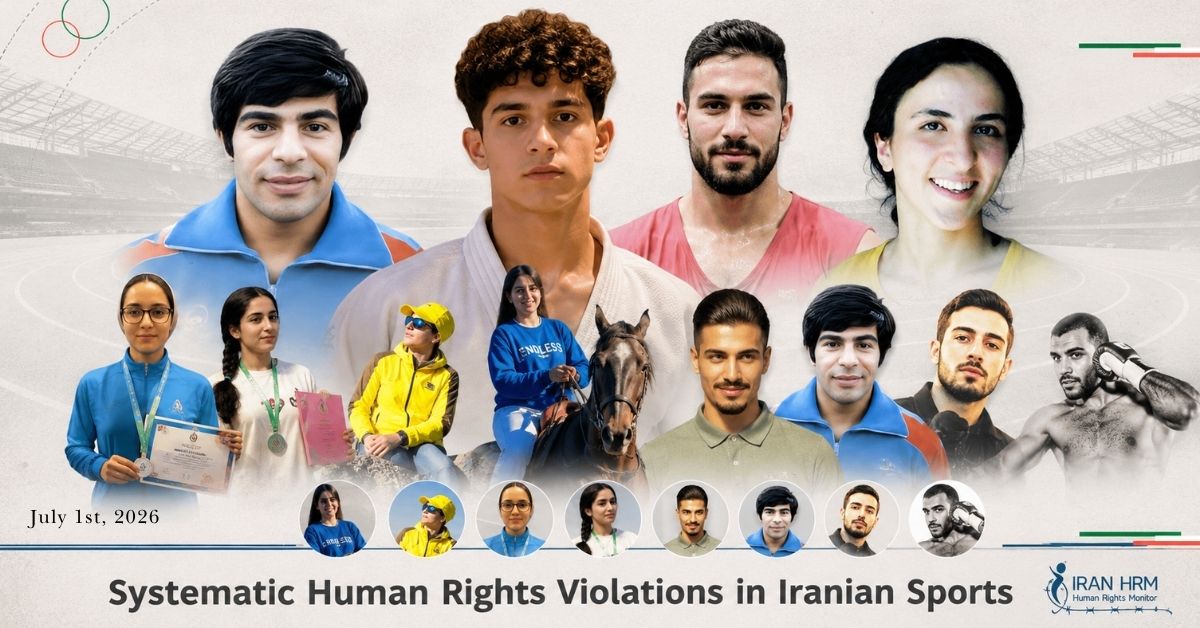
Political Control of Sport and International Accountability
While Part I documented the execution, killing, imprisonment, and persecution of Iranian athletes, Part II shifts from individual cases to the institutional framework governing sport in Iran. It analyzes the structures through which authorities exercise control over athletes and sporting institutions, while assessing the responses of international sporting organizations and human rights mechanisms.

Sport as an Instrument of Political Control
The cases documented in this report point to a pattern of state involvement in the governance of sport in Iran. Political and security institutions exert significant influence over sports federations, athletes’ careers, and decisions relating to participation in national and international competitions. Rather than operating independently, key areas of Iranian sport are subject to political and security oversight that affects both institutions and individual athletes.
State interference extends well beyond criminal prosecutions. Athletes have faced pressure to withdraw from competitions against Israeli opponents, ideological restrictions governing women’s participation in sport, exclusion from national teams, disciplinary sanctions, travel bans, suspension from competitions, removal from professional sporting structures, arbitrary dismissal, and sustained pressure to remain silent in the face of widespread human rights abuses.
Athletes who publicly expressed support for peaceful protests or criticized government policies have frequently been subjected to surveillance, arbitrary detention, security interrogations, professional retaliation, and politically motivated judicial proceedings. In many documented cases, the exercise of internationally protected rights—including freedom of expression, freedom of association, and peaceful assembly—has been treated by the authorities as a national security offense.
The cumulative impact of these policies extends far beyond individual victims. Systematic political interference has undermined the independence of Iranian sports institutions, contributed to the forced migration of elite athletes, damaged Iran’s international sporting reputation, and weakened public confidence in the country’s sports governance.
Taken together, these patterns indicate that sport in Iran has increasingly been transformed from an independent civic institution into an instrument of political, ideological, and security control. The resulting environment leaves athletes vulnerable not only to violations of their civil and political rights but also to discrimination affecting their professional careers, personal security, and freedom to participate in sport without political coercion.
Human Rights Analysis
The documented cases presented throughout this report reveal a pattern of violations extending far beyond individual acts of repression. Collectively, they demonstrate the systematic denial of a wide range of internationally protected human rights.
Iranian athletes have been subjected to arbitrary arrest, torture, enforced confessions, unfair trials, prolonged imprisonment, executions, professional exclusion, and discrimination because of their peaceful exercise of fundamental freedoms. These practices violate internationally recognized rights, including the right to life, freedom from torture and other cruel, inhuman or degrading treatment or punishment, the right to liberty and security of person, the right to a fair trial, freedom of expression, freedom of association, freedom of peaceful assembly, freedom of religion or belief, the right to work, and the right to participate in cultural and sporting life without discrimination.
Taken together, these documented violations indicate that the repression of Iranian athletes is not episodic but forms part of a broader policy aimed at restricting civic space, suppressing dissent, and subordinating sport to political and ideological objectives.
Why International Accountability Matters
The continued persecution of Iranian athletes is not solely a domestic concern. International sporting organizations, human rights institutions, and United Nations mechanisms all have important responsibilities in safeguarding the independence of sport and protecting athletes from politically motivated persecution.
Effective international monitoring, continued documentation of violations, and sustained engagement by sporting federations and human rights bodies can help deter further abuses, provide greater protection for athletes at risk, and reinforce international standards governing both human rights and the autonomy of sport.
Ensuring accountability for serious human rights violations committed against athletes is essential not only for justice for the victims, but also for preserving the integrity of international sport and reaffirming that no athlete should face persecution for peacefully exercising fundamental human rights.
International Response: The Global Sporting Community Confronts the Repression of Iranian Athletes
The persecution of Iranian athletes has attracted sustained international attention, particularly following the executions of Navid Afkari and Mohammad Mehdi Karami, as well as the arrest, imprisonment, and prosecution of numerous other athletes.
International sports organizations, professional associations, prominent athletes, human rights organizations, and United Nations human rights mechanisms have repeatedly expressed concern regarding arbitrary detention, death sentences, torture, denial of fair trial guarantees, and the growing interference of political and security institutions in Iranian sport.
Alongside these institutional responses, hundreds of athletes, coaches, Olympic medalists, and sports figures from around the world have publicly called for an end to executions, the release of imprisoned athletes, and full respect for internationally recognized human rights standards in the treatment of Iran’s sporting community.
These reactions demonstrate that the situation of Iranian athletes has evolved beyond a domestic concern and has become an issue of international significance for both the global sporting community and international human rights mechanisms.
Despite sustained international attention, available evidence indicates that arbitrary arrests, harsh prison sentences, professional retaliation, and security persecution of athletes continue. Continued monitoring, systematic documentation, and international engagement therefore remain essential for protecting athletes at risk, supporting victims, and promoting accountability for serious human rights violations committed against Iran’s sporting community.
Conclusion
This report has documented both the human impact of persecution against Iranian athletes and the broader structures through which political and security institutions influence sport in Iran. Together, the evidence presents a comprehensive picture of the challenges faced by athletes whose professional careers and fundamental rights have been affected by state interference.
From the early years following the establishment of the Islamic Republic to the nationwide uprising of 2026, Iranian athletes have been subjected to execution, arbitrary detention, torture, unfair trials, internal exile, forced displacement, professional exclusion, and other serious human rights violations because of their peaceful civic engagement, support for public protests, political opinions, religious beliefs, ethnic identity, or commitment to the fundamental values of sport.
These practices violate a broad range of internationally protected rights, including the right to life, freedom from torture and other cruel, inhuman or degrading treatment or punishment, the right to liberty and security of person, the right to a fair trial, freedom of expression, freedom of thought, conscience and religion, freedom of peaceful assembly, the right to work, freedom of movement, and the right to participate freely in cultural and sporting life without discrimination.
Beyond their devastating impact on individual athletes and their families, these violations have seriously undermined the independence of sport in Iran, weakened public trust in national sporting institutions, accelerated the departure of elite athletes from the country, and damaged Iran’s standing within the international sporting community.
Taken together, the evidence documented in this report shows how political and security institutions have influenced the governance of sport in Iran, with significant consequences for athletes’ rights, the autonomy of sporting institutions, and civic space more broadly.
The international community, international sporting bodies, United Nations human rights mechanisms, and other relevant stakeholders can play a vital role by continuing to document violations, closely monitor the situation of athletes at risk, advocate for their protection, and promote accountability for those responsible for serious human rights violations.
Protecting the independence of sport, safeguarding the fundamental rights of athletes, and ensuring accountability for these violations are essential not only for preserving human dignity but also for upholding the rule of law and fulfilling the principles and obligations enshrined in international human rights law.
━━━━━━━━━━━━━━━━━━━━━━━━━━
Related Report
Part I: Executions, Killings and Imprisonment of Athletes
Part I documents the execution, killing, imprisonment, and persecution of Iranian athletes through documented case studies, illustrating the human impact of systematic human rights violations against Iran’s sporting community.