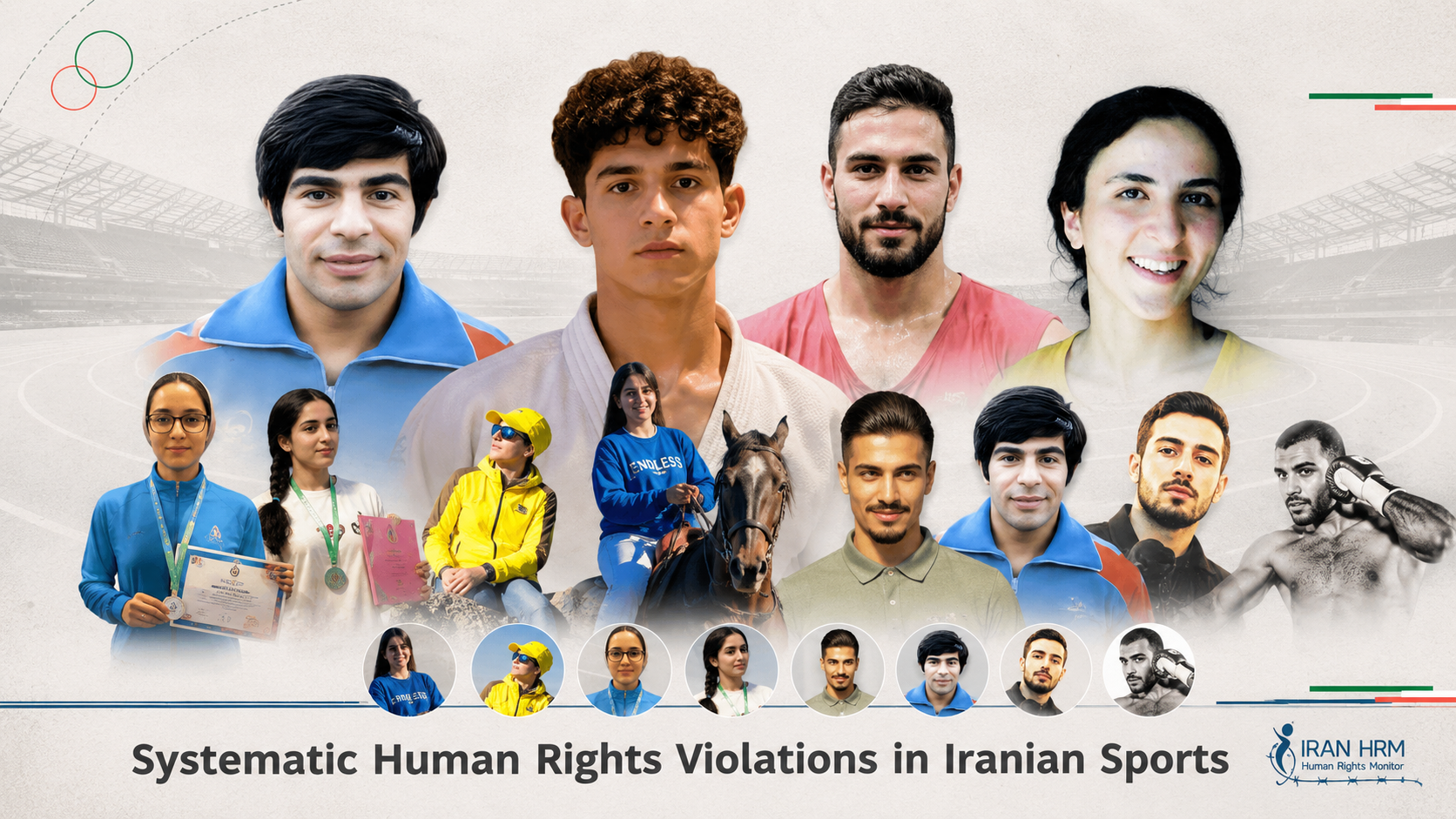
Sport in Iran has increasingly become an instrument of political, ideological, and security control rather than an independent professional institution. Over the past four decades, numerous athletes have faced execution, imprisonment, torture, forced confessions, professional exclusion, and other serious human rights violations because of their peaceful civic engagement, political opinions, religious beliefs, or refusal to comply with state-imposed ideological policies.

This report examines documented cases of executed, imprisoned, and killed athletes, demonstrating that the persecution of Iran’s sporting community is not the result of isolated incidents but forms part of a broader pattern of systematic human rights violations.
Part I focuses on athletes who lost their lives, were executed, or remain imprisoned because of their exercise of fundamental rights and freedoms.
The 2026 Uprising: Athletes Standing with the People
The nationwide uprising of 2026 marked another defining moment in the relationship between Iran’s sporting community and the country’s broader movement for civil rights and democratic freedoms. During this period, numerous athletes, coaches, and national champions, like millions of other Iranian citizens, stood alongside the public in peaceful protests and expressions of solidarity.
As a consequence of their participation in, or support for, these demonstrations, many were subjected to severe reprisals, including arbitrary arrest, enforced disappearance, torture, politically motivated prosecutions, lengthy prison sentences, and, in several documented cases, execution.
Among the victims of the 2026 uprising were a number of accomplished athletes whose professional achievements had previously brought distinction to Iranian sport. Their sporting status, however, offered no protection against state violence. Instead, many became direct targets of the authorities’ campaign to suppress dissent.
Saleh Mohammadi, a young wrestler, was arrested during the protests, sentenced to death, and subsequently executed.
Mehdi Ghadimi, an athlete who participated in the demonstrations, was arrested on national security-related charges, subjected to judicial proceedings that raised serious concerns regarding due process and fair trial guarantees, and was later executed.
Masoud Zatparvar, a bodybuilding champion, was detained because of his participation in the protests and subsequently executed, becoming one of the most prominent athlete victims of the 2026 uprising.
Sasan Azadvar, a young karate athlete, was arrested during the protests and became one of the most prominent examples of athletes subjected to the harshest forms of judicial repression.
Arshia Barari, a young fitness champion, was arrested in connection with the protests and sentenced to death. His case has become another emblematic example of the repression directed against Iranian athletes during the 2026 uprising.
In addition to these prominent cases, Yazdan Afrough, Abbas Khadem, Hadi Forough, Ali-Mohammad Kordkazemi, Hassan Kalaher, Robin Moradi, Mohammad-Hossein Parnoun, Mojtaba Torshizi, Mohammad-Reza Golmakani, and Qasem Vakili are among the athletes and coaches who, because of their alleged connection to the protests, were subjected to arbitrary arrest, security harassment, politically motivated prosecutions, or other forms of serious human rights violations.
These documented cases demonstrate that the Iranian authorities deliberately targeted members of the sporting community as part of a broader strategy to suppress public dissent. Rather than treating athletes as independent citizens entitled to fundamental rights, the authorities subjected them to the same coercive machinery that has been employed against journalists, students, lawyers, artists, and other sectors of Iranian civil society.
Athletes Killed While Standing for Freedom
The nationwide uprising of 2026 was not only marked by mass public protests but also by the active participation of members of Iran’s sporting community. Athletes who had once represented their country in national competitions joined ordinary citizens in demanding freedom, justice, and fundamental rights. For several of them, that choice proved fatal.
The deaths of these athletes were not isolated tragedies. They form part of a broader pattern involving the excessive and often lethal use of force against civilians participating in peaceful demonstrations.
Zahra Azadpour, a professional football player, mountaineer, and former invitee to Iran’s women’s national football training camp, was shot dead by government security forces in Karaj on 9 January 2026.
Sahba Rashtian, a 23-year-old women’s football assistant referee and athlete in track and field and physical fitness, was fatally shot during protests in Isfahan on 9 January 2026.
Sakineh Akbari, a mountaineering instructor and volunteer rescue worker, was killed after government forces opened fire on demonstrators in Ardabil.
Sara Behboudi, a 45-year-old mountaineer from Rasht who had successfully climbed several major peaks, was shot while participating in demonstrations on 9 January 2026 and later died from her injuries.
Arnika Dabbagh, a 15-year-old national swimming champion and winner of multiple domestic medals, was killed by gunfire in Gorgan. According to available reports, widespread communication disruptions prevented her timely transfer to a medical facility, contributing to her death.
Mahna Doukoushani, an 18-year-old taekwondo champion from Kermanshah, was fatally shot by security forces on 8 January 2026.
Parastoo Jarrahian, an athlete in boxing and equestrian sports, succumbed to injuries sustained during protests in Arak. Reports indicate that members of her family were denied access to her while she was hospitalized.
The deaths of these athletes illustrate that Iran’s sporting community was subjected to the same pattern of lethal repression experienced by other sectors of society during the 2026 uprising. Their cases demonstrate that athletes were not targeted because of their profession alone, but because they exercised the same fundamental rights as other citizens, including the rights to peaceful assembly, freedom of expression, and participation in public life.
Together with athletes who have been executed, imprisoned, tortured, or forced into exile, these victims have become part of the documented record of systematic human rights violations committed against Iran’s sporting community.
Execution: The State’s Ultimate Instrument of Repression Against Athletes
Execution represents the gravest and most irreversible violation of the right to life. Over the past four decades, Iranian authorities have repeatedly used capital punishment against athletes in connection with political cases, nationwide protests, and broadly defined national security charges.
Documented cases indicate that many of these athletes were prosecuted through judicial proceedings characterized by allegations of torture, coerced confessions, denial of access to legal counsel of their own choosing, and serious violations of international fair trial standards.
These executions extend beyond the deprivation of individual lives. They form part of a broader strategy designed to intimidate Iran’s sporting community and deter athletes from exercising their fundamental rights or using their public standing to express solidarity with popular movements.
Rather than protecting them, the public visibility and social influence of these athletes often made them more vulnerable. In several cases, the authorities appeared to transform their prosecutions into highly publicized examples intended to discourage other athletes from engaging in civic or political expression.
The following cases represent some of the most significant documented examples of athletes who were executed or sentenced to death in Iran.
Habib Khabiri
Former captain of Iran’s national football team, Habib Khabiri was arrested in 1983 because of his political activities and views. After enduring detention and torture, he was executed in July 1984 at Evin Prison. His case remains one of the earliest documented executions of a prominent Iranian athlete following the establishment of the Islamic Republic.
Forouzan Abdi
Former captain of Iran’s women’s national volleyball team, Forouzan Abdi was arrested during the 1980s and remained imprisoned for several years before being executed during the mass execution of political prisoners in the summer of 1988. She is widely recognized as one of the most prominent female athlete victims of political repression in Iran.
Navid Afkari
Champion Greco-Roman wrestler Navid Afkari was arrested in connection with the nationwide protests of 2018. He was sentenced to death based on confessions that he consistently stated had been extracted under torture. Despite widespread international appeals from governments, United Nations experts, human rights organizations, and the global sporting community, he was executed unexpectedly in September 2020. His case became one of the most internationally recognized symbols of judicial repression against Iranian athletes.
Mohammad Mehdi Karami
Iranian karate champion Mohammad Mehdi Karami was arrested during the 2022 nationwide protests. Following judicial proceedings that attracted widespread criticism for failing to meet basic standards of due process and fair trial, he was executed in January 2023. His execution became a defining symbol of the state’s crackdown on protesting athletes.
Seyed Mohammad Hosseini
Volunteer karate instructor Seyed Mohammad Hosseini was arrested in the same protest-related case as Mohammad Mehdi Karami and executed alongside him in January 2023. Reports concerning his case documented allegations of torture, coerced confessions, and denial of fundamental fair trial guarantees.
Majidreza Rahnavard
Wrestler and bodybuilder Majidreza Rahnavard was arrested during the 2022 protests, sentenced to death in an expedited judicial process, and publicly executed in December 2022. The public implementation of his execution generated widespread international condemnation and intensified concerns regarding Iran’s use of capital punishment against protesters.
These cases demonstrate that the death penalty has functioned not merely as a criminal punishment but as an instrument of political repression. The recurring allegations of torture, forced confessions, denial of due process, and expedited judicial proceedings raise serious concerns regarding violations of Iran’s obligations under international human rights law, including the right to life and the right to a fair trial.
Imprisonment: Silencing the Voices of Athletes
Execution has not been the only instrument used to suppress Iran’s sporting community. Over the past several years, dozens of athletes and coaches have been subjected to arbitrary arrest, prolonged imprisonment, torture, and other serious human rights violations because of their participation in peaceful protests, expression of critical views, or refusal to conform to official state policies.
Many of these cases have been accompanied by credible allegations of prolonged solitary confinement, torture, coerced confessions, denial of access to independent legal counsel, and judicial proceedings that failed to satisfy internationally recognized standards of due process and fair trial.
The cases presented below do not represent all imprisoned athletes in Iran. Rather, they constitute some of the best-documented examples illustrating a broader and systematic pattern of repression against members of the country’s sporting community.
Mohammad Javad Vafaei-Sani
Boxing coach and athlete Mohammad Javad Vafaei-Sani was arrested following the nationwide protests of November 2019. Since his detention, he has repeatedly been sentenced to death in judicial proceedings that have drawn sustained criticism because of allegations of torture, procedural irregularities, and violations of due process. He remains imprisoned, and reports indicate that he continues to face the imminent risk of execution.
Peyvand Naeimi
Swimmer Peyvand Naeimi was arrested during the 2026 nationwide uprising. According to documented reports, he was subjected to severe torture, including mock execution, while in detention. He remains in solitary confinement and continues to face the risk of a death sentence.
Barna Naeimi
Karate champion Barna Naeimi, a member of Iran’s Baha’i community, was arrested and reportedly subjected to electric shocks, coercive interrogation, and threats directed against members of his family in an effort to extract forced confessions. He remains in detention amid serious concerns regarding his physical condition and judicial status.
Parham Parvari
National swimming champion Parham Parvari was arrested during the 2022 protests and sentenced to 15 years’ imprisonment together with internal exile to Jask Prison. His case illustrates the authorities’ combined use of lengthy imprisonment and punitive internal exile as mechanisms of repression against athletes.
Sahand Nourmohammadzadeh
Bodybuilding champion Sahand Nourmohammadzadeh initially received a death sentence, which was later commuted to a prison term. Although the execution order was overturned, he continues to serve a lengthy sentence.
Amir Reza Nasr-Azadani
Former professional football player Amir Reza Nasr-Azadani was arrested in connection with the 2022 protests and sentenced to a lengthy prison term. His prosecution prompted widespread concern and condemnation from international football organizations and members of the global sporting community.
These cases demonstrate that imprisonment, torture, prolonged detention, and the continuing threat of execution have become integral components of a broader strategy designed to silence independent voices within Iran’s sporting community and create an atmosphere of fear among athletes who seek to exercise their fundamental rights.
Rather than serving legitimate criminal justice objectives, these measures appear to function as instruments of political intimidation aimed at deterring athletes from participating in civic life, expressing dissenting opinions, or demonstrating solidarity with broader social movements.
The cases documented in this first part demonstrate that executions, arbitrary detention, torture, and prolonged imprisonment have become central instruments of repression against Iran’s sporting community. Together, they reveal a systematic effort to silence athletes who exercise their fundamental rights or publicly stand alongside Iranian society.
━━━━━━━━━━━━━━━━━━━━━━━━━━
Continue Reading
Part II: Political Control of Sport and International Accountability
Part II examines how political and security institutions have transformed sport into an instrument of ideological control, reviews the response of the international sporting community and United Nations human rights mechanisms, and concludes with an assessment of the broader human rights implications of these documented violations.